

490
The Chemistry and Technology of Petroleum
Thus, a crude oil residuum or tar sand bitumen is passed through a furnace where it is heated to
a temperature of 480°C (895°F) under an outlet pressure on the order of 100 psi (Figure 18.1). The
heating coils in the furnace are arranged to provide a soaking section of low heat density, where the
charge remains until the visbreaking reactions are completed. The cracked products are then passed
into a flash-distillation chamber. The overhead material from this chamber is then fractionated to
produce naphtha as an overhead product and light gas oil. The liquid products from the flash chamber are cooled with a gas oil flux and then sent to a vacuum fractionator. This yields a heavy gas oil
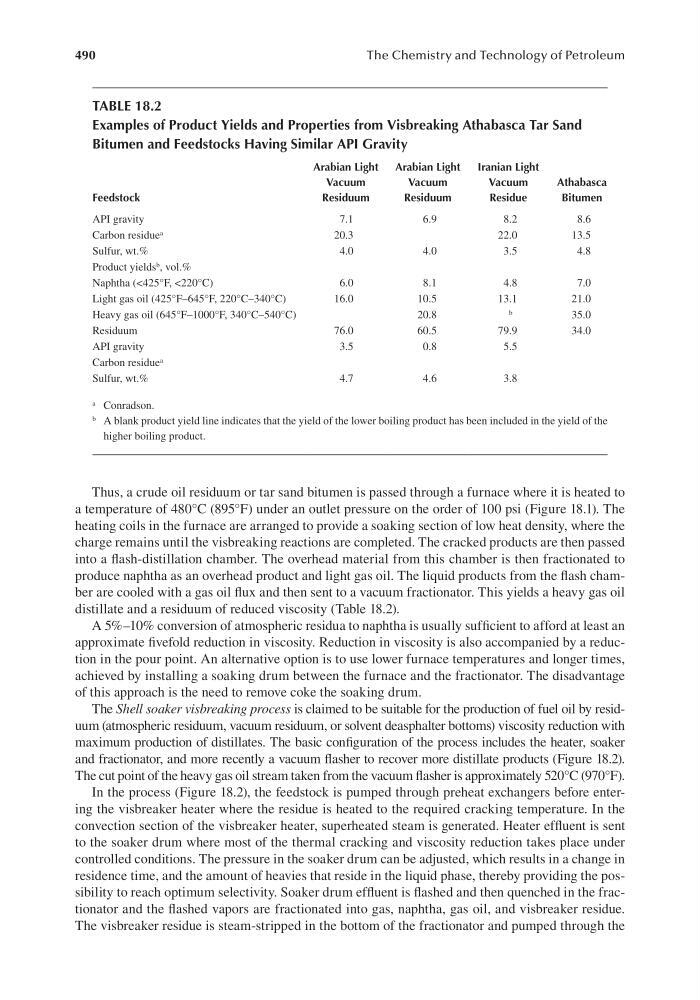
distillate and a residuum of reduced viscosity (Table 18.2).
A 5%–10% conversion of atmospheric residua to naphtha is usually sufficient to afford at least an
approximate fivefold reduction in viscosity. Reduction in viscosity is also accompanied by a reduction in the pour point. An alternative option is to use lower furnace temperatures and longer times,
achieved by installing a soaking drum between the furnace and the fractionator. The disadvantage
of this approach is the need to remove coke the soaking drum.
The Shell soaker visbreaking process is claimed to be suitable for the production of fuel oil by residuum (atmospheric residuum, vacuum residuum, or solvent deasphalter bottoms) viscosity reduction with
maximum production of distillates. The basic configuration of the process includes the heater, soaker
and fractionator, and more recently a vacuum flasher to recover more distillate products (Figure 18.2).
The cut point of the heavy gas oil stream taken from the vacuum flasher is approximately 520°C (970°F).
In the process (Figure 18.2), the feedstock is pumped through preheat exchangers before entering the visbreaker heater where the residue is heated to the required cracking temperature. In the
convection section of the visbreaker heater, superheated steam is generated. Heater effluent is sent
to the soaker drum where most of the thermal cracking and viscosity reduction takes place under
controlled conditions. The pressure in the soaker drum can be adjusted, which results in a change in
residence time, and the amount of heavies that reside in the liquid phase, thereby providing the possibility to reach optimum selectivity. Soaker drum effluent is flashed and then quenched in the fractionator and the flashed vapors are fractionated into gas, naphtha, gas oil, and visbreaker residue.
The visbreaker residue is steam-stripped in the bottom of the fractionator and pumped through the
TABLE 18.2
Examples of Product Yields and Properties from Visbreaking Athabasca Tar Sand
Bitumen and Feedstocks Having Similar API Gravity
Feedstock
Arabian Light
Vacuum
Residuum
Arabian Light
Vacuum
Residuum
Iranian Light
Vacuum
Residue
Athabasca
Bitumen
API gravity
7.1
6.9
8.2
8.6
Carbon residue a
20.3
22.0
13.5
Sulfur, wt.%
4.0
4.0
3.5
4.8
Product yields b , vol.%
Naphtha (<425°F, <220°C)
6.0
8.1
4.8
7.0
Light gas oil (425°F–645°F, 220°C–340°C)
16.0
10.5
13.1
21.0
Heavy gas oil (645°F–1000°F, 340°C–540°C)
20.8
b
35.0
Residuum
76.0
60.5
79.9
34.0
API gravity
3.5
0.8
5.5
Carbon residue a
Sulfur, wt.%
4.7
4.6
3.8
a Conradson.
b A blank product yield line indicates that the yield of the lower boiling product has been included in the yield of the
higher boiling product.