

489
Thermal Cracking
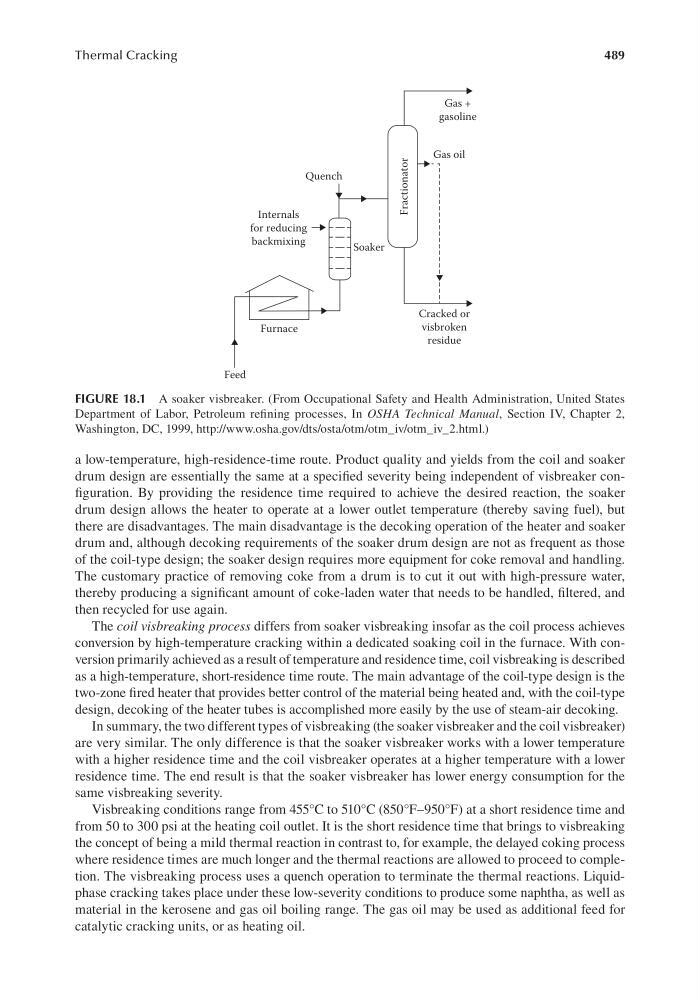
a low-temperature, high-residence-time route. Product quality and yields from the coil and soaker
drum design are essentially the same at a specified severity being independent of visbreaker configuration. By providing the residence time required to achieve the desired reaction, the soaker
drum design allows the heater to operate at a lower outlet temperature (thereby saving fuel), but
there are disadvantages. The main disadvantage is the decoking operation of the heater and soaker
drum and, although decoking requirements of the soaker drum design are not as frequent as those
of the coil-type design; the soaker design requires more equipment for coke removal and handling.
The customary practice of removing coke from a drum is to cut it out with high-pressure water,
thereby producing a significant amount of coke-laden water that needs to be handled, filtered, and
then recycled for use again.
The coil visbreaking process differs from soaker visbreaking insofar as the coil process achieves
conversion by high-temperature cracking within a dedicated soaking coil in the furnace. With conversion primarily achieved as a result of temperature and residence time, coil visbreaking is described
as a high-temperature, short-residence time route. The main advantage of the coil-type design is the
two-zone fired heater that provides better control of the material being heated and, with the coil-type
design, decoking of the heater tubes is accomplished more easily by the use of steam-air decoking.
In summary, the two different types of visbreaking (the soaker visbreaker and the coil visbreaker)
are very similar. The only difference is that the soaker visbreaker works with a lower temperature
with a higher residence time and the coil visbreaker operates at a higher temperature with a lower
residence time. The end result is that the soaker visbreaker has lower energy consumption for the
same visbreaking severity.
Visbreaking conditions range from 455°C to 510°C (850°F–950°F) at a short residence time and
from 50 to 300 psi at the heating coil outlet. It is the short residence time that brings to visbreaking
the concept of being a mild thermal reaction in contrast to, for example, the delayed coking process
where residence times are much longer and the thermal reactions are allowed to proceed to completion. The visbreaking process uses a quench operation to terminate the thermal reactions. Liquidphase cracking takes place under these low-severity conditions to produce some naphtha, as well as
material in the kerosene and gas oil boiling range. The gas oil may be used as additional feed for
catalytic cracking units, or as heating oil.
Furnace
Quench
Cracked or
visbroken
residue
Gas +
gasoline
Gas oil
Soaker
Fractionator
Internals
for reducing
backmixing
Feed
FIGURE 18.1 A soaker visbreaker. (From Occupational Safety and Health Administration, United States
Department of Labor, Petroleum refining processes, In OSHA Technical Manual, Section IV, Chapter 2,
Washington, DC, 1999, http://www.osha.gov/dts/osta/otm/otm_iv/otm_iv_2.html.)