

491
Thermal Cracking
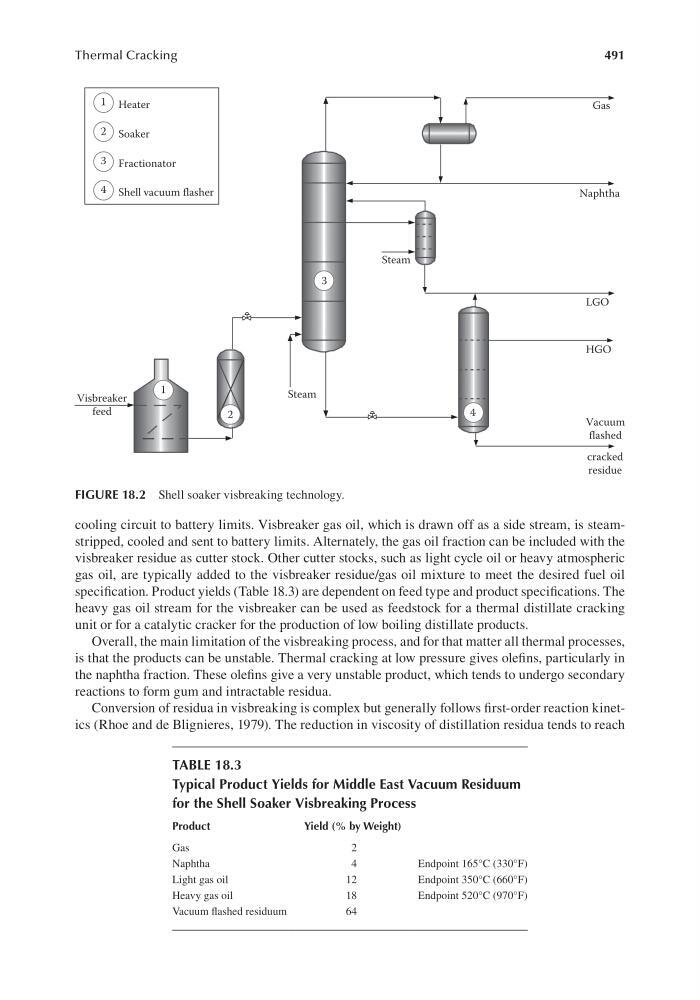
cooling circuit to battery limits. Visbreaker gas oil, which is drawn off as a side stream, is steamstripped, cooled and sent to battery limits. Alternately, the gas oil fraction can be included with the
visbreaker residue as cutter stock. Other cutter stocks, such as light cycle oil or heavy atmospheric
gas oil, are typically added to the visbreaker residue/gas oil mixture to meet the desired fuel oil
specification. Product yields (Table 18.3) are dependent on feed type and product specifications. The
heavy gas oil stream for the visbreaker can be used as feedstock for a thermal distillate cracking
unit or for a catalytic cracker for the production of low boiling distillate products.
Overall, the main limitation of the visbreaking process, and for that matter all thermal processes,
is that the products can be unstable. Thermal cracking at low pressure gives olefins, particularly in
the naphtha fraction. These olefins give a very unstable product, which tends to undergo secondary
reactions to form gum and intractable residua.
Conversion of residua in visbreaking is complex but generally follows first-order reaction kinetics (Rhoe and de Blignieres, 1979). The reduction in viscosity of distillation residua tends to reach
cracked
residue
Steam
Steam
Gas
Naphtha
Visbreaker
feed
1 Heater
2 Soaker
3 Fractionator
4 Shell vacuum flasher
1
2
3
Vacuum
flashed
4
HGO
LGO
FIGURE 18.2 Shell soaker visbreaking technology.
TABLE 18.3
Typical Product Yields for Middle East Vacuum Residuum
for the Shell Soaker Visbreaking Process
Product
Yield (% by Weight)
Gas
2
Naphtha
4
Endpoint 165°C (330°F)
Light gas oil
12
Endpoint 350°C (660°F)
Heavy gas oil
18
Endpoint 520°C (970°F)
Vacuum flashed residuum
64