

462
The Chemistry and Technology of Petroleum
accurately analyzed assuming the periodic boundary conditions, which allows calibration of the
porous media model for a big packing segment.
In early refineries, distillation was the primary means by which products were separated from
crude petroleum. As the technologies for refining evolved into the twentieth century, refineries
became much more complex, but distillation remained the prime means by which petroleum is
refined. Indeed, the distillation section of a modern refinery is the most flexible unit in the refinery,
since conditions can be adjusted to process a wide range of refinery feedstocks from the lighter
crude oils to the heavier, more viscous crude oils. However, the maximum permissible temperature
(in the vaporizing furnace or heater) to which the feedstock can be subjected is 350°C (660°F). The
rate of thermal decomposition increases markedly above this temperature; if decomposition occurs
within a distillation unit, it can lead to coke deposition in the heater pipes or in the tower itself with
the resulting failure of the unit unless steps are taken to make the crude oil preheat trains more
efficient by employing zero fouling self-cleaning heat exchangers (Klaren et al., 2004).
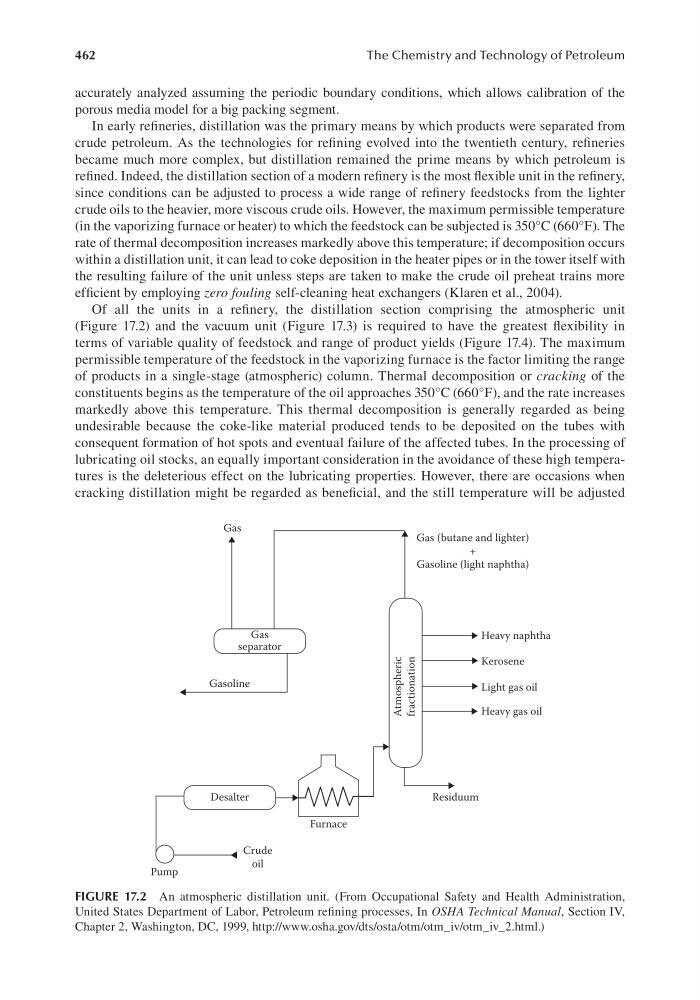
Of all the units in a refinery, the distillation section comprising the atmospheric unit
(Figure 17.2) and the vacuum unit (Figure 17.3) is required to have the greatest flexibility in
terms of variable quality of feedstock and range of product yields (Figure 17.4). The maximum
permissible temperature of the feedstock in the vaporizing furnace is the factor limiting the range
of products in a single-stage (atmospheric) column. Thermal decomposition or cracking of the
constituents begins as the temperature of the oil approaches 350°C (660°F), and the rate increases
markedly above this temperature. This thermal decomposition is generally regarded as being
undesirable because the coke-like material produced tends to be deposited on the tubes with
consequent formation of hot spots and eventual failure of the affected tubes. In the processing of
lubricating oil stocks, an equally important consideration in the avoidance of these high temperatures is the deleterious effect on the lubricating properties. However, there are occasions when
cracking distillation might be regarded as beneficial, and the still temperature will be adjusted
Gas (butane and lighter)
+
Gasoline (light naphtha)
Heavy naphtha
Gas
separator
Kerosene
Light gas oil
Heavy gas oil
Residuum
Furnace
Crude
oil
Desalter
Gas
Gasoline
Atmospheric
fractionation
Pump
FIGURE 17.2 An atmospheric distillation unit. (From Occupational Safety and Health Administration,
United States Department of Labor, Petroleum refining processes, In OSHA Technical Manual, Section IV,
Chapter 2, Washington, DC, 1999, http://www.osha.gov/dts/osta/otm/otm_iv/otm_iv_2.html.)