

461
Distillation
type have been devised, but the selection of a particular process depends on the type of salt
dispersion and the properties of the crude oil.
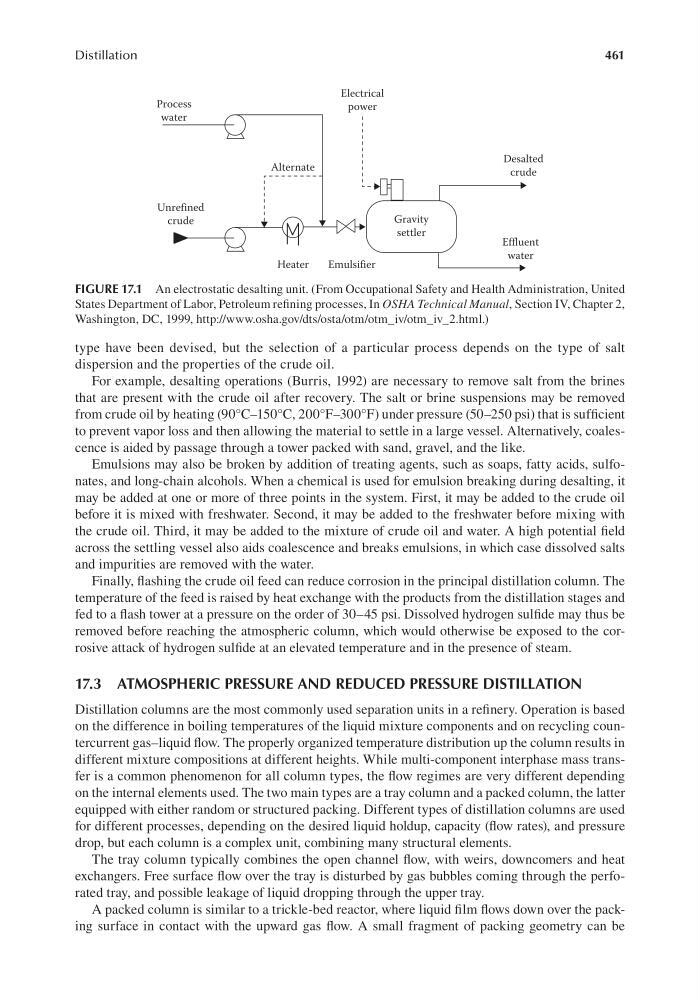
For example, desalting operations (Burris, 1992) are necessary to remove salt from the brines
that are present with the crude oil after recovery. The salt or brine suspensions may be removed
from crude oil by heating (90°C–150°C, 200°F–300°F) under pressure (50–250 psi) that is sufficient
to prevent vapor loss and then allowing the material to settle in a large vessel. Alternatively, coalescence is aided by passage through a tower packed with sand, gravel, and the like.
Emulsions may also be broken by addition of treating agents, such as soaps, fatty acids, sulfonates, and long-chain alcohols. When a chemical is used for emulsion breaking during desalting, it
may be added at one or more of three points in the system. First, it may be added to the crude oil
before it is mixed with freshwater. Second, it may be added to the freshwater before mixing with
the crude oil. Third, it may be added to the mixture of crude oil and water. A high potential field
across the settling vessel also aids coalescence and breaks emulsions, in which case dissolved salts
and impurities are removed with the water.
Finally, flashing the crude oil feed can reduce corrosion in the principal distillation column. The
temperature of the feed is raised by heat exchange with the products from the distillation stages and
fed to a flash tower at a pressure on the order of 30–45 psi. Dissolved hydrogen sulfide may thus be
removed before reaching the atmospheric column, which would otherwise be exposed to the corrosive attack of hydrogen sulfide at an elevated temperature and in the presence of steam.
17.3 ATMOSPHERIC PRESSURE AND REDUCED PRESSURE DISTILLATION
Distillation columns are the most commonly used separation units in a refinery. Operation is based
on the difference in boiling temperatures of the liquid mixture components and on recycling countercurrent gas–liquid flow. The properly organized temperature distribution up the column results in
different mixture compositions at different heights. While multi-component interphase mass transfer is a common phenomenon for all column types, the flow regimes are very different depending
on the internal elements used. The two main types are a tray column and a packed column, the latter
equipped with either random or structured packing. Different types of distillation columns are used
for different processes, depending on the desired liquid holdup, capacity (flow rates), and pressure
drop, but each column is a complex unit, combining many structural elements.
The tray column typically combines the open channel flow, with weirs, downcomers and heat
exchangers. Free surface flow over the tray is disturbed by gas bubbles coming through the perforated tray, and possible leakage of liquid dropping through the upper tray.
A packed column is similar to a trickle-bed reactor, where liquid film flows down over the packing surface in contact with the upward gas flow. A small fragment of packing geometry can be
Process
water
Unrefined
crude
Alternate
Electrical
power
Gravity
settler
Effluent
water
Desalted
crude
Heater
Emulsifier
FIGURE 17.1 An electrostatic desalting unit. (From Occupational Safety and Health Administration, United
States Department of Labor, Petroleum refining processes, In OSHA Technical Manual, Section IV, Chapter 2,
Washington, DC, 1999, http://www.osha.gov/dts/osta/otm/otm_iv/otm_iv_2.html.)