

453
Refining Chemistry
A visbreaking unit consists of a reaction furnace, followed by quenching with a recycled oil, and fractionation of the product mixture. All of the reaction in this process occurs as the oil flows through the
tubes of the reaction furnace. The severity is controlled by the flow rate through the furnace and the temperature; typical conditions are 475°C–500°C (885°F–930°F) at the furnace exit with a residence time of
1–3 min, with operation for 3–6 months on stream (continuous use) is possible before the furnace tubes
must be cleaned and the coke removed. The operating pressure in the furnace tubes can range from
0.7 to 5 MPa depending on the degree of vaporization and the residence time desired. For a given furnace tube volume, a lower operating pressure will reduce the actual residence time of the liquid phase.
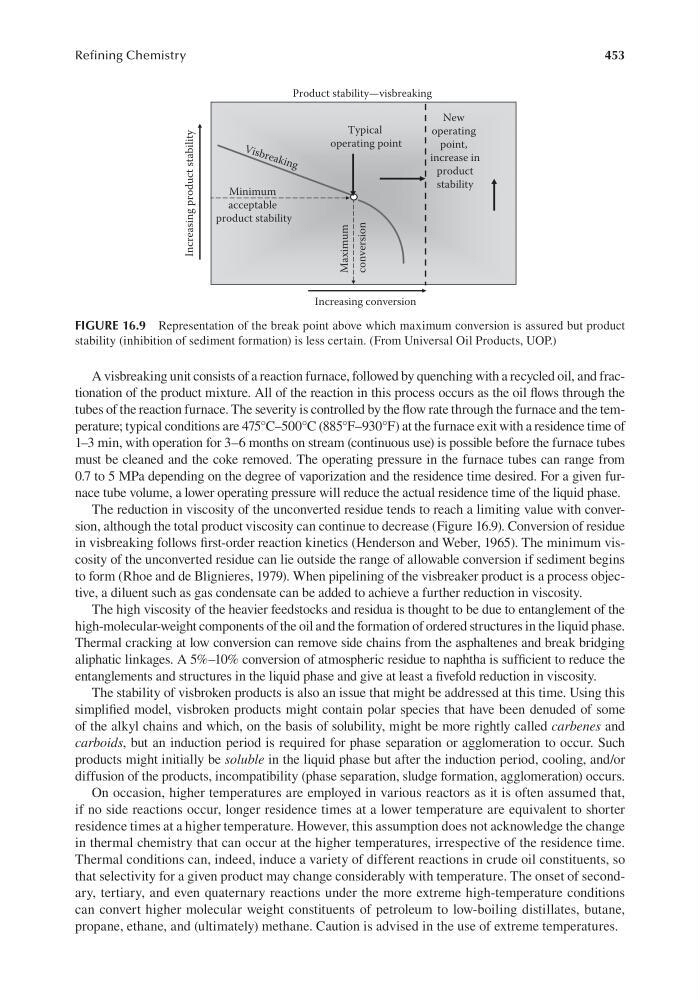
The reduction in viscosity of the unconverted residue tends to reach a limiting value with conversion, although the total product viscosity can continue to decrease (Figure 16.9). Conversion of residue
in visbreaking follows first-order reaction kinetics (Henderson and Weber, 1965). The minimum viscosity of the unconverted residue can lie outside the range of allowable conversion if sediment begins
to form (Rhoe and de Blignieres, 1979). When pipelining of the visbreaker product is a process objective, a diluent such as gas condensate can be added to achieve a further reduction in viscosity.
The high viscosity of the heavier feedstocks and residua is thought to be due to entanglement of the
high-molecular-weight components of the oil and the formation of ordered structures in the liquid phase.
Thermal cracking at low conversion can remove side chains from the asphaltenes and break bridging
aliphatic linkages. A 5%–10% conversion of atmospheric residue to naphtha is sufficient to reduce the
entanglements and structures in the liquid phase and give at least a fivefold reduction in viscosity.
The stability of visbroken products is also an issue that might be addressed at this time. Using this
simplified model, visbroken products might contain polar species that have been denuded of some
of the alkyl chains and which, on the basis of solubility, might be more rightly called carbenes and
carboids, but an induction period is required for phase separation or agglomeration to occur. Such
products might initially be soluble in the liquid phase but after the induction period, cooling, and/or
diffusion of the products, incompatibility (phase separation, sludge formation, agglomeration) occurs.
On occasion, higher temperatures are employed in various reactors as it is often assumed that,
if no side reactions occur, longer residence times at a lower temperature are equivalent to shorter
residence times at a higher temperature. However, this assumption does not acknowledge the change
in thermal chemistry that can occur at the higher temperatures, irrespective of the residence time.
Thermal conditions can, indeed, induce a variety of different reactions in crude oil constituents, so
that selectivity for a given product may change considerably with temperature. The onset of secondary, tertiary, and even quaternary reactions under the more extreme high-temperature conditions
can convert higher molecular weight constituents of petroleum to low-boiling distillates, butane,
propane, ethane, and (ultimately) methane. Caution is advised in the use of extreme temperatures.
Product stability—visbreaking
Increasing product stability
Typical
operating point
Minimum
acceptable
product stability
Maximum
conversion
New
operating
point,
increase in
product
stability
Increasing conversion
FIGURE 16.9 Representation of the break point above which maximum conversion is assured but product
stability (inhibition of sediment formation) is less certain. (From Universal Oil Products, UOP.)
Refining Chemistry
A visbreaking unit consists of a reaction furnace, followed by quenching with a recycled oil, and fractionation of the product mixture. All of the reaction in this process occurs as the oil flows through the
tubes of the reaction furnace. The severity is controlled by the flow rate through the furnace and the temperature; typical conditions are 475°C–500°C (885°F–930°F) at the furnace exit with a residence time of
1–3 min, with operation for 3–6 months on stream (continuous use) is possible before the furnace tubes
must be cleaned and the coke removed. The operating pressure in the furnace tubes can range from
0.7 to 5 MPa depending on the degree of vaporization and the residence time desired. For a given furnace tube volume, a lower operating pressure will reduce the actual residence time of the liquid phase.
The reduction in viscosity of the unconverted residue tends to reach a limiting value with conversion, although the total product viscosity can continue to decrease (Figure 16.9). Conversion of residue
in visbreaking follows first-order reaction kinetics (Henderson and Weber, 1965). The minimum viscosity of the unconverted residue can lie outside the range of allowable conversion if sediment begins
to form (Rhoe and de Blignieres, 1979). When pipelining of the visbreaker product is a process objective, a diluent such as gas condensate can be added to achieve a further reduction in viscosity.
The high viscosity of the heavier feedstocks and residua is thought to be due to entanglement of the
high-molecular-weight components of the oil and the formation of ordered structures in the liquid phase.
Thermal cracking at low conversion can remove side chains from the asphaltenes and break bridging
aliphatic linkages. A 5%–10% conversion of atmospheric residue to naphtha is sufficient to reduce the
entanglements and structures in the liquid phase and give at least a fivefold reduction in viscosity.
The stability of visbroken products is also an issue that might be addressed at this time. Using this
simplified model, visbroken products might contain polar species that have been denuded of some
of the alkyl chains and which, on the basis of solubility, might be more rightly called carbenes and
carboids, but an induction period is required for phase separation or agglomeration to occur. Such
products might initially be soluble in the liquid phase but after the induction period, cooling, and/or
diffusion of the products, incompatibility (phase separation, sludge formation, agglomeration) occurs.
On occasion, higher temperatures are employed in various reactors as it is often assumed that,
if no side reactions occur, longer residence times at a lower temperature are equivalent to shorter
residence times at a higher temperature. However, this assumption does not acknowledge the change
in thermal chemistry that can occur at the higher temperatures, irrespective of the residence time.
Thermal conditions can, indeed, induce a variety of different reactions in crude oil constituents, so
that selectivity for a given product may change considerably with temperature. The onset of secondary, tertiary, and even quaternary reactions under the more extreme high-temperature conditions
can convert higher molecular weight constituents of petroleum to low-boiling distillates, butane,
propane, ethane, and (ultimately) methane. Caution is advised in the use of extreme temperatures.
Product stability—visbreaking
Increasing product stability
Typical
operating point
Minimum
acceptable
product stability
Maximum
conversion
New
operating
point,
increase in
product
stability
Increasing conversion
FIGURE 16.9 Representation of the break point above which maximum conversion is assured but product
stability (inhibition of sediment formation) is less certain. (From Universal Oil Products, UOP.)