

452
The Chemistry and Technology of Petroleum
they do offer different avenues for conversion, these processes are illustrative of the thermal
chemistry that occurs in refineries.
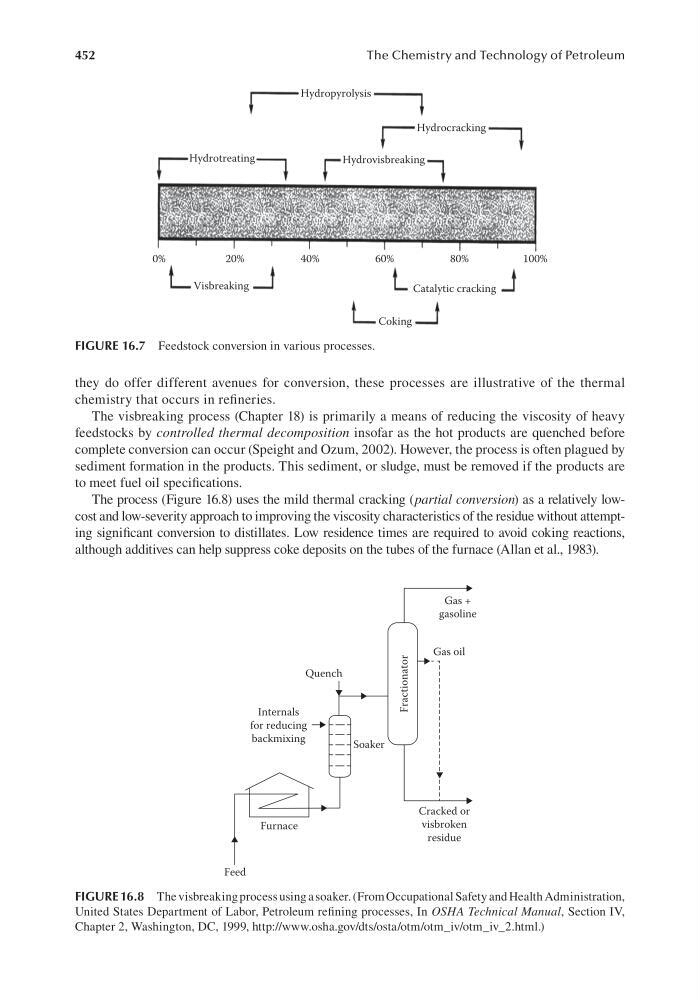
The visbreaking process (Chapter 18) is primarily a means of reducing the viscosity of heavy
feedstocks by controlled thermal decomposition insofar as the hot products are quenched before
complete conversion can occur (Speight and Ozum, 2002). However, the process is often plagued by
sediment formation in the products. This sediment, or sludge, must be removed if the products are
to meet fuel oil specifications.
The process (Figure 16.8) uses the mild thermal cracking (partial conversion) as a relatively lowcost and low-severity approach to improving the viscosity characteristics of the residue without attempting significant conversion to distillates. Low residence times are required to avoid coking reactions,
although additives can help suppress coke deposits on the tubes of the furnace (Allan et al., 1983).
Furnace
Quench
Cracked or
visbroken
residue
Gas +
gasoline
Gas oil
Soaker
Fractionator
Internals
for reducing
backmixing
Feed
FIGURE 16.8 The visbreaking process using a soaker. (From Occupational Safety and Health Administration,
United States Department of Labor, Petroleum refining processes, In OSHA Technical Manual, Section IV,
Chapter 2, Washington, DC, 1999, http://www.osha.gov/dts/osta/otm/otm_iv/otm_iv_2.html.)
Visbreaking
Hydrotreating
Hydropyrolysis
Hydrocracking
Hydrovisbreaking
Catalytic cracking
100%
80%
60%
40%
20%
0%
Coking
FIGURE 16.7 Feedstock conversion in various processes.
The Chemistry and Technology of Petroleum
they do offer different avenues for conversion, these processes are illustrative of the thermal
chemistry that occurs in refineries.
The visbreaking process (Chapter 18) is primarily a means of reducing the viscosity of heavy
feedstocks by controlled thermal decomposition insofar as the hot products are quenched before
complete conversion can occur (Speight and Ozum, 2002). However, the process is often plagued by
sediment formation in the products. This sediment, or sludge, must be removed if the products are
to meet fuel oil specifications.
The process (Figure 16.8) uses the mild thermal cracking (partial conversion) as a relatively lowcost and low-severity approach to improving the viscosity characteristics of the residue without attempting significant conversion to distillates. Low residence times are required to avoid coking reactions,
although additives can help suppress coke deposits on the tubes of the furnace (Allan et al., 1983).
Furnace
Quench
Cracked or
visbroken
residue
Gas +
gasoline
Gas oil
Soaker
Fractionator
Internals
for reducing
backmixing
Feed
FIGURE 16.8 The visbreaking process using a soaker. (From Occupational Safety and Health Administration,
United States Department of Labor, Petroleum refining processes, In OSHA Technical Manual, Section IV,
Chapter 2, Washington, DC, 1999, http://www.osha.gov/dts/osta/otm/otm_iv/otm_iv_2.html.)
Visbreaking
Hydrotreating
Hydropyrolysis
Hydrocracking
Hydrovisbreaking
Catalytic cracking
100%
80%
60%
40%
20%
0%
Coking
FIGURE 16.7 Feedstock conversion in various processes.