

451
Refining Chemistry
and other heteroatoms, and have lower volatility than their hydrocarbon analogs, are the prime movers in the production of coke (Speight, 1987).
When catalytic processes are employed, complex molecules such as those that may be found in
the original asphaltene fraction or those or formed during the process, are not sufficiently mobile
(or are too strongly adsorbed by the catalyst) to be saturated by the hydrogenation components and,
hence, continue to condense and eventually degrade to coke. These deposits deactivate the catalyst
sites and eventually interfere with the hydroprocess.
A convenient means of understanding the influence of feedstock on the hydrocracking process
is through a study of the hydrogen content (hydrogen-to-carbon atomic ratio) and molecular weight
(carbon number) of the feedstocks and products. Such data show the extent to which the carbon number
must be reduced and/or the relative amount of hydrogen that must be added to generate the desired
lower molecular weight, hydrogenated products. In addition, it is possible to use data for hydrogen
usage in residuum processing, where the relative amount of hydrogen consumed in the process can be
shown to be dependent upon the sulfur content of the feedstock.
16.7.3 CHemIstry In tHe reFInery
Thermal cracking processes are commonly used to convert petroleum residua into distillable liquid
products, although thermal cracking processes as used in the early refineries are no longer in use.
Examples of modern thermal cracking processes are visbreaking and coking (delayed coking, fluid
coking, and flexicoking) (Chapter 18). In all of these processes, the simultaneous formation of sediment
or coke limits the conversion to usable liquid products. However, for the purposes of this section, the
focus will be on the visbreaking and hydrocracking processes. The coking processes in which the reactions are taken to completion with the maximum yields of products are not a part of this discussion.
16.7.3.1 Visbreaking
To study the thermal chemistry of petroleum constituents, it is appropriate to select the visbreaking process (a carbon rejection process) (Chapter 18) and the hydrocracking process (a hydrogen
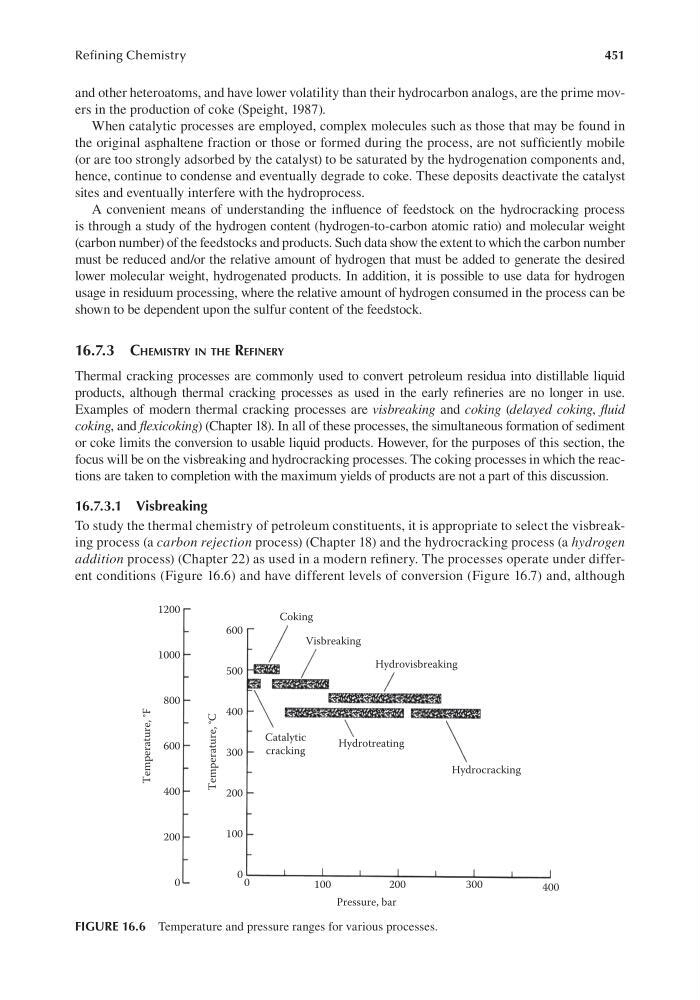
addition process) (Chapter 22) as used in a modern refinery. The processes operate under different conditions (Figure 16.6) and have different levels of conversion (Figure 16.7) and, although
200
200
Temperature, °C
Temperature, °F
200
100
100
0
0
0
300
300
Hydrocracking
Hydrotreating
Hydrovisbreaking
Visbreaking
Coking
Catalytic
cracking
400
400
600
800
1000
1200
400
500
600
Pressure, bar
FIGURE 16.6 Temperature and pressure ranges for various processes.
Refining Chemistry
and other heteroatoms, and have lower volatility than their hydrocarbon analogs, are the prime movers in the production of coke (Speight, 1987).
When catalytic processes are employed, complex molecules such as those that may be found in
the original asphaltene fraction or those or formed during the process, are not sufficiently mobile
(or are too strongly adsorbed by the catalyst) to be saturated by the hydrogenation components and,
hence, continue to condense and eventually degrade to coke. These deposits deactivate the catalyst
sites and eventually interfere with the hydroprocess.
A convenient means of understanding the influence of feedstock on the hydrocracking process
is through a study of the hydrogen content (hydrogen-to-carbon atomic ratio) and molecular weight
(carbon number) of the feedstocks and products. Such data show the extent to which the carbon number
must be reduced and/or the relative amount of hydrogen that must be added to generate the desired
lower molecular weight, hydrogenated products. In addition, it is possible to use data for hydrogen
usage in residuum processing, where the relative amount of hydrogen consumed in the process can be
shown to be dependent upon the sulfur content of the feedstock.
16.7.3 CHemIstry In tHe reFInery
Thermal cracking processes are commonly used to convert petroleum residua into distillable liquid
products, although thermal cracking processes as used in the early refineries are no longer in use.
Examples of modern thermal cracking processes are visbreaking and coking (delayed coking, fluid
coking, and flexicoking) (Chapter 18). In all of these processes, the simultaneous formation of sediment
or coke limits the conversion to usable liquid products. However, for the purposes of this section, the
focus will be on the visbreaking and hydrocracking processes. The coking processes in which the reactions are taken to completion with the maximum yields of products are not a part of this discussion.
16.7.3.1 Visbreaking
To study the thermal chemistry of petroleum constituents, it is appropriate to select the visbreaking process (a carbon rejection process) (Chapter 18) and the hydrocracking process (a hydrogen
addition process) (Chapter 22) as used in a modern refinery. The processes operate under different conditions (Figure 16.6) and have different levels of conversion (Figure 16.7) and, although
200
200
Temperature, °C
Temperature, °F
200
100
100
0
0
0
300
300
Hydrocracking
Hydrotreating
Hydrovisbreaking
Visbreaking
Coking
Catalytic
cracking
400
400
600
800
1000
1200
400
500
600
Pressure, bar
FIGURE 16.6 Temperature and pressure ranges for various processes.