

454
The Chemistry and Technology of Petroleum
Obviously, the temperature and residence time of the asphaltene constituents in the reactor are
key to the successful operation of a visbreaker. Visbreakers must operate in temperature and residence time regimes that do not promote the formation of sediment (often referred to as coke).
However, as already noted, there is a break point above which considering might be increased but
the possibility of sediment deposition increases (Figure 16.9). At the temperatures and residence
times outside of the most beneficial temperature and residence time regimes, thermal changes to
the asphaltene constituents cause phase separation of a solid product that then progresses to coke.
Furthermore, it is in such operations that models derived from average parameters can be ineffective and misleading.
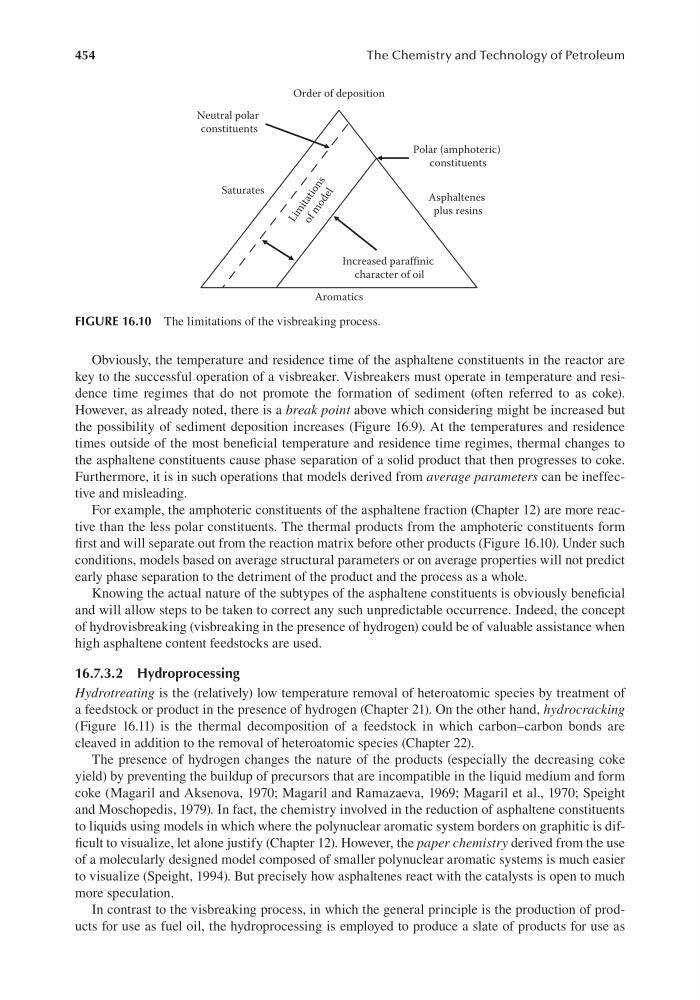
For example, the amphoteric constituents of the asphaltene fraction (Chapter 12) are more reactive than the less polar constituents. The thermal products from the amphoteric constituents form
first and will separate out from the reaction matrix before other products (Figure 16.10). Under such
conditions, models based on average structural parameters or on average properties will not predict
early phase separation to the detriment of the product and the process as a whole.
Knowing the actual nature of the subtypes of the asphaltene constituents is obviously beneficial
and will allow steps to be taken to correct any such unpredictable occurrence. Indeed, the concept
of hydrovisbreaking (visbreaking in the presence of hydrogen) could be of valuable assistance when
high asphaltene content feedstocks are used.
16.7.3.2 Hydroprocessing
Hydrotreating is the (relatively) low temperature removal of heteroatomic species by treatment of
a feedstock or product in the presence of hydrogen (Chapter 21). On the other hand, hydrocracking
(Figure 16.11) is the thermal decomposition of a feedstock in which carbon–carbon bonds are
cleaved in addition to the removal of heteroatomic species (Chapter 22).
The presence of hydrogen changes the nature of the products (especially the decreasing coke
yield) by preventing the buildup of precursors that are incompatible in the liquid medium and form
coke (Magaril and Aksenova, 1970; Magaril and Ramazaeva, 1969; Magaril et al., 1970; Speight
and Moschopedis, 1979). In fact, the chemistry involved in the reduction of asphaltene constituents
to liquids using models in which where the polynuclear aromatic system borders on graphitic is difficult to visualize, let alone justify (Chapter 12). However, the paper chemistry derived from the use
of a molecularly designed model composed of smaller polynuclear aromatic systems is much easier
to visualize (Speight, 1994). But precisely how asphaltenes react with the catalysts is open to much
more speculation.
In contrast to the visbreaking process, in which the general principle is the production of products for use as fuel oil, the hydroprocessing is employed to produce a slate of products for use as
Order of deposition
Asphaltenes
plus resins
Saturates
Neutral polar
constituents
Polar (amphoteric)
constituents
Increased paraffinic
character of oil
Aromatics
FIGURE 16.10 The limitations of the visbreaking process.
The Chemistry and Technology of Petroleum
Obviously, the temperature and residence time of the asphaltene constituents in the reactor are
key to the successful operation of a visbreaker. Visbreakers must operate in temperature and residence time regimes that do not promote the formation of sediment (often referred to as coke).
However, as already noted, there is a break point above which considering might be increased but
the possibility of sediment deposition increases (Figure 16.9). At the temperatures and residence
times outside of the most beneficial temperature and residence time regimes, thermal changes to
the asphaltene constituents cause phase separation of a solid product that then progresses to coke.
Furthermore, it is in such operations that models derived from average parameters can be ineffective and misleading.
For example, the amphoteric constituents of the asphaltene fraction (Chapter 12) are more reactive than the less polar constituents. The thermal products from the amphoteric constituents form
first and will separate out from the reaction matrix before other products (Figure 16.10). Under such
conditions, models based on average structural parameters or on average properties will not predict
early phase separation to the detriment of the product and the process as a whole.
Knowing the actual nature of the subtypes of the asphaltene constituents is obviously beneficial
and will allow steps to be taken to correct any such unpredictable occurrence. Indeed, the concept
of hydrovisbreaking (visbreaking in the presence of hydrogen) could be of valuable assistance when
high asphaltene content feedstocks are used.
16.7.3.2 Hydroprocessing
Hydrotreating is the (relatively) low temperature removal of heteroatomic species by treatment of
a feedstock or product in the presence of hydrogen (Chapter 21). On the other hand, hydrocracking
(Figure 16.11) is the thermal decomposition of a feedstock in which carbon–carbon bonds are
cleaved in addition to the removal of heteroatomic species (Chapter 22).
The presence of hydrogen changes the nature of the products (especially the decreasing coke
yield) by preventing the buildup of precursors that are incompatible in the liquid medium and form
coke (Magaril and Aksenova, 1970; Magaril and Ramazaeva, 1969; Magaril et al., 1970; Speight
and Moschopedis, 1979). In fact, the chemistry involved in the reduction of asphaltene constituents
to liquids using models in which where the polynuclear aromatic system borders on graphitic is difficult to visualize, let alone justify (Chapter 12). However, the paper chemistry derived from the use
of a molecularly designed model composed of smaller polynuclear aromatic systems is much easier
to visualize (Speight, 1994). But precisely how asphaltenes react with the catalysts is open to much
more speculation.
In contrast to the visbreaking process, in which the general principle is the production of products for use as fuel oil, the hydroprocessing is employed to produce a slate of products for use as
Order of deposition
Asphaltenes
plus resins
Saturates
Neutral polar
constituents
Polar (amphoteric)
constituents
Increased paraffinic
character of oil
Aromatics
FIGURE 16.10 The limitations of the visbreaking process.