

422
The Chemistry and Technology of Petroleum
The limitations of processing these heavy feedstocks depend to a large extent on the amount
of higher molecular weight constituents (i.e., asphaltene constituents) that contain the majority of
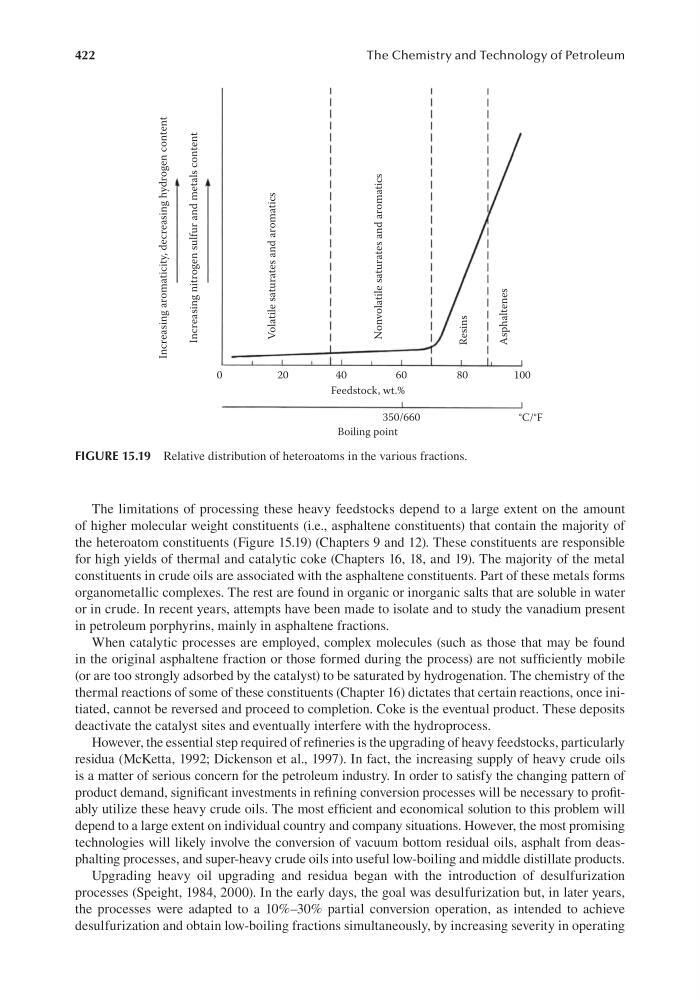
the heteroatom constituents (Figure 15.19) (Chapters 9 and 12). These constituents are responsible
for high yields of thermal and catalytic coke (Chapters 16, 18, and 19). The majority of the metal
constituents in crude oils are associated with the asphaltene constituents. Part of these metals forms
organometallic complexes. The rest are found in organic or inorganic salts that are soluble in water
or in crude. In recent years, attempts have been made to isolate and to study the vanadium present
in petroleum porphyrins, mainly in asphaltene fractions.
When catalytic processes are employed, complex molecules (such as those that may be found
in the original asphaltene fraction or those formed during the process) are not sufficiently mobile
(or are too strongly adsorbed by the catalyst) to be saturated by hydrogenation. The chemistry of the
thermal reactions of some of these constituents (Chapter 16) dictates that certain reactions, once initiated, cannot be reversed and proceed to completion. Coke is the eventual product. These deposits
deactivate the catalyst sites and eventually interfere with the hydroprocess.
However, the essential step required of refineries is the upgrading of heavy feedstocks, particularly
residua (McKetta, 1992; Dickenson et al., 1997). In fact, the increasing supply of heavy crude oils
is a matter of serious concern for the petroleum industry. In order to satisfy the changing pattern of
product demand, significant investments in refining conversion processes will be necessary to profitably utilize these heavy crude oils. The most efficient and economical solution to this problem will
depend to a large extent on individual country and company situations. However, the most promising
technologies will likely involve the conversion of vacuum bottom residual oils, asphalt from deasphalting processes, and super-heavy crude oils into useful low-boiling and middle distillate products.
Upgrading heavy oil upgrading and residua began with the introduction of desulfurization
processes (Speight, 1984, 2000). In the early days, the goal was desulfurization but, in later years,
the processes were adapted to a 10%–30% partial conversion operation, as intended to achieve
desulfurization and obtain low-boiling fractions simultaneously, by increasing severity in operating
°C/°F
0
4 0
Volatile saturates and aromatics
Increasing aromaticity, decreasing hydrogen content
Increasing nitrogen sulfur and metals content
Nonvolatile saturates and aromatics
Resins
Asphaltenes
100
60
80
350/660
20
Feedstock, wt.%
Boiling point
FIGURE 15.19 Relative distribution of heteroatoms in the various fractions.
The Chemistry and Technology of Petroleum
The limitations of processing these heavy feedstocks depend to a large extent on the amount
of higher molecular weight constituents (i.e., asphaltene constituents) that contain the majority of
the heteroatom constituents (Figure 15.19) (Chapters 9 and 12). These constituents are responsible
for high yields of thermal and catalytic coke (Chapters 16, 18, and 19). The majority of the metal
constituents in crude oils are associated with the asphaltene constituents. Part of these metals forms
organometallic complexes. The rest are found in organic or inorganic salts that are soluble in water
or in crude. In recent years, attempts have been made to isolate and to study the vanadium present
in petroleum porphyrins, mainly in asphaltene fractions.
When catalytic processes are employed, complex molecules (such as those that may be found
in the original asphaltene fraction or those formed during the process) are not sufficiently mobile
(or are too strongly adsorbed by the catalyst) to be saturated by hydrogenation. The chemistry of the
thermal reactions of some of these constituents (Chapter 16) dictates that certain reactions, once initiated, cannot be reversed and proceed to completion. Coke is the eventual product. These deposits
deactivate the catalyst sites and eventually interfere with the hydroprocess.
However, the essential step required of refineries is the upgrading of heavy feedstocks, particularly
residua (McKetta, 1992; Dickenson et al., 1997). In fact, the increasing supply of heavy crude oils
is a matter of serious concern for the petroleum industry. In order to satisfy the changing pattern of
product demand, significant investments in refining conversion processes will be necessary to profitably utilize these heavy crude oils. The most efficient and economical solution to this problem will
depend to a large extent on individual country and company situations. However, the most promising
technologies will likely involve the conversion of vacuum bottom residual oils, asphalt from deasphalting processes, and super-heavy crude oils into useful low-boiling and middle distillate products.
Upgrading heavy oil upgrading and residua began with the introduction of desulfurization
processes (Speight, 1984, 2000). In the early days, the goal was desulfurization but, in later years,
the processes were adapted to a 10%–30% partial conversion operation, as intended to achieve
desulfurization and obtain low-boiling fractions simultaneously, by increasing severity in operating
°C/°F
0
4 0
Volatile saturates and aromatics
Increasing aromaticity, decreasing hydrogen content
Increasing nitrogen sulfur and metals content
Nonvolatile saturates and aromatics
Resins
Asphaltenes
100
60
80
350/660
20
Feedstock, wt.%
Boiling point
FIGURE 15.19 Relative distribution of heteroatoms in the various fractions.