

423
Introduction to Refining Processes
conditions. Refinery evolution has seen the introduction of a variety of residuum cracking processes
based on thermal cracking (Chapter 18), catalytic cracking processes (Chapter 19), hydroconversion processes (Chapters 21 and 22), and solvent-based processes (Chapter 20) (Speight, 2011b).
Those processes are different from one another in cracking method, cracked product patterns, and
product properties, and will be employed in refineries according to their respective features. Thus,
refining heavy feedstocks has become a major issue in modern refinery practice and several process
configurations have evolved to accommodate the heavy feedstocks (RAROP, 1991; Shih and Oballa,
1991; Khan and Patmore, 1997).
Technologies for upgrading heavy crude oils such as heavy oil, bitumen, and residua can be
broadly divided into carbon rejection and hydrogen addition processes. Carbon rejection redistributes hydrogen among the various components, resulting in fractions with increased H/C atomic
ratios and fractions with lower H/C atomic ratios. On the other hand, hydrogen addition processes
involve reaction heavy crude oils with an external source of hydrogen and result in an overall
increase in H/C ratio. Within these broad ranges, all more common upgrading technologies can be
subdivided as follows:
1. Carbon rejection—visbreaking, coking, and FCC
2. Hydrogen addition—hydrovisbreaking and catalytic hydrocracking
3. Separation processes—distillation and deasphalting
Thus, the options for refiners processing heavy high sulfur will be a combination of upgrading
schemes and by-product utilization. Residue upgrading options include (1) deep-cut vacuum distillation, (2) solvent deasphalting, (3) residue hydroprocessing, and residue catalytic cracking in
addition to options that focus on the well-established visbreaking and coking technologies. These
process options for upgrading heavy oils and residua will be described in more detail in the respective chapters, since a detailed description of every process would be repetitive at this point.
For the present, using a schematic refinery operation (Figure 15.1), new processes for the conversion of residua and heavy oils will probably be used in concert with visbreaking with some degree
of hydroprocessing as a primary conversion step. Other processes may replace or augment the deasphalting units in many refineries. An exception, which may become the rule, is the upgrading of
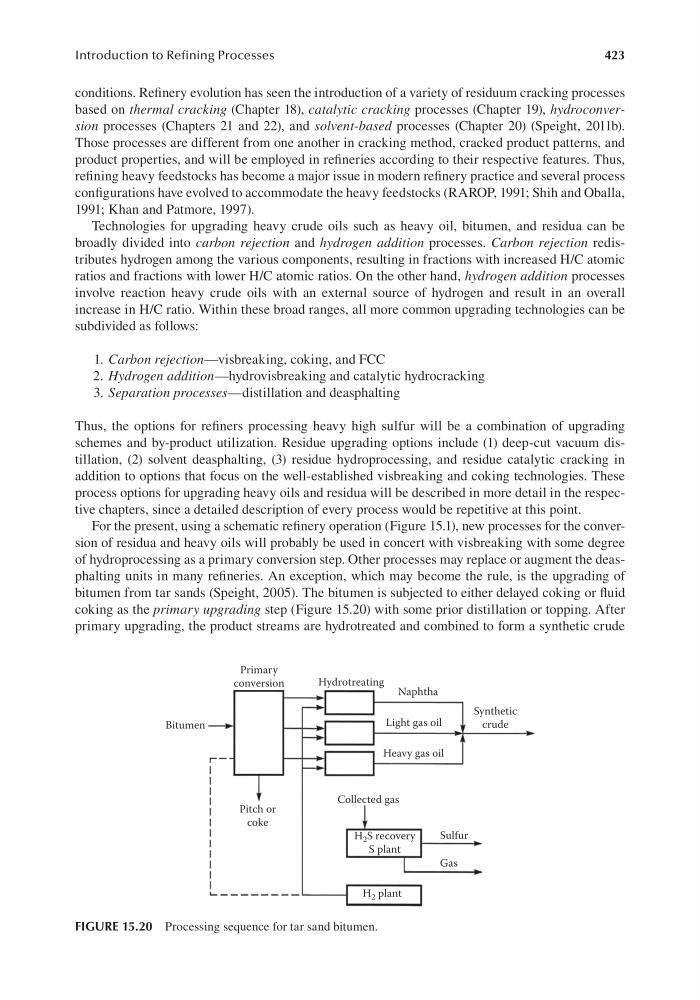
bitumen from tar sands (Speight, 2005). The bitumen is subjected to either delayed coking or fluid
coking as the primary upgrading step (Figure 15.20) with some prior distillation or topping. After
primary upgrading, the product streams are hydrotreated and combined to form a synthetic crude
Primary
conversion
Hydrotreating Naphtha
Light gas oil
Heavy gas oil
Sulfur
Gas
H 2 plant
H 2 S recovery
S plant
Synthetic
crude
Bitumen
Pitch or
coke
Collected gas
FIGURE 15.20 Processing sequence for tar sand bitumen.
Introduction to Refining Processes
conditions. Refinery evolution has seen the introduction of a variety of residuum cracking processes
based on thermal cracking (Chapter 18), catalytic cracking processes (Chapter 19), hydroconversion processes (Chapters 21 and 22), and solvent-based processes (Chapter 20) (Speight, 2011b).
Those processes are different from one another in cracking method, cracked product patterns, and
product properties, and will be employed in refineries according to their respective features. Thus,
refining heavy feedstocks has become a major issue in modern refinery practice and several process
configurations have evolved to accommodate the heavy feedstocks (RAROP, 1991; Shih and Oballa,
1991; Khan and Patmore, 1997).
Technologies for upgrading heavy crude oils such as heavy oil, bitumen, and residua can be
broadly divided into carbon rejection and hydrogen addition processes. Carbon rejection redistributes hydrogen among the various components, resulting in fractions with increased H/C atomic
ratios and fractions with lower H/C atomic ratios. On the other hand, hydrogen addition processes
involve reaction heavy crude oils with an external source of hydrogen and result in an overall
increase in H/C ratio. Within these broad ranges, all more common upgrading technologies can be
subdivided as follows:
1. Carbon rejection—visbreaking, coking, and FCC
2. Hydrogen addition—hydrovisbreaking and catalytic hydrocracking
3. Separation processes—distillation and deasphalting
Thus, the options for refiners processing heavy high sulfur will be a combination of upgrading
schemes and by-product utilization. Residue upgrading options include (1) deep-cut vacuum distillation, (2) solvent deasphalting, (3) residue hydroprocessing, and residue catalytic cracking in
addition to options that focus on the well-established visbreaking and coking technologies. These
process options for upgrading heavy oils and residua will be described in more detail in the respective chapters, since a detailed description of every process would be repetitive at this point.
For the present, using a schematic refinery operation (Figure 15.1), new processes for the conversion of residua and heavy oils will probably be used in concert with visbreaking with some degree
of hydroprocessing as a primary conversion step. Other processes may replace or augment the deasphalting units in many refineries. An exception, which may become the rule, is the upgrading of
bitumen from tar sands (Speight, 2005). The bitumen is subjected to either delayed coking or fluid
coking as the primary upgrading step (Figure 15.20) with some prior distillation or topping. After
primary upgrading, the product streams are hydrotreated and combined to form a synthetic crude
Primary
conversion
Hydrotreating Naphtha
Light gas oil
Heavy gas oil
Sulfur
Gas
H 2 plant
H 2 S recovery
S plant
Synthetic
crude
Bitumen
Pitch or
coke
Collected gas
FIGURE 15.20 Processing sequence for tar sand bitumen.