

421
Introduction to Refining Processes
acetone-benzene, trichloroethylene, ethylene dichloride-benzene (Barisol), methyl ethyl ketonebenzene (benzol), methyl-n-butyl ketone, and methyl-n-propyl ketone.
The process as now practiced involves mixing the feedstock with one to four times its volume
of the ketone (Figure 15.17) (Scholten, 1992). The mixture is then heated until the oil is in solution
and the solution is chilled at a slow, controlled rate in double-pipe, scraped-surface exchangers.
Cold solvent, such as filtrate from the filters, passes through the 2 in. annular space between the
inner and outer pipes and chills the waxy oil solution flowing through the inner 6 in. pipe.
15.13 REFINING HEAVY FEEDSTOCKS
Petroleum refining is now in a significant transition period as the industry moves into the twentyfirst century. Although the demand for petroleum and petroleum products has shown a sharp growth
in recent years, this might be the last century for petroleum refining, as it is currently practiced
(Speight, 2011b). The demand for transportation fuels and fuel oil is forecast to continue to show a
steady growth in the future. The simplest means to cover the demand growth in low-boiling products is to increase the imports of light crude oils and low-boiling petroleum products, but these steps
may be limited in the future.
Over the past three decades, crude oils available to refineries have generally decreased in API
gravity. There is, nevertheless, a major focus in refineries on the ways in which heavy feedstocks
might be converted into low-boiling high-value products (Khan and Patmore, 1997; Rana et al.,
2007; Rispoli et al., 2009; Stratiev and Petkov, 2009; Motaghi et al., 2010a,b). Simultaneously,
the changing crude oil properties are reflected in changes such as an increase in asphaltene constituents, an increase in sulfur, metal, and nitrogen contents. Pretreatment processes for removing such constituents or at least negating their effect in thermal process those would also play an
important role.
Heavy oil, tar sand bitumen, and residua are generally characterized by low API gravity (high
density) and high viscosity, high initial boiling point, high carbon residue, high nitrogen content,
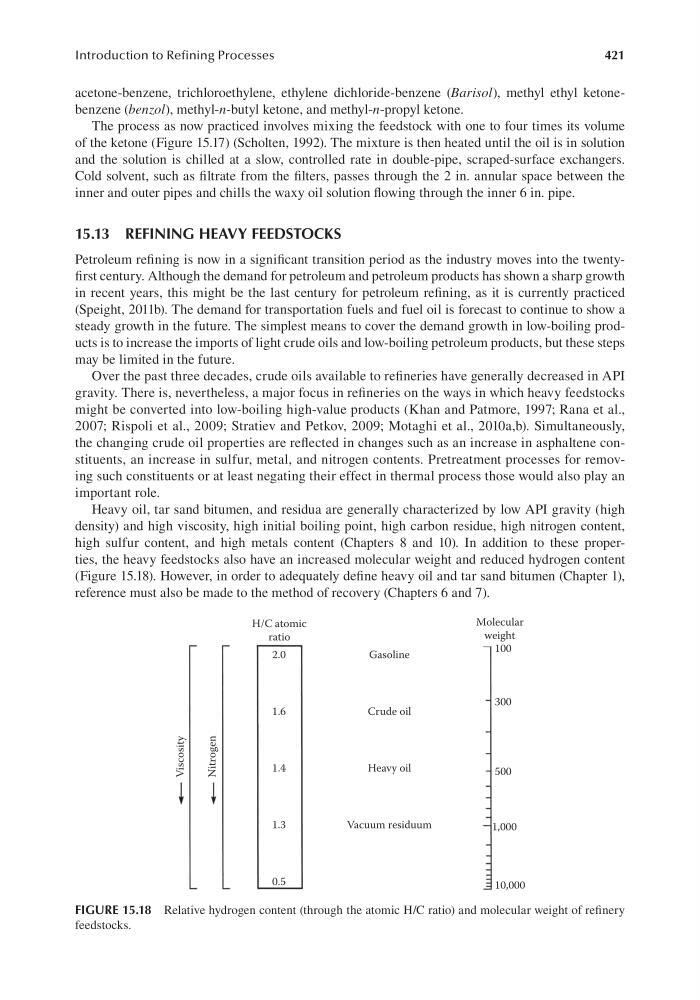
high sulfur content, and high metals content (Chapters 8 and 10). In addition to these properties, the heavy feedstocks also have an increased molecular weight and reduced hydrogen content
(Figure 15.18). However, in order to adequately define heavy oil and tar sand bitumen (Chapter 1),
reference must also be made to the method of recovery (Chapters 6 and 7).
Gasoline
2.0
1.6
1.4
1.3
0.5
100
300
500
1,000
Molecular
weight
Viscosity
Nitrogen
H/C atomic
ratio
Crude oil
Heavy oil
Vacuum residuum
10,000
FIGURE 15.18 Relative hydrogen content (through the atomic H/C ratio) and molecular weight of refinery
feedstocks.
Introduction to Refining Processes
acetone-benzene, trichloroethylene, ethylene dichloride-benzene (Barisol), methyl ethyl ketonebenzene (benzol), methyl-n-butyl ketone, and methyl-n-propyl ketone.
The process as now practiced involves mixing the feedstock with one to four times its volume
of the ketone (Figure 15.17) (Scholten, 1992). The mixture is then heated until the oil is in solution
and the solution is chilled at a slow, controlled rate in double-pipe, scraped-surface exchangers.
Cold solvent, such as filtrate from the filters, passes through the 2 in. annular space between the
inner and outer pipes and chills the waxy oil solution flowing through the inner 6 in. pipe.
15.13 REFINING HEAVY FEEDSTOCKS
Petroleum refining is now in a significant transition period as the industry moves into the twentyfirst century. Although the demand for petroleum and petroleum products has shown a sharp growth
in recent years, this might be the last century for petroleum refining, as it is currently practiced
(Speight, 2011b). The demand for transportation fuels and fuel oil is forecast to continue to show a
steady growth in the future. The simplest means to cover the demand growth in low-boiling products is to increase the imports of light crude oils and low-boiling petroleum products, but these steps
may be limited in the future.
Over the past three decades, crude oils available to refineries have generally decreased in API
gravity. There is, nevertheless, a major focus in refineries on the ways in which heavy feedstocks
might be converted into low-boiling high-value products (Khan and Patmore, 1997; Rana et al.,
2007; Rispoli et al., 2009; Stratiev and Petkov, 2009; Motaghi et al., 2010a,b). Simultaneously,
the changing crude oil properties are reflected in changes such as an increase in asphaltene constituents, an increase in sulfur, metal, and nitrogen contents. Pretreatment processes for removing such constituents or at least negating their effect in thermal process those would also play an
important role.
Heavy oil, tar sand bitumen, and residua are generally characterized by low API gravity (high
density) and high viscosity, high initial boiling point, high carbon residue, high nitrogen content,
high sulfur content, and high metals content (Chapters 8 and 10). In addition to these properties, the heavy feedstocks also have an increased molecular weight and reduced hydrogen content
(Figure 15.18). However, in order to adequately define heavy oil and tar sand bitumen (Chapter 1),
reference must also be made to the method of recovery (Chapters 6 and 7).
Gasoline
2.0
1.6
1.4
1.3
0.5
100
300
500
1,000
Molecular
weight
Viscosity
Nitrogen
H/C atomic
ratio
Crude oil
Heavy oil
Vacuum residuum
10,000
FIGURE 15.18 Relative hydrogen content (through the atomic H/C ratio) and molecular weight of refinery
feedstocks.