

419
Introduction to Refining Processes
regenerate simply by washing and recoating; the serious disadvantage is that tar must occasionally
be burned off the support. The process using liquid phosphoric acid catalyst is far more responsible
to attempts to raise production by increasing temperature than the other processes.
15.12 SOLVENT PROCESSES
15.12.1 deAsPHAltIng ProCesses
Solvent deasphalting processes are a major part of refinery operations (Bland and Davidson, 1967;
Hobson and Pohl, 1973; Speight and Ozum, 2002; Hsu and Robinson, 2006; Gary et al., 2007;
Speight, 2011b) and are not often appreciated for the tasks for which they are used. In the solvent
deasphalting processes, an alkane is injected into the feedstock to disrupt the dispersion of components and causes the polar constituents to precipitate. Propane (or sometimes propane/butane
mixtures) is extensively used for deasphalting and produces a deasphalted oil (DAO) and propane
deasphalter asphalt (PDA or PD tar) (Dunning and Moore, 1957). Propane has unique solvent properties; at lower temperatures (38°C–60°C; 100°C–140°C) paraffins are very soluble in propane, and
at higher temperatures (about 93°C; 200°F) all hydrocarbons are almost insoluble in propane.
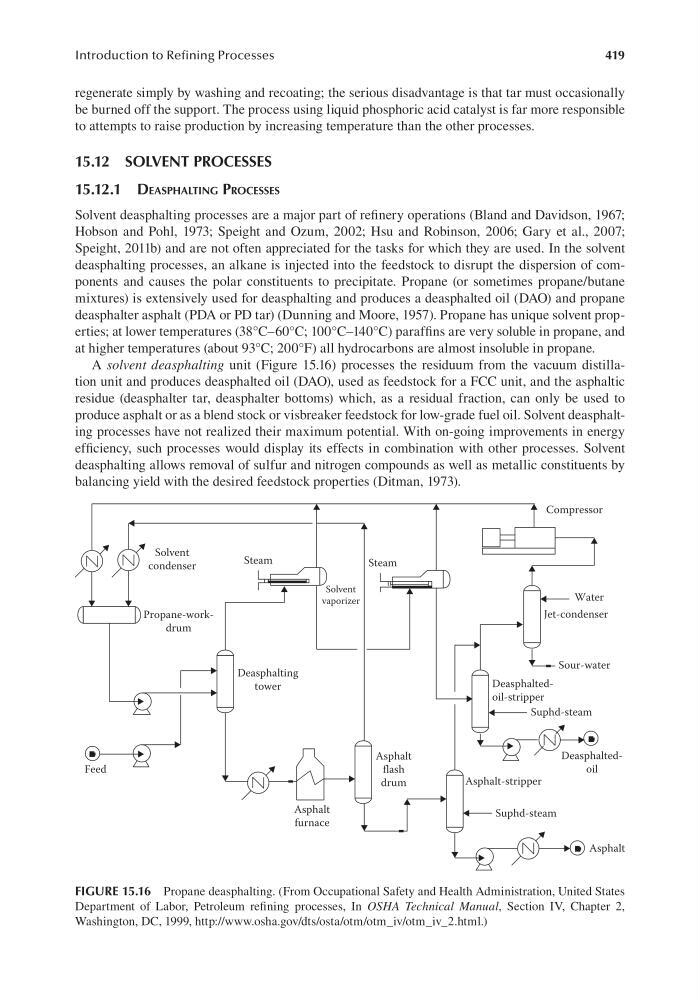
A solvent deasphalting unit (Figure 15.16) processes the residuum from the vacuum distillation unit and produces deasphalted oil (DAO), used as feedstock for a FCC unit, and the asphaltic
residue (deasphalter tar, deasphalter bottoms) which, as a residual fraction, can only be used to
produce asphalt or as a blend stock or visbreaker feedstock for low-grade fuel oil. Solvent deasphalting processes have not realized their maximum potential. With on-going improvements in energy
efficiency, such processes would display its effects in combination with other processes. Solvent
deasphalting allows removal of sulfur and nitrogen compounds as well as metallic constituents by
balancing yield with the desired feedstock properties (Ditman, 1973).
Compressor
Water
Jet-condenser
Sour-water
Deasphaltedoil-stripper
Suphd-steam
Deasphaltedoil
Asphalt
Asphalt-stripper
Suphd-steam
Asphalt
furnace
Deasphalting
tower
Propane-workdrum
Steam
Feed
Solvent
vaporizer
Solvent
condenser
Steam
Asphalt
flash
drum
FIGURE 15.16 Propane deasphalting. (From Occupational Safety and Health Administration, United States
Department of Labor, Petroleum refining processes, In OSHA Technical Manual, Section IV, Chapter 2,
Washington, DC, 1999, http://www.osha.gov/dts/osta/otm/otm_iv/otm_iv_2.html.)
Introduction to Refining Processes
regenerate simply by washing and recoating; the serious disadvantage is that tar must occasionally
be burned off the support. The process using liquid phosphoric acid catalyst is far more responsible
to attempts to raise production by increasing temperature than the other processes.
15.12 SOLVENT PROCESSES
15.12.1 deAsPHAltIng ProCesses
Solvent deasphalting processes are a major part of refinery operations (Bland and Davidson, 1967;
Hobson and Pohl, 1973; Speight and Ozum, 2002; Hsu and Robinson, 2006; Gary et al., 2007;
Speight, 2011b) and are not often appreciated for the tasks for which they are used. In the solvent
deasphalting processes, an alkane is injected into the feedstock to disrupt the dispersion of components and causes the polar constituents to precipitate. Propane (or sometimes propane/butane
mixtures) is extensively used for deasphalting and produces a deasphalted oil (DAO) and propane
deasphalter asphalt (PDA or PD tar) (Dunning and Moore, 1957). Propane has unique solvent properties; at lower temperatures (38°C–60°C; 100°C–140°C) paraffins are very soluble in propane, and
at higher temperatures (about 93°C; 200°F) all hydrocarbons are almost insoluble in propane.
A solvent deasphalting unit (Figure 15.16) processes the residuum from the vacuum distillation unit and produces deasphalted oil (DAO), used as feedstock for a FCC unit, and the asphaltic
residue (deasphalter tar, deasphalter bottoms) which, as a residual fraction, can only be used to
produce asphalt or as a blend stock or visbreaker feedstock for low-grade fuel oil. Solvent deasphalting processes have not realized their maximum potential. With on-going improvements in energy
efficiency, such processes would display its effects in combination with other processes. Solvent
deasphalting allows removal of sulfur and nitrogen compounds as well as metallic constituents by
balancing yield with the desired feedstock properties (Ditman, 1973).
Compressor
Water
Jet-condenser
Sour-water
Deasphaltedoil-stripper
Suphd-steam
Deasphaltedoil
Asphalt
Asphalt-stripper
Suphd-steam
Asphalt
furnace
Deasphalting
tower
Propane-workdrum
Steam
Feed
Solvent
vaporizer
Solvent
condenser
Steam
Asphalt
flash
drum
FIGURE 15.16 Propane deasphalting. (From Occupational Safety and Health Administration, United States
Department of Labor, Petroleum refining processes, In OSHA Technical Manual, Section IV, Chapter 2,
Washington, DC, 1999, http://www.osha.gov/dts/osta/otm/otm_iv/otm_iv_2.html.)