

418
The Chemistry and Technology of Petroleum
15.11 POLYMERIZATION PROCESSES
15.11.1 HIstorICAl develoPment
In the petroleum industry, polymerization is the process by which olefin gases are converted to
liquid products that may be suitable for gasoline (polymer gasoline) or other liquid fuels. The feedstock usually consists of propylene and butylenes from cracking processes or may even be selective
olefins for dimer, trimer, or tetramer production.
Polymerization is a process that can claim to be the earliest process to employ catalysts on a commercial scale. Catalytic polymerization came into use in the 1930s and was one of the first catalytic
processes to be used in the petroleum industry.
15.11.2 modern ProCesses
Polymerization may be accomplished thermally or in the presence of a catalyst at lower temperatures. Thermal polymerization is regarded as not being as effective as catalytic polymerization but
has the advantage that it can be used to polymerize saturated materials that cannot be induced to
react by catalysts. The process consists of vapor-phase cracking of, for example, propane and butane
followed by prolonged periods at the high temperature (510°C–595°C, 950°F–1100°F) for the reactions to proceed to near-completion.
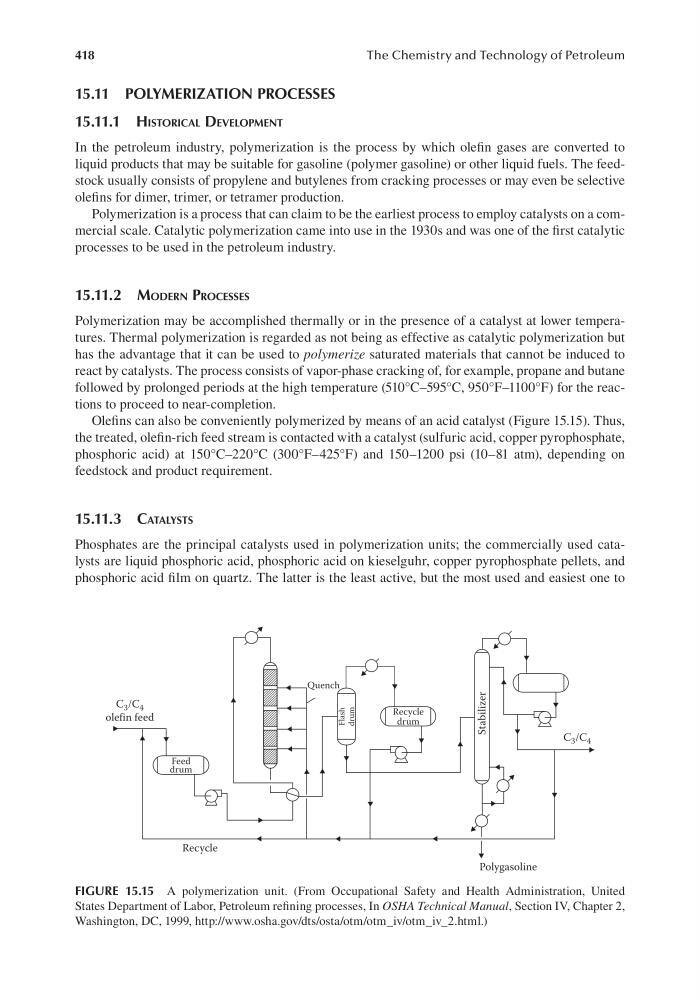
Olefins can also be conveniently polymerized by means of an acid catalyst (Figure 15.15). Thus,
the treated, olefin-rich feed stream is contacted with a catalyst (sulfuric acid, copper pyrophosphate,
phosphoric acid) at 150°C–220°C (300°F–425°F) and 150–1200 psi (10–81 atm), depending on
feedstock and product requirement.
15.11.3 CAtAlysts
Phosphates are the principal catalysts used in polymerization units; the commercially used catalysts are liquid phosphoric acid, phosphoric acid on kieselguhr, copper pyrophosphate pellets, and
phosphoric acid film on quartz. The latter is the least active, but the most used and easiest one to
Quench
Recycle
drum
Feed
drum
Flash
drum
Recycle
Stabilizer
C 3 /C 4
C 3 /C 4
olefin feed
Polygasoline
FIGURE 15.15 A polymerization unit. (From Occupational Safety and Health Administration, United
States Department of Labor, Petroleum refining processes, In OSHA Technical Manual, Section IV, Chapter 2,
Washington, DC, 1999, http://www.osha.gov/dts/osta/otm/otm_iv/otm_iv_2.html.)
The Chemistry and Technology of Petroleum
15.11 POLYMERIZATION PROCESSES
15.11.1 HIstorICAl develoPment
In the petroleum industry, polymerization is the process by which olefin gases are converted to
liquid products that may be suitable for gasoline (polymer gasoline) or other liquid fuels. The feedstock usually consists of propylene and butylenes from cracking processes or may even be selective
olefins for dimer, trimer, or tetramer production.
Polymerization is a process that can claim to be the earliest process to employ catalysts on a commercial scale. Catalytic polymerization came into use in the 1930s and was one of the first catalytic
processes to be used in the petroleum industry.
15.11.2 modern ProCesses
Polymerization may be accomplished thermally or in the presence of a catalyst at lower temperatures. Thermal polymerization is regarded as not being as effective as catalytic polymerization but
has the advantage that it can be used to polymerize saturated materials that cannot be induced to
react by catalysts. The process consists of vapor-phase cracking of, for example, propane and butane
followed by prolonged periods at the high temperature (510°C–595°C, 950°F–1100°F) for the reactions to proceed to near-completion.
Olefins can also be conveniently polymerized by means of an acid catalyst (Figure 15.15). Thus,
the treated, olefin-rich feed stream is contacted with a catalyst (sulfuric acid, copper pyrophosphate,
phosphoric acid) at 150°C–220°C (300°F–425°F) and 150–1200 psi (10–81 atm), depending on
feedstock and product requirement.
15.11.3 CAtAlysts
Phosphates are the principal catalysts used in polymerization units; the commercially used catalysts are liquid phosphoric acid, phosphoric acid on kieselguhr, copper pyrophosphate pellets, and
phosphoric acid film on quartz. The latter is the least active, but the most used and easiest one to
Quench
Recycle
drum
Feed
drum
Flash
drum
Recycle
Stabilizer
C 3 /C 4
C 3 /C 4
olefin feed
Polygasoline
FIGURE 15.15 A polymerization unit. (From Occupational Safety and Health Administration, United
States Department of Labor, Petroleum refining processes, In OSHA Technical Manual, Section IV, Chapter 2,
Washington, DC, 1999, http://www.osha.gov/dts/osta/otm/otm_iv/otm_iv_2.html.)