

417
Introduction to Refining Processes
In the mid-1950s, aviation-gasoline demand started to decline, but motor-gasoline quality
requirements rose sharply. Wherever practical, refiners shifted the use of alkylate to premium motor
fuel. To aid in the improvement of the economics of the alkylation process and also the sensitivity of
the premium gasoline pool, additional olefins were gradually added to alkylation feed. New plants
were built to alkylate propylene and the butylenes (butanes) produced in the refinery rather than the
butane–butylene stream formerly used.
15.10.2 modern ProCesses
The alkylation reaction as now practiced in petroleum refining is the union, through the agency of
a catalyst, of an olefin (ethylene, propylene, butylene, and amylene) with isobutane to yield highoctane branched-chain hydrocarbons in the gasoline boiling range. Olefin feedstock is derived from
the gas produced in a catalytic cracker, while isobutane is recovered by refinery gases or produced
by catalytic butane isomerization.
To accomplish this, either ethylene or propylene is combined with isobutane at 50°C–280°C
(125°F–450°F) and 300–1000 psi (20–68 atm) in the presence of metal halide catalysts such as
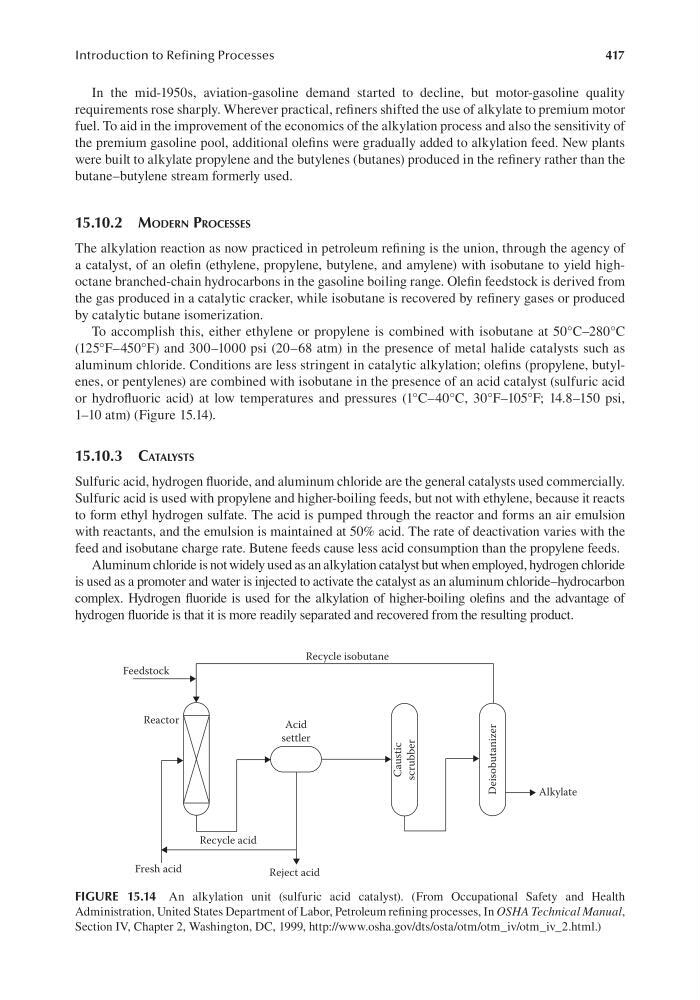
aluminum chloride. Conditions are less stringent in catalytic alkylation; olefins (propylene, butylenes, or pentylenes) are combined with isobutane in the presence of an acid catalyst (sulfuric acid
or hydrofluoric acid) at low temperatures and pressures (1°C–40°C, 30°F–105°F; 14.8–150 psi,
1–10 atm) (Figure 15.14).
15.10.3 CAtAlysts
Sulfuric acid, hydrogen fluoride, and aluminum chloride are the general catalysts used commercially.
Sulfuric acid is used with propylene and higher-boiling feeds, but not with ethylene, because it reacts
to form ethyl hydrogen sulfate. The acid is pumped through the reactor and forms an air emulsion
with reactants, and the emulsion is maintained at 50% acid. The rate of deactivation varies with the
feed and isobutane charge rate. Butene feeds cause less acid consumption than the propylene feeds.
Aluminum chloride is not widely used as an alkylation catalyst but when employed, hydrogen chloride
is used as a promoter and water is injected to activate the catalyst as an aluminum chloride– hydrocarbon
complex. Hydrogen fluoride is used for the alkylation of higher-boiling olefins and the advantage of
hydrogen fluoride is that it is more readily separated and recovered from the resulting product.
Acid
settler
Caustic
scrubber
Alkylate
Deisobutanizer
Recycle acid
Reactor
Feedstock
Recycle isobutane
Reject acid
Fresh acid
FIGURE 15.14 An alkylation unit (sulfuric acid catalyst). (From Occupational Safety and Health
Administration, United States Department of Labor, Petroleum refining processes, In OSHA Technical Manual,
Section IV, Chapter 2, Washington, DC, 1999, http://www.osha.gov/dts/osta/otm/otm_iv/otm_iv_2.html.)
Introduction to Refining Processes
In the mid-1950s, aviation-gasoline demand started to decline, but motor-gasoline quality
requirements rose sharply. Wherever practical, refiners shifted the use of alkylate to premium motor
fuel. To aid in the improvement of the economics of the alkylation process and also the sensitivity of
the premium gasoline pool, additional olefins were gradually added to alkylation feed. New plants
were built to alkylate propylene and the butylenes (butanes) produced in the refinery rather than the
butane–butylene stream formerly used.
15.10.2 modern ProCesses
The alkylation reaction as now practiced in petroleum refining is the union, through the agency of
a catalyst, of an olefin (ethylene, propylene, butylene, and amylene) with isobutane to yield highoctane branched-chain hydrocarbons in the gasoline boiling range. Olefin feedstock is derived from
the gas produced in a catalytic cracker, while isobutane is recovered by refinery gases or produced
by catalytic butane isomerization.
To accomplish this, either ethylene or propylene is combined with isobutane at 50°C–280°C
(125°F–450°F) and 300–1000 psi (20–68 atm) in the presence of metal halide catalysts such as
aluminum chloride. Conditions are less stringent in catalytic alkylation; olefins (propylene, butylenes, or pentylenes) are combined with isobutane in the presence of an acid catalyst (sulfuric acid
or hydrofluoric acid) at low temperatures and pressures (1°C–40°C, 30°F–105°F; 14.8–150 psi,
1–10 atm) (Figure 15.14).
15.10.3 CAtAlysts
Sulfuric acid, hydrogen fluoride, and aluminum chloride are the general catalysts used commercially.
Sulfuric acid is used with propylene and higher-boiling feeds, but not with ethylene, because it reacts
to form ethyl hydrogen sulfate. The acid is pumped through the reactor and forms an air emulsion
with reactants, and the emulsion is maintained at 50% acid. The rate of deactivation varies with the
feed and isobutane charge rate. Butene feeds cause less acid consumption than the propylene feeds.
Aluminum chloride is not widely used as an alkylation catalyst but when employed, hydrogen chloride
is used as a promoter and water is injected to activate the catalyst as an aluminum chloride– hydrocarbon
complex. Hydrogen fluoride is used for the alkylation of higher-boiling olefins and the advantage of
hydrogen fluoride is that it is more readily separated and recovered from the resulting product.
Acid
settler
Caustic
scrubber
Alkylate
Deisobutanizer
Recycle acid
Reactor
Feedstock
Recycle isobutane
Reject acid
Fresh acid
FIGURE 15.14 An alkylation unit (sulfuric acid catalyst). (From Occupational Safety and Health
Administration, United States Department of Labor, Petroleum refining processes, In OSHA Technical Manual,
Section IV, Chapter 2, Washington, DC, 1999, http://www.osha.gov/dts/osta/otm/otm_iv/otm_iv_2.html.)