

416
The Chemistry and Technology of Petroleum
Non-regenerable aluminum chloride catalyst is employed with various carriers in a fixed-bed or
liquid contactor. Platinum or other metal catalyst processes utilized fixed-bed operation and can be
regenerable or non-regenerable. The reaction conditions vary widely depending on the particular
process and feedstock, 40°C–480°C (100°F–900°F) and 150–1000 psi (10–68 atm).
15.10 ALKYLATION PROCESSES
The combination of olefins with paraffins to form higher iso-paraffins is termed alkylation. Since
olefins are reactive (unstable) and are responsible for exhaust pollutants, their conversion to highoctane iso-paraffins is desirable when possible. In refinery practice, only isobutane is alkylated,
by reaction with iso-butene or normal butene and isooctane is the product. Although alkylation is
possible without catalysts, commercial processes use aluminum chloride, sulfuric acid, or hydrogen
fluoride as catalysts, when the reactions can take place at low temperatures, minimizing undesirable
side reactions, such as polymerization of olefins.
Alkylate is composed of a mixture of iso-paraffins which have octane numbers that vary with the
olefins from which they were made. Butylenes produce the highest octane numbers, propylene the
lowest and pentylenes the intermediate values. All alkylates, however, have high octane numbers
(>87) which makes them particularly valuable.
15.10.1 HIstorICAl develoPment
Alkylation is another twentieth-century refinery innovation, and developments in petroleum
processing in the late 1930s and during World War II were directed toward production of
high-octane liquids for aviation gasoline. The sulfuric acid process was introduced in 1938,
and hydrogen fluoride alkylation was introduced in 1942. Rapid commercialization took place
during the war to supply military needs, but many of these plants were shut down at the end of
the war.
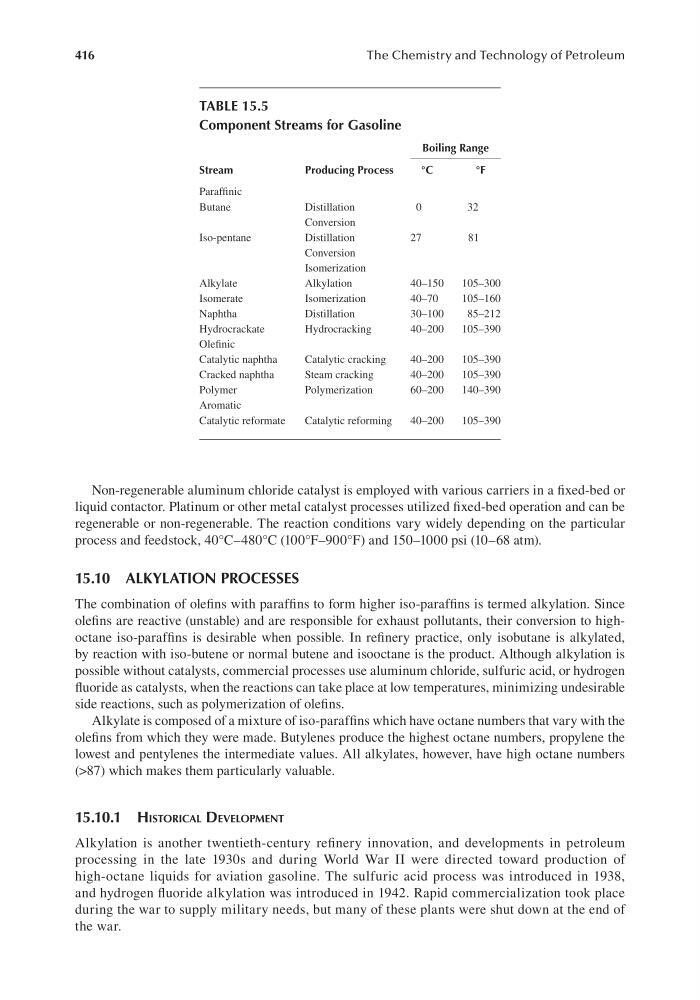
TABLE 15.5
Component Streams for Gasoline
Stream
Producing Process
Boiling Range
°C
°F
Paraffinic
Butane
Distillation
0
32
Conversion
Iso-pentane
Distillation
27
81
Conversion
Isomerization
Alkylate
Alkylation
40–150
105–300
Isomerate
Isomerization
40–70
105–160
Naphtha
Distillation
30–100
85–212
Hydrocrackate
Hydrocracking
40–200
105–390
Olefinic
Catalytic naphtha
Catalytic cracking
40–200
105–390
Cracked naphtha
Steam cracking
40–200
105–390
Polymer
Polymerization
60–200
140–390
Aromatic
Catalytic reformate
Catalytic reforming
40–200
105–390
The Chemistry and Technology of Petroleum
Non-regenerable aluminum chloride catalyst is employed with various carriers in a fixed-bed or
liquid contactor. Platinum or other metal catalyst processes utilized fixed-bed operation and can be
regenerable or non-regenerable. The reaction conditions vary widely depending on the particular
process and feedstock, 40°C–480°C (100°F–900°F) and 150–1000 psi (10–68 atm).
15.10 ALKYLATION PROCESSES
The combination of olefins with paraffins to form higher iso-paraffins is termed alkylation. Since
olefins are reactive (unstable) and are responsible for exhaust pollutants, their conversion to highoctane iso-paraffins is desirable when possible. In refinery practice, only isobutane is alkylated,
by reaction with iso-butene or normal butene and isooctane is the product. Although alkylation is
possible without catalysts, commercial processes use aluminum chloride, sulfuric acid, or hydrogen
fluoride as catalysts, when the reactions can take place at low temperatures, minimizing undesirable
side reactions, such as polymerization of olefins.
Alkylate is composed of a mixture of iso-paraffins which have octane numbers that vary with the
olefins from which they were made. Butylenes produce the highest octane numbers, propylene the
lowest and pentylenes the intermediate values. All alkylates, however, have high octane numbers
(>87) which makes them particularly valuable.
15.10.1 HIstorICAl develoPment
Alkylation is another twentieth-century refinery innovation, and developments in petroleum
processing in the late 1930s and during World War II were directed toward production of
high-octane liquids for aviation gasoline. The sulfuric acid process was introduced in 1938,
and hydrogen fluoride alkylation was introduced in 1942. Rapid commercialization took place
during the war to supply military needs, but many of these plants were shut down at the end of
the war.
TABLE 15.5
Component Streams for Gasoline
Stream
Producing Process
Boiling Range
°C
°F
Paraffinic
Butane
Distillation
0
32
Conversion
Iso-pentane
Distillation
27
81
Conversion
Isomerization
Alkylate
Alkylation
40–150
105–300
Isomerate
Isomerization
40–70
105–160
Naphtha
Distillation
30–100
85–212
Hydrocrackate
Hydrocracking
40–200
105–390
Olefinic
Catalytic naphtha
Catalytic cracking
40–200
105–390
Cracked naphtha
Steam cracking
40–200
105–390
Polymer
Polymerization
60–200
140–390
Aromatic
Catalytic reformate
Catalytic reforming
40–200
105–390