

415
Introduction to Refining Processes
alkylation units. The lowered alkylate demands in the post–World War II period led to the majority
of the butane isomerization units being shut down. In recent years, the greater demand for highoctane motor fuel has resulted in the installation of new butane isomerization units.
The earliest process of note was the production of isobutane, which is required as an alkylation
feed. The isomerization may take place in the vapor phase, with the activated catalyst supported
on a solid phase, or in the liquid phase with a dissolved catalyst. In the process, pure butane or a
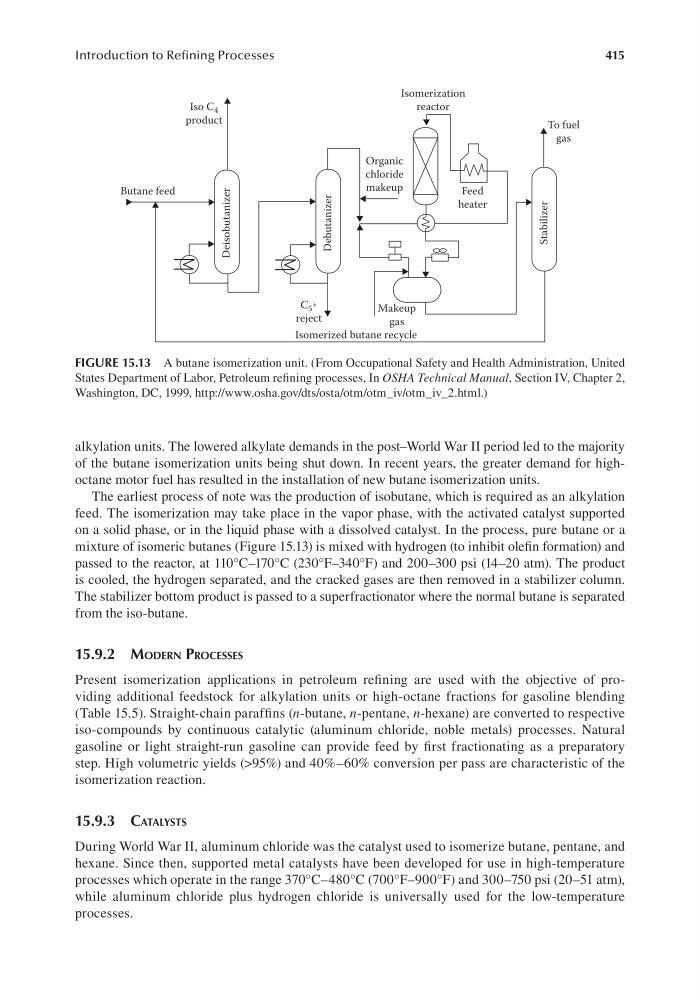
mixture of isomeric butanes (Figure 15.13) is mixed with hydrogen (to inhibit olefin formation) and
passed to the reactor, at 110°C–170°C (230°F–340°F) and 200–300 psi (14–20 atm). The product
is cooled, the hydrogen separated, and the cracked gases are then removed in a stabilizer column.
The stabilizer bottom product is passed to a superfractionator where the normal butane is separated
from the iso-butane.
15.9.2 modern ProCesses
Present isomerization applications in petroleum refining are used with the objective of providing additional feedstock for alkylation units or high-octane fractions for gasoline blending
(Table 15.5). Straight-chain paraffins (n-butane, n-pentane, n-hexane) are converted to respective
iso-compounds by continuous catalytic (aluminum chloride, noble metals) processes. Natural
gasoline or light straight-run gasoline can provide feed by first fractionating as a preparatory
step. High volumetric yields (>95%) and 40%–60% conversion per pass are characteristic of the
isomerization reaction.
15.9.3 CAtAlysts
During World War II, aluminum chloride was the catalyst used to isomerize butane, pentane, and
hexane. Since then, supported metal catalysts have been developed for use in high-temperature
processes which operate in the range 370°C–480°C (700°F–900°F) and 300–750 psi (20–51 atm),
while aluminum chloride plus hydrogen chloride is universally used for the low-temperature
processes.
Isomerization
reactor
Organic
chloride
makeup
Isomerized butane recycle
Makeup
gas
Butane feed
Iso C 4
product
C 5
+
reject
To fuel
gas
Feed
heater
Stabilizer
Debutanizer
Deisobutanizer
FIGURE 15.13 A butane isomerization unit. (From Occupational Safety and Health Administration, United
States Department of Labor, Petroleum refining processes, In OSHA Technical Manual, Section IV, Chapter 2,
Washington, DC, 1999, http://www.osha.gov/dts/osta/otm/otm_iv/otm_iv_2.html.)
Introduction to Refining Processes
alkylation units. The lowered alkylate demands in the post–World War II period led to the majority
of the butane isomerization units being shut down. In recent years, the greater demand for highoctane motor fuel has resulted in the installation of new butane isomerization units.
The earliest process of note was the production of isobutane, which is required as an alkylation
feed. The isomerization may take place in the vapor phase, with the activated catalyst supported
on a solid phase, or in the liquid phase with a dissolved catalyst. In the process, pure butane or a
mixture of isomeric butanes (Figure 15.13) is mixed with hydrogen (to inhibit olefin formation) and
passed to the reactor, at 110°C–170°C (230°F–340°F) and 200–300 psi (14–20 atm). The product
is cooled, the hydrogen separated, and the cracked gases are then removed in a stabilizer column.
The stabilizer bottom product is passed to a superfractionator where the normal butane is separated
from the iso-butane.
15.9.2 modern ProCesses
Present isomerization applications in petroleum refining are used with the objective of providing additional feedstock for alkylation units or high-octane fractions for gasoline blending
(Table 15.5). Straight-chain paraffins (n-butane, n-pentane, n-hexane) are converted to respective
iso-compounds by continuous catalytic (aluminum chloride, noble metals) processes. Natural
gasoline or light straight-run gasoline can provide feed by first fractionating as a preparatory
step. High volumetric yields (>95%) and 40%–60% conversion per pass are characteristic of the
isomerization reaction.
15.9.3 CAtAlysts
During World War II, aluminum chloride was the catalyst used to isomerize butane, pentane, and
hexane. Since then, supported metal catalysts have been developed for use in high-temperature
processes which operate in the range 370°C–480°C (700°F–900°F) and 300–750 psi (20–51 atm),
while aluminum chloride plus hydrogen chloride is universally used for the low-temperature
processes.
Isomerization
reactor
Organic
chloride
makeup
Isomerized butane recycle
Makeup
gas
Butane feed
Iso C 4
product
C 5
+
reject
To fuel
gas
Feed
heater
Stabilizer
Debutanizer
Deisobutanizer
FIGURE 15.13 A butane isomerization unit. (From Occupational Safety and Health Administration, United
States Department of Labor, Petroleum refining processes, In OSHA Technical Manual, Section IV, Chapter 2,
Washington, DC, 1999, http://www.osha.gov/dts/osta/otm/otm_iv/otm_iv_2.html.)