

414
The Chemistry and Technology of Petroleum
for feeds containing, for example, sulfur, which poisons platinum catalysts, although pretreatment
processes (e.g., hydrodesulfurization) may permit platinum catalysts to be employed.
The purpose of platinum on the catalyst is to promote dehydrogenation and hydrogenation
reactions, that is, the production of aromatics, participation in hydrocracking, and rapid hydrogenation of carbon-forming precursors. For the catalyst to have an activity for the isomerization of
both paraffins and naphthenes—the initial cracking step of hydrocracking—and to participate in
paraffin dehydrocyclization, it must have an acid activity. The balance between these two activities is most important in a reforming catalyst. In fact, in the production of aromatics from cyclic
saturated materials (naphthenes), it is important that hydrocracking be minimized to avoid loss
of the desired product and, thus, the catalytic activity must be moderated relative to the case of
gasoline production from a paraffinic feed, where dehydrocyclization and hydrocracking play an
important part.
15.9 ISOMERIZATION
Catalytic reforming processes provide high-octane constituents in the heavier gasoline fraction, but
the normal paraffin components of the lighter gasoline fraction, especially butanes, pentanes, and
hexanes, have poor octane ratings. The conversion of these normal paraffins to their isomers (isomerization) yields gasoline components of high octane rating in this lower-boiling range. Conversion
is obtained in the presence of a catalyst (aluminum chloride activated with hydrochloric acid), and
it is essential to inhibit side reactions such as cracking and olefin formation.
15.9.1 HIstorICAl develoPment
Isomerization, another child of the twentieth century, found initial commercial applications during World War II for making high-octane aviation gasoline components and additional feed for
Reactor
R eactor
Reactor
Furnace
Furnace
Light
hydrocarbons
Separator
Hydrogen
recycle
Fractionator
Furnace
Feedstock
Reformate
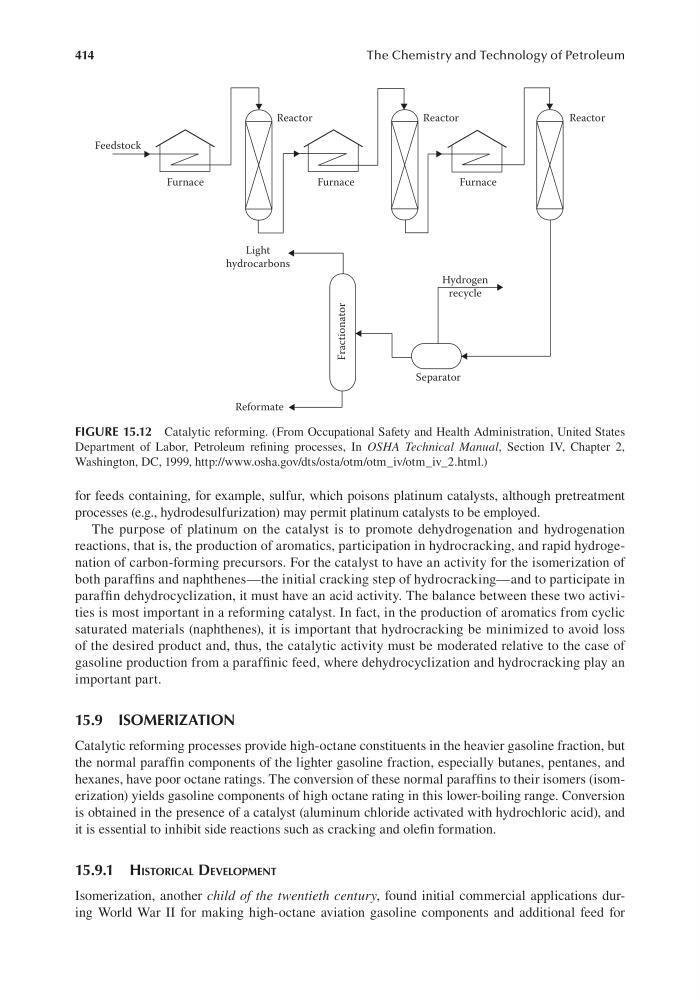
FIGURE 15.12 Catalytic reforming. (From Occupational Safety and Health Administration, United States
Department of Labor, Petroleum refining processes, In OSHA Technical Manual, Section IV, Chapter 2,
Washington, DC, 1999, http://www.osha.gov/dts/osta/otm/otm_iv/otm_iv_2.html.)
The Chemistry and Technology of Petroleum
for feeds containing, for example, sulfur, which poisons platinum catalysts, although pretreatment
processes (e.g., hydrodesulfurization) may permit platinum catalysts to be employed.
The purpose of platinum on the catalyst is to promote dehydrogenation and hydrogenation
reactions, that is, the production of aromatics, participation in hydrocracking, and rapid hydrogenation of carbon-forming precursors. For the catalyst to have an activity for the isomerization of
both paraffins and naphthenes—the initial cracking step of hydrocracking—and to participate in
paraffin dehydrocyclization, it must have an acid activity. The balance between these two activities is most important in a reforming catalyst. In fact, in the production of aromatics from cyclic
saturated materials (naphthenes), it is important that hydrocracking be minimized to avoid loss
of the desired product and, thus, the catalytic activity must be moderated relative to the case of
gasoline production from a paraffinic feed, where dehydrocyclization and hydrocracking play an
important part.
15.9 ISOMERIZATION
Catalytic reforming processes provide high-octane constituents in the heavier gasoline fraction, but
the normal paraffin components of the lighter gasoline fraction, especially butanes, pentanes, and
hexanes, have poor octane ratings. The conversion of these normal paraffins to their isomers (isomerization) yields gasoline components of high octane rating in this lower-boiling range. Conversion
is obtained in the presence of a catalyst (aluminum chloride activated with hydrochloric acid), and
it is essential to inhibit side reactions such as cracking and olefin formation.
15.9.1 HIstorICAl develoPment
Isomerization, another child of the twentieth century, found initial commercial applications during World War II for making high-octane aviation gasoline components and additional feed for
Reactor
R eactor
Reactor
Furnace
Furnace
Light
hydrocarbons
Separator
Hydrogen
recycle
Fractionator
Furnace
Feedstock
Reformate
FIGURE 15.12 Catalytic reforming. (From Occupational Safety and Health Administration, United States
Department of Labor, Petroleum refining processes, In OSHA Technical Manual, Section IV, Chapter 2,
Washington, DC, 1999, http://www.osha.gov/dts/osta/otm/otm_iv/otm_iv_2.html.)