

410
The Chemistry and Technology of Petroleum
Hydrogenation processes for the conversion of petroleum fractions and petroleum products
may be classified as destructive and nondestructive. Destructive hydrogenation (hydrogenolysis or
hydrocracking) is characterized by the conversion of the higher molecular weight constituents in a
feedstock to lower-boiling products. Such treatment requires severe processing conditions and the
use of high hydrogen pressures to minimize polymerization and condensation reactions that lead to
coke formation.
Non-destructive or simple hydrogenation is generally used for the purpose of improving product
quality without appreciable alteration of the boiling range. Mild processing conditions are employed
so that only the more unstable materials are attacked. Nitrogen, sulfur, and oxygen compounds
undergo reaction with the hydrogen to remove ammonia, hydrogen sulfide, and water, respectively.
Unstable compounds, which might lead to the formation of gums, or insoluble materials, are converted to more stable compounds.
15.7.2 modern ProCesses
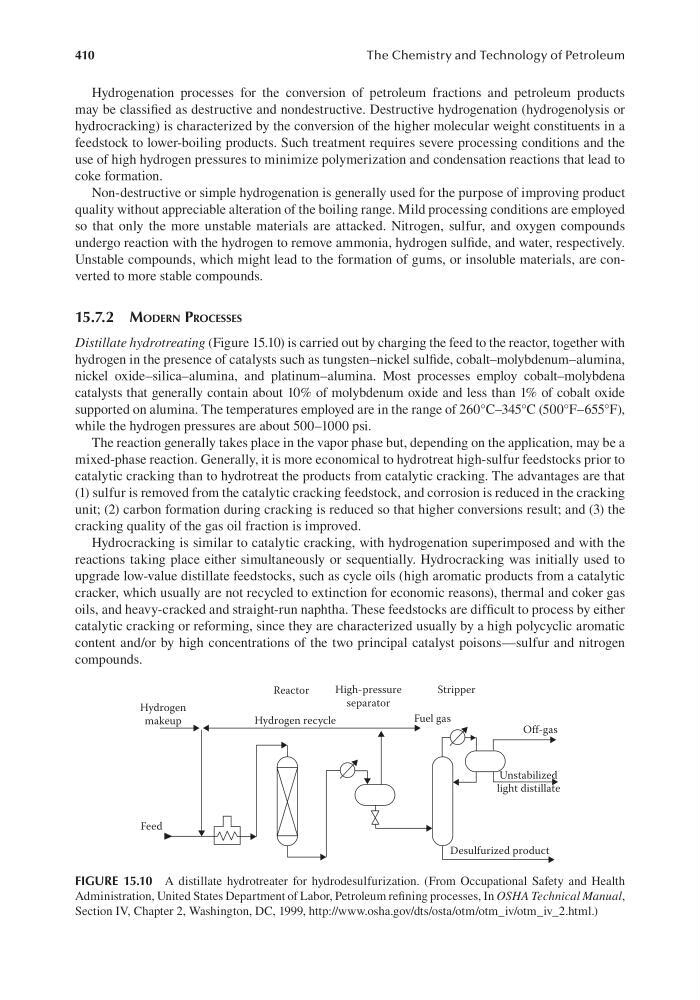
Distillate hydrotreating (Figure 15.10) is carried out by charging the feed to the reactor, together with
hydrogen in the presence of catalysts such as tungsten–nickel sulfide, cobalt–molybdenum–alumina,
nickel oxide–silica–alumina, and platinum–alumina. Most processes employ cobalt–molybdena
catalysts that generally contain about 10% of molybdenum oxide and less than 1% of cobalt oxide
supported on alumina. The temperatures employed are in the range of 260°C–345°C (500°F–655°F),
while the hydrogen pressures are about 500–1000 psi.
The reaction generally takes place in the vapor phase but, depending on the application, may be a
mixed-phase reaction. Generally, it is more economical to hydrotreat high-sulfur feedstocks prior to
catalytic cracking than to hydrotreat the products from catalytic cracking. The advantages are that
(1) sulfur is removed from the catalytic cracking feedstock, and corrosion is reduced in the cracking
unit; (2) carbon formation during cracking is reduced so that higher conversions result; and (3) the
cracking quality of the gas oil fraction is improved.
Hydrocracking is similar to catalytic cracking, with hydrogenation superimposed and with the
reactions taking place either simultaneously or sequentially. Hydrocracking was initially used to
upgrade low-value distillate feedstocks, such as cycle oils (high aromatic products from a catalytic
cracker, which usually are not recycled to extinction for economic reasons), thermal and coker gas
oils, and heavy-cracked and straight-run naphtha. These feedstocks are difficult to process by either
catalytic cracking or reforming, since they are characterized usually by a high polycyclic aromatic
content and/or by high concentrations of the two principal catalyst poisons—sulfur and nitrogen
compounds.
Hydrogen recycle
Hydrogen
makeup
Feed
Reactor
Fuel gas
Stripper
Unstabilized
light distillate
Off-gas
Desulfurized product
High-pressure
separator
FIGURE 15.10 A distillate hydrotreater for hydrodesulfurization. (From Occupational Safety and Health
Administration, United States Department of Labor, Petroleum refining processes, In OSHA Technical Manual,
Section IV, Chapter 2, Washington, DC, 1999, http://www.osha.gov/dts/osta/otm/otm_iv/otm_iv_2.html.)
The Chemistry and Technology of Petroleum
Hydrogenation processes for the conversion of petroleum fractions and petroleum products
may be classified as destructive and nondestructive. Destructive hydrogenation (hydrogenolysis or
hydrocracking) is characterized by the conversion of the higher molecular weight constituents in a
feedstock to lower-boiling products. Such treatment requires severe processing conditions and the
use of high hydrogen pressures to minimize polymerization and condensation reactions that lead to
coke formation.
Non-destructive or simple hydrogenation is generally used for the purpose of improving product
quality without appreciable alteration of the boiling range. Mild processing conditions are employed
so that only the more unstable materials are attacked. Nitrogen, sulfur, and oxygen compounds
undergo reaction with the hydrogen to remove ammonia, hydrogen sulfide, and water, respectively.
Unstable compounds, which might lead to the formation of gums, or insoluble materials, are converted to more stable compounds.
15.7.2 modern ProCesses
Distillate hydrotreating (Figure 15.10) is carried out by charging the feed to the reactor, together with
hydrogen in the presence of catalysts such as tungsten–nickel sulfide, cobalt–molybdenum–alumina,
nickel oxide–silica–alumina, and platinum–alumina. Most processes employ cobalt–molybdena
catalysts that generally contain about 10% of molybdenum oxide and less than 1% of cobalt oxide
supported on alumina. The temperatures employed are in the range of 260°C–345°C (500°F–655°F),
while the hydrogen pressures are about 500–1000 psi.
The reaction generally takes place in the vapor phase but, depending on the application, may be a
mixed-phase reaction. Generally, it is more economical to hydrotreat high-sulfur feedstocks prior to
catalytic cracking than to hydrotreat the products from catalytic cracking. The advantages are that
(1) sulfur is removed from the catalytic cracking feedstock, and corrosion is reduced in the cracking
unit; (2) carbon formation during cracking is reduced so that higher conversions result; and (3) the
cracking quality of the gas oil fraction is improved.
Hydrocracking is similar to catalytic cracking, with hydrogenation superimposed and with the
reactions taking place either simultaneously or sequentially. Hydrocracking was initially used to
upgrade low-value distillate feedstocks, such as cycle oils (high aromatic products from a catalytic
cracker, which usually are not recycled to extinction for economic reasons), thermal and coker gas
oils, and heavy-cracked and straight-run naphtha. These feedstocks are difficult to process by either
catalytic cracking or reforming, since they are characterized usually by a high polycyclic aromatic
content and/or by high concentrations of the two principal catalyst poisons—sulfur and nitrogen
compounds.
Hydrogen recycle
Hydrogen
makeup
Feed
Reactor
Fuel gas
Stripper
Unstabilized
light distillate
Off-gas
Desulfurized product
High-pressure
separator
FIGURE 15.10 A distillate hydrotreater for hydrodesulfurization. (From Occupational Safety and Health
Administration, United States Department of Labor, Petroleum refining processes, In OSHA Technical Manual,
Section IV, Chapter 2, Washington, DC, 1999, http://www.osha.gov/dts/osta/otm/otm_iv/otm_iv_2.html.)