

411
Introduction to Refining Processes
The older hydrogenolysis type of hydrocracking practiced in Europe during, and after, World
War II used tungsten or molybdenum sulfides as catalysts and required high reaction temperatures
and operating pressures, sometimes in excess of about 3000 psi (203 atm) for continuous operation.
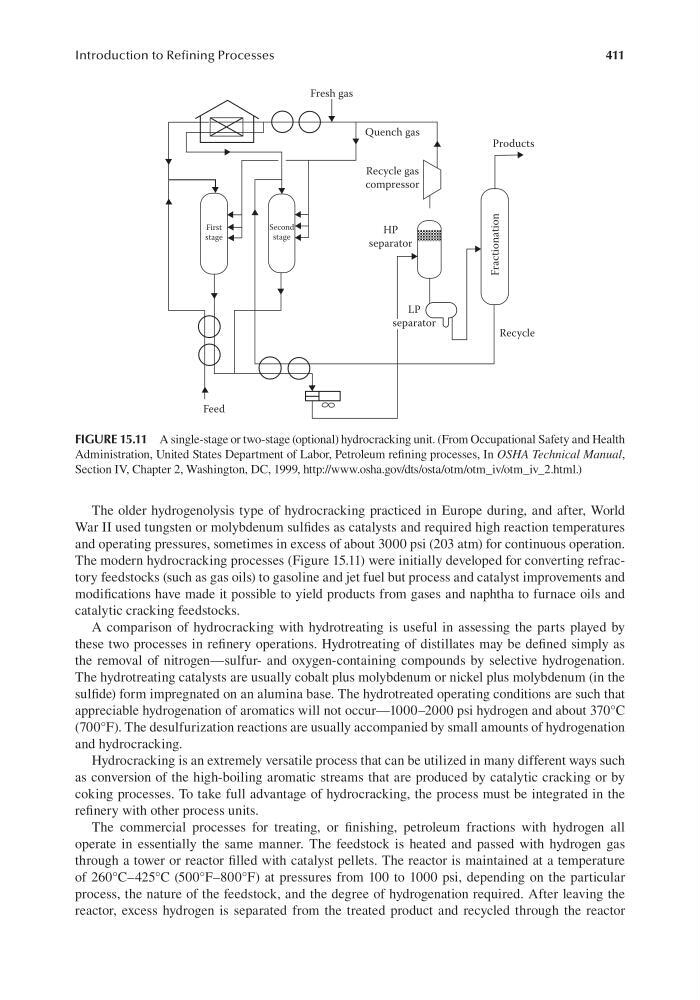
The modern hydrocracking processes (Figure 15.11) were initially developed for converting refractory feedstocks (such as gas oils) to gasoline and jet fuel but process and catalyst improvements and
modifications have made it possible to yield products from gases and naphtha to furnace oils and
catalytic cracking feedstocks.
A comparison of hydrocracking with hydrotreating is useful in assessing the parts played by
these two processes in refinery operations. Hydrotreating of distillates may be defined simply as
the removal of nitrogen—sulfur- and oxygen-containing compounds by selective hydrogenation.
The hydrotreating catalysts are usually cobalt plus molybdenum or nickel plus molybdenum (in the
sulfide) form impregnated on an alumina base. The hydrotreated operating conditions are such that
appreciable hydrogenation of aromatics will not occur—1000–2000 psi hydrogen and about 370°C
(700°F). The desulfurization reactions are usually accompanied by small amounts of hydrogenation
and hydrocracking.
Hydrocracking is an extremely versatile process that can be utilized in many different ways such
as conversion of the high-boiling aromatic streams that are produced by catalytic cracking or by
coking processes. To take full advantage of hydrocracking, the process must be integrated in the
refinery with other process units.
The commercial processes for treating, or finishing, petroleum fractions with hydrogen all
operate in essentially the same manner. The feedstock is heated and passed with hydrogen gas
through a tower or reactor filled with catalyst pellets. The reactor is maintained at a temperature
of 260°C–425°C (500°F–800°F) at pressures from 100 to 1000 psi, depending on the particular
process, the nature of the feedstock, and the degree of hydrogenation required. After leaving the
reactor, excess hydrogen is separated from the treated product and recycled through the reactor
Fresh gas
First
stage
Second
stage
Products
Recycle
Fractionation
Quench gas
Recycle gas
compressor
HP
separator
LP
separator
Feed
FIGURE 15.11 A single-stage or two-stage (optional) hydrocracking unit. (From Occupational Safety and Health
Administration, United States Department of Labor, Petroleum refining processes, In OSHA Technical Manual,
Section IV, Chapter 2, Washington, DC, 1999, http://www.osha.gov/dts/osta/otm/otm_iv/otm_iv_2.html.)
Introduction to Refining Processes
The older hydrogenolysis type of hydrocracking practiced in Europe during, and after, World
War II used tungsten or molybdenum sulfides as catalysts and required high reaction temperatures
and operating pressures, sometimes in excess of about 3000 psi (203 atm) for continuous operation.
The modern hydrocracking processes (Figure 15.11) were initially developed for converting refractory feedstocks (such as gas oils) to gasoline and jet fuel but process and catalyst improvements and
modifications have made it possible to yield products from gases and naphtha to furnace oils and
catalytic cracking feedstocks.
A comparison of hydrocracking with hydrotreating is useful in assessing the parts played by
these two processes in refinery operations. Hydrotreating of distillates may be defined simply as
the removal of nitrogen—sulfur- and oxygen-containing compounds by selective hydrogenation.
The hydrotreating catalysts are usually cobalt plus molybdenum or nickel plus molybdenum (in the
sulfide) form impregnated on an alumina base. The hydrotreated operating conditions are such that
appreciable hydrogenation of aromatics will not occur—1000–2000 psi hydrogen and about 370°C
(700°F). The desulfurization reactions are usually accompanied by small amounts of hydrogenation
and hydrocracking.
Hydrocracking is an extremely versatile process that can be utilized in many different ways such
as conversion of the high-boiling aromatic streams that are produced by catalytic cracking or by
coking processes. To take full advantage of hydrocracking, the process must be integrated in the
refinery with other process units.
The commercial processes for treating, or finishing, petroleum fractions with hydrogen all
operate in essentially the same manner. The feedstock is heated and passed with hydrogen gas
through a tower or reactor filled with catalyst pellets. The reactor is maintained at a temperature
of 260°C–425°C (500°F–800°F) at pressures from 100 to 1000 psi, depending on the particular
process, the nature of the feedstock, and the degree of hydrogenation required. After leaving the
reactor, excess hydrogen is separated from the treated product and recycled through the reactor
Fresh gas
First
stage
Second
stage
Products
Recycle
Fractionation
Quench gas
Recycle gas
compressor
HP
separator
LP
separator
Feed
FIGURE 15.11 A single-stage or two-stage (optional) hydrocracking unit. (From Occupational Safety and Health
Administration, United States Department of Labor, Petroleum refining processes, In OSHA Technical Manual,
Section IV, Chapter 2, Washington, DC, 1999, http://www.osha.gov/dts/osta/otm/otm_iv/otm_iv_2.html.)