

409
Introduction to Refining Processes
(which has a tendency to volatilize away on use), and thorium. Natural and synthetic catalysts can
be used as pellets or beads and also in the form of powder; in either case replacements are necessary because of attrition and gradual loss of efficiency. It is essential that they be stable to withstand
the physical impact of loading and thermal shocks and that they withstand the action of carbon
dioxide, air, nitrogen compounds, and steam. They also should be resistant to sulfur and nitrogen
compounds and synthetic catalysts, or certain selected clays, appear to be better in this regard than
average untreated natural catalysts.
The catalysts are porous and highly adsorptive, and their performance is affected markedly by
the method of preparation. Two chemically identical catalysts having pores of different size and
distribution may have different activity, selectivity, temperature coefficients of reaction rates, and
responses to poisons. The intrinsic chemistry and catalytic action of a surface may be independent
of pore size but, small pores produce different effects because of the manner in which hydrocarbon
vapors are transported into and out of the pore systems.
15.7 HYDROPROCESSES
15.7.1 HIstorICAl develoPment
The use of hydrogen in thermal processes is perhaps the single most significant advance in refining
technology during the twentieth century. The process uses the principle that the presence of hydrogen during a thermal reaction of a petroleum feedstock will terminate many of the coke-forming
reactions and enhance the yields of the lower-boiling components such as gasoline, kerosene, and
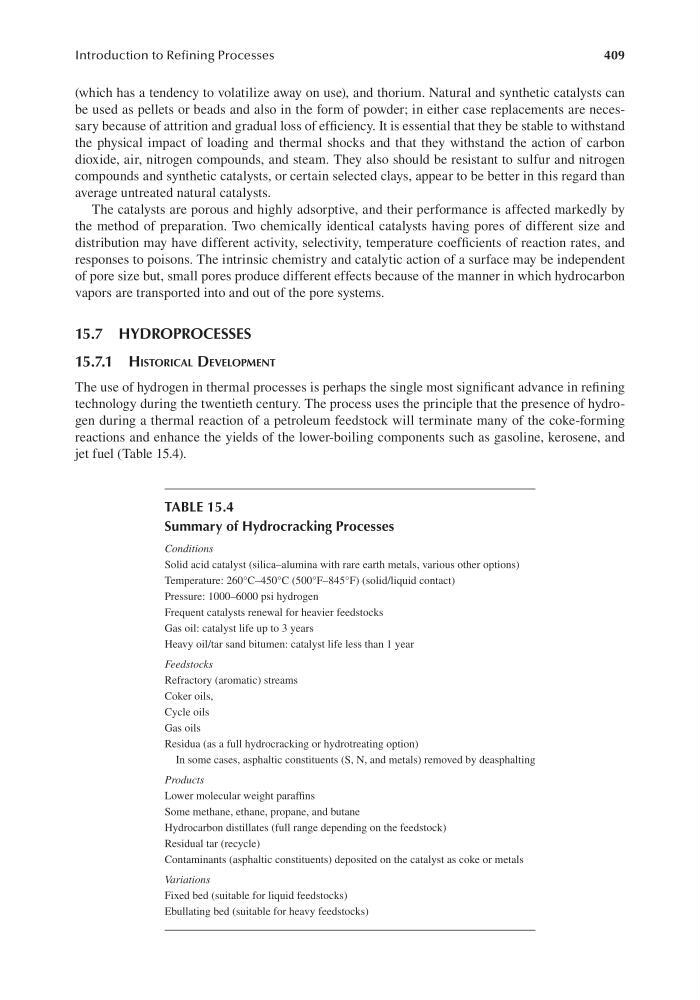
jet fuel (Table 15.4).
TABLE 15.4
Summary of Hydrocracking Processes
Conditions
Solid acid catalyst (silica–alumina with rare earth metals, various other options)
Temperature: 260°C–450°C (500°F–845°F) (solid/liquid contact)
Pressure: 1000–6000 psi hydrogen
Frequent catalysts renewal for heavier feedstocks
Gas oil: catalyst life up to 3 years
Heavy oil/tar sand bitumen: catalyst life less than 1 year
Feedstocks
Refractory (aromatic) streams
Coker oils,
Cycle oils
Gas oils
Residua (as a full hydrocracking or hydrotreating option)
In some cases, asphaltic constituents (S, N, and metals) removed by deasphalting
Products
Lower molecular weight paraffins
Some methane, ethane, propane, and butane
Hydrocarbon distillates (full range depending on the feedstock)
Residual tar (recycle)
Contaminants (asphaltic constituents) deposited on the catalyst as coke or metals
Variations
Fixed bed (suitable for liquid feedstocks)
Ebullating bed (suitable for heavy feedstocks)
Introduction to Refining Processes
(which has a tendency to volatilize away on use), and thorium. Natural and synthetic catalysts can
be used as pellets or beads and also in the form of powder; in either case replacements are necessary because of attrition and gradual loss of efficiency. It is essential that they be stable to withstand
the physical impact of loading and thermal shocks and that they withstand the action of carbon
dioxide, air, nitrogen compounds, and steam. They also should be resistant to sulfur and nitrogen
compounds and synthetic catalysts, or certain selected clays, appear to be better in this regard than
average untreated natural catalysts.
The catalysts are porous and highly adsorptive, and their performance is affected markedly by
the method of preparation. Two chemically identical catalysts having pores of different size and
distribution may have different activity, selectivity, temperature coefficients of reaction rates, and
responses to poisons. The intrinsic chemistry and catalytic action of a surface may be independent
of pore size but, small pores produce different effects because of the manner in which hydrocarbon
vapors are transported into and out of the pore systems.
15.7 HYDROPROCESSES
15.7.1 HIstorICAl develoPment
The use of hydrogen in thermal processes is perhaps the single most significant advance in refining
technology during the twentieth century. The process uses the principle that the presence of hydrogen during a thermal reaction of a petroleum feedstock will terminate many of the coke-forming
reactions and enhance the yields of the lower-boiling components such as gasoline, kerosene, and
jet fuel (Table 15.4).
TABLE 15.4
Summary of Hydrocracking Processes
Conditions
Solid acid catalyst (silica–alumina with rare earth metals, various other options)
Temperature: 260°C–450°C (500°F–845°F) (solid/liquid contact)
Pressure: 1000–6000 psi hydrogen
Frequent catalysts renewal for heavier feedstocks
Gas oil: catalyst life up to 3 years
Heavy oil/tar sand bitumen: catalyst life less than 1 year
Feedstocks
Refractory (aromatic) streams
Coker oils,
Cycle oils
Gas oils
Residua (as a full hydrocracking or hydrotreating option)
In some cases, asphaltic constituents (S, N, and metals) removed by deasphalting
Products
Lower molecular weight paraffins
Some methane, ethane, propane, and butane
Hydrocarbon distillates (full range depending on the feedstock)
Residual tar (recycle)
Contaminants (asphaltic constituents) deposited on the catalyst as coke or metals
Variations
Fixed bed (suitable for liquid feedstocks)
Ebullating bed (suitable for heavy feedstocks)