

408
The Chemistry and Technology of Petroleum
of coke from the catalyst by burning, and (3) insertion of the reactor on stream. The moving-bed
process uses a reaction vessel (in which cracking takes place) and a kiln (in which the spent catalyst
is regenerated) and catalyst movement between the vessels is provided by various means.
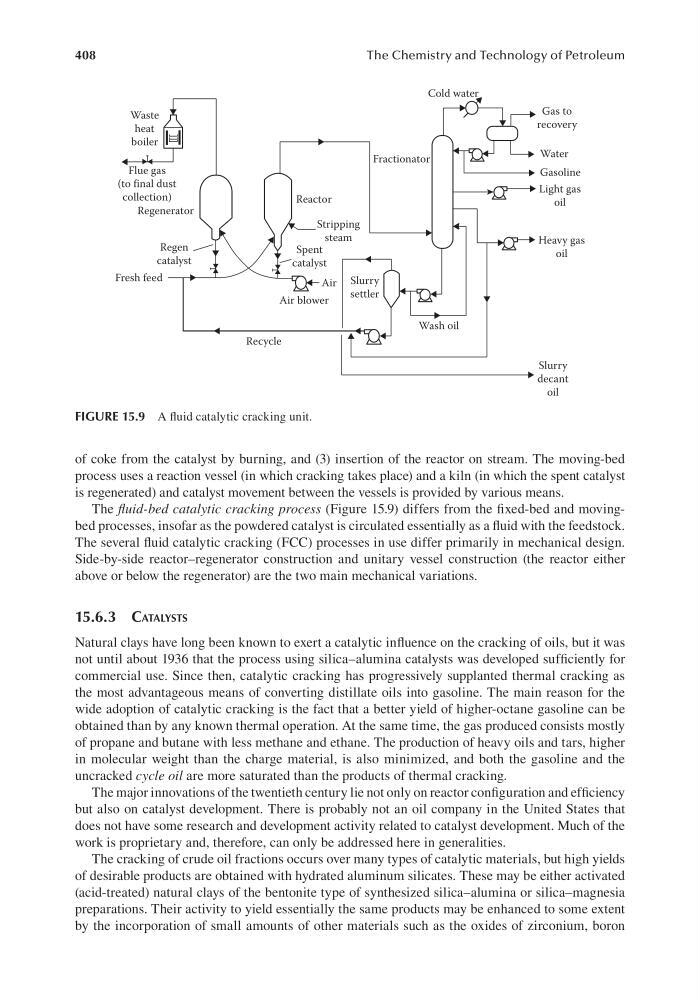
The fluid-bed catalytic cracking process (Figure 15.9) differs from the fixed-bed and movingbed processes, insofar as the powdered catalyst is circulated essentially as a fluid with the feedstock.
The several fluid catalytic cracking (FCC) processes in use differ primarily in mechanical design.
Side-by-side reactor–regenerator construction and unitary vessel construction (the reactor either
above or below the regenerator) are the two main mechanical variations.
15.6.3 CAtAlysts
Natural clays have long been known to exert a catalytic influence on the cracking of oils, but it was
not until about 1936 that the process using silica–alumina catalysts was developed sufficiently for
commercial use. Since then, catalytic cracking has progressively supplanted thermal cracking as
the most advantageous means of converting distillate oils into gasoline. The main reason for the
wide adoption of catalytic cracking is the fact that a better yield of higher-octane gasoline can be
obtained than by any known thermal operation. At the same time, the gas produced consists mostly
of propane and butane with less methane and ethane. The production of heavy oils and tars, higher
in molecular weight than the charge material, is also minimized, and both the gasoline and the
uncracked cycle oil are more saturated than the products of thermal cracking.
The major innovations of the twentieth century lie not only on reactor configuration and efficiency
but also on catalyst development. There is probably not an oil company in the United States that
does not have some research and development activity related to catalyst development. Much of the
work is proprietary and, therefore, can only be addressed here in generalities.
The cracking of crude oil fractions occurs over many types of catalytic materials, but high yields
of desirable products are obtained with hydrated aluminum silicates. These may be either activated
(acid-treated) natural clays of the bentonite type of synthesized silica–alumina or silica–magnesia
preparations. Their activity to yield essentially the same products may be enhanced to some extent
by the incorporation of small amounts of other materials such as the oxides of zirconium, boron
Cold water
Gas to
recovery
Water
Gasoline
Light gas
oil
Heavy gas
oil
Wash oil
Fractionator
Reactor
Stripping
steam
Spent
catalyst
Air blower
Slurry
settler
Regen
catalyst
Waste
heat
boiler
Flue gas
(to final dust
collection)
Regenerator
Fresh feed
Air
Recycle
Slurry
decant
oil
FIGURE 15.9 A fluid catalytic cracking unit.
The Chemistry and Technology of Petroleum
of coke from the catalyst by burning, and (3) insertion of the reactor on stream. The moving-bed
process uses a reaction vessel (in which cracking takes place) and a kiln (in which the spent catalyst
is regenerated) and catalyst movement between the vessels is provided by various means.
The fluid-bed catalytic cracking process (Figure 15.9) differs from the fixed-bed and movingbed processes, insofar as the powdered catalyst is circulated essentially as a fluid with the feedstock.
The several fluid catalytic cracking (FCC) processes in use differ primarily in mechanical design.
Side-by-side reactor–regenerator construction and unitary vessel construction (the reactor either
above or below the regenerator) are the two main mechanical variations.
15.6.3 CAtAlysts
Natural clays have long been known to exert a catalytic influence on the cracking of oils, but it was
not until about 1936 that the process using silica–alumina catalysts was developed sufficiently for
commercial use. Since then, catalytic cracking has progressively supplanted thermal cracking as
the most advantageous means of converting distillate oils into gasoline. The main reason for the
wide adoption of catalytic cracking is the fact that a better yield of higher-octane gasoline can be
obtained than by any known thermal operation. At the same time, the gas produced consists mostly
of propane and butane with less methane and ethane. The production of heavy oils and tars, higher
in molecular weight than the charge material, is also minimized, and both the gasoline and the
uncracked cycle oil are more saturated than the products of thermal cracking.
The major innovations of the twentieth century lie not only on reactor configuration and efficiency
but also on catalyst development. There is probably not an oil company in the United States that
does not have some research and development activity related to catalyst development. Much of the
work is proprietary and, therefore, can only be addressed here in generalities.
The cracking of crude oil fractions occurs over many types of catalytic materials, but high yields
of desirable products are obtained with hydrated aluminum silicates. These may be either activated
(acid-treated) natural clays of the bentonite type of synthesized silica–alumina or silica–magnesia
preparations. Their activity to yield essentially the same products may be enhanced to some extent
by the incorporation of small amounts of other materials such as the oxides of zirconium, boron
Cold water
Gas to
recovery
Water
Gasoline
Light gas
oil
Heavy gas
oil
Wash oil
Fractionator
Reactor
Stripping
steam
Spent
catalyst
Air blower
Slurry
settler
Regen
catalyst
Waste
heat
boiler
Flue gas
(to final dust
collection)
Regenerator
Fresh feed
Air
Recycle
Slurry
decant
oil
FIGURE 15.9 A fluid catalytic cracking unit.