

406
The Chemistry and Technology of Petroleum
15.6 CATALYTIC METHODS
15.6.1 HIstorICAl develoPment
There are many processes in a refinery that employ a catalyst to improve process efficiency
(Table 15.3). The original incentive arose from the need to increase gasoline supplies in the
1930s and 1940s. Since cracking could virtually double the volume of gasoline from a barrel of
crude oil, cracking was justifiable on this basis alone.
In the 1930s, thermal cracking units produced approximately 50% of the total gasoline. The
octane number of this gasoline was about 70 compared to 60 for straight-run (distilled) gasoline.
The thermal reforming and polymerization processes that were developed during the 1930s could
be expected to further increase the octane number of gasoline to some extent, but an additional
innovation was needed to increase the octane number of gasoline to enhance the development of
more powerful automobile engines.
In 1936, a new cracking process opened the way to higher-octane gasoline—this process was
catalytic cracking. This process is basically the same as thermal cracking but differs by the use of
a catalyst, which is not (in theory) consumed in the process, and directs the course of the cracking
reactions to produce more of the desired higher-octane hydrocarbon products.
Catalytic cracking has a number of advantages over thermal cracking—(a) the gasoline produced has a higher octane number and (b) the catalytically cracked gasoline consists largely of
iso-paraffins and aromatics, which have high octane numbers and greater chemical stability than
mono-olefins and di-olefins that are present in much greater quantities in thermally cracked gasoline. Substantial quantities of olefinic gases suitable for polymer gasoline manufacture and smaller
quantities of methane, ethane, and ethylene are produced by catalytic cracking. Sulfur compounds
are changed in such a way that the sulfur content of catalytically cracked gasoline is lower than in
thermally cracked gasoline. Catalytic cracking produces less heavy residual or tar and more of the
useful gas oils than does thermal cracking. The process has considerable flexibility, permitting the
Reactor products
to fractionator
Steam
generation
Cooling
Coke fines
Fines
removal
Coke gas to
sulfur removal
Gasifier
Air
Heater
Purge
coke
Reactor
Steam
Bitumen
Scrubber
Recycle
Steam
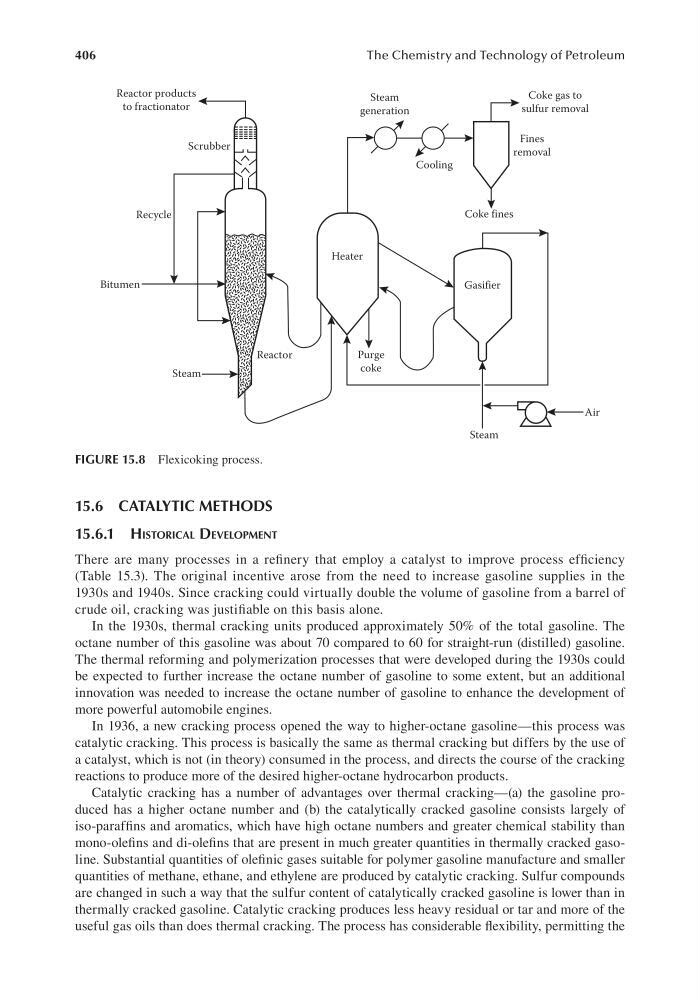
FIGURE 15.8 Flexicoking process.
The Chemistry and Technology of Petroleum
15.6 CATALYTIC METHODS
15.6.1 HIstorICAl develoPment
There are many processes in a refinery that employ a catalyst to improve process efficiency
(Table 15.3). The original incentive arose from the need to increase gasoline supplies in the
1930s and 1940s. Since cracking could virtually double the volume of gasoline from a barrel of
crude oil, cracking was justifiable on this basis alone.
In the 1930s, thermal cracking units produced approximately 50% of the total gasoline. The
octane number of this gasoline was about 70 compared to 60 for straight-run (distilled) gasoline.
The thermal reforming and polymerization processes that were developed during the 1930s could
be expected to further increase the octane number of gasoline to some extent, but an additional
innovation was needed to increase the octane number of gasoline to enhance the development of
more powerful automobile engines.
In 1936, a new cracking process opened the way to higher-octane gasoline—this process was
catalytic cracking. This process is basically the same as thermal cracking but differs by the use of
a catalyst, which is not (in theory) consumed in the process, and directs the course of the cracking
reactions to produce more of the desired higher-octane hydrocarbon products.
Catalytic cracking has a number of advantages over thermal cracking—(a) the gasoline produced has a higher octane number and (b) the catalytically cracked gasoline consists largely of
iso-paraffins and aromatics, which have high octane numbers and greater chemical stability than
mono-olefins and di-olefins that are present in much greater quantities in thermally cracked gasoline. Substantial quantities of olefinic gases suitable for polymer gasoline manufacture and smaller
quantities of methane, ethane, and ethylene are produced by catalytic cracking. Sulfur compounds
are changed in such a way that the sulfur content of catalytically cracked gasoline is lower than in
thermally cracked gasoline. Catalytic cracking produces less heavy residual or tar and more of the
useful gas oils than does thermal cracking. The process has considerable flexibility, permitting the
Reactor products
to fractionator
Steam
generation
Cooling
Coke fines
Fines
removal
Coke gas to
sulfur removal
Gasifier
Air
Heater
Purge
coke
Reactor
Steam
Bitumen
Scrubber
Recycle
Steam
FIGURE 15.8 Flexicoking process.