

405
Introduction to Refining Processes
continue. The cracked products leave as overheads, and coke deposits form on the inner surface of
the drum. To give continuous operation, two drums are used; while one is on stream, the other is
being cleaned. The temperature in the coke drum ranges from 415°C to 450°C (780°F–840°F), with
pressures from 15 to 90 psi.
Overhead products go to the fractionator, where naphtha and heating oil fractions are recovered.
The nonvolatile material is combined with preheated fresh feed and returned to the reactor. The
coke drum is usually on stream for about 24 h, before becoming filled with porous coke after which
the coke is removed hydraulically. Normally, 24 h is required to complete the cleaning operation
and to prepare the coke drum for subsequent use on stream.
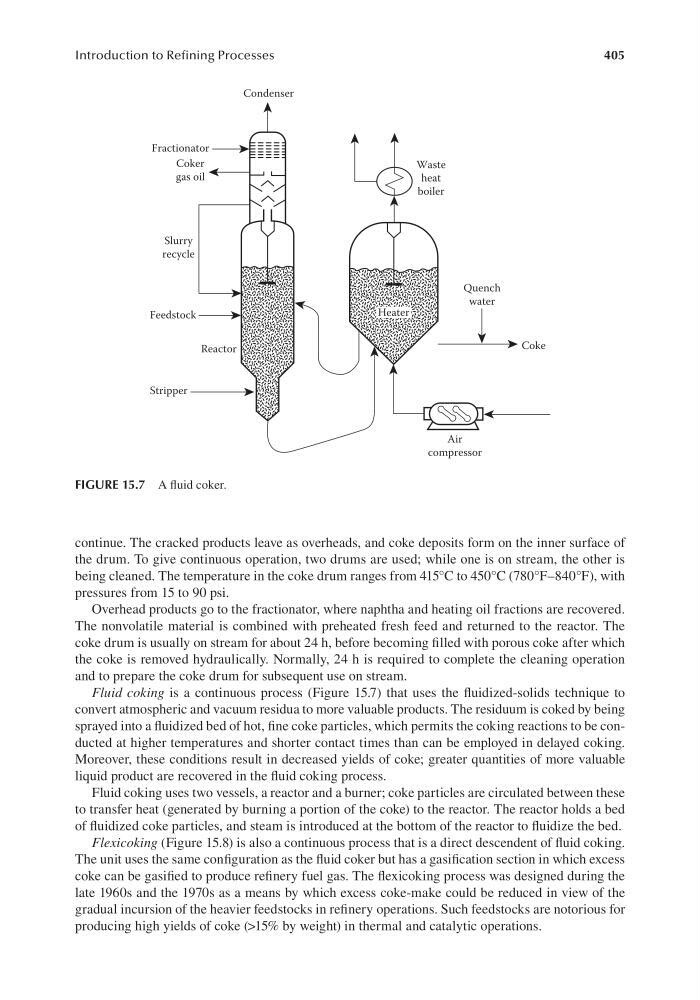
Fluid coking is a continuous process (Figure 15.7) that uses the fluidized-solids technique to
convert atmospheric and vacuum residua to more valuable products. The residuum is coked by being
sprayed into a fluidized bed of hot, fine coke particles, which permits the coking reactions to be conducted at higher temperatures and shorter contact times than can be employed in delayed coking.
Moreover, these conditions result in decreased yields of coke; greater quantities of more valuable
liquid product are recovered in the fluid coking process.
Fluid coking uses two vessels, a reactor and a burner; coke particles are circulated between these
to transfer heat (generated by burning a portion of the coke) to the reactor. The reactor holds a bed
of fluidized coke particles, and steam is introduced at the bottom of the reactor to fluidize the bed.
Flexicoking (Figure 15.8) is also a continuous process that is a direct descendent of fluid coking.
The unit uses the same configuration as the fluid coker but has a gasification section in which excess
coke can be gasified to produce refinery fuel gas. The flexicoking process was designed during the
late 1960s and the 1970s as a means by which excess coke-make could be reduced in view of the
gradual incursion of the heavier feedstocks in refinery operations. Such feedstocks are notorious for
producing high yields of coke (>15% by weight) in thermal and catalytic operations.
Air
compressor
Stripper
Reactor
Feedstock
Slurry
recycle
Fractionator
Coker
gas oil
Quench
water
Condenser
Waste
heat
boiler
Coke
Heater
FIGURE 15.7 A fluid coker.
Introduction to Refining Processes
continue. The cracked products leave as overheads, and coke deposits form on the inner surface of
the drum. To give continuous operation, two drums are used; while one is on stream, the other is
being cleaned. The temperature in the coke drum ranges from 415°C to 450°C (780°F–840°F), with
pressures from 15 to 90 psi.
Overhead products go to the fractionator, where naphtha and heating oil fractions are recovered.
The nonvolatile material is combined with preheated fresh feed and returned to the reactor. The
coke drum is usually on stream for about 24 h, before becoming filled with porous coke after which
the coke is removed hydraulically. Normally, 24 h is required to complete the cleaning operation
and to prepare the coke drum for subsequent use on stream.
Fluid coking is a continuous process (Figure 15.7) that uses the fluidized-solids technique to
convert atmospheric and vacuum residua to more valuable products. The residuum is coked by being
sprayed into a fluidized bed of hot, fine coke particles, which permits the coking reactions to be conducted at higher temperatures and shorter contact times than can be employed in delayed coking.
Moreover, these conditions result in decreased yields of coke; greater quantities of more valuable
liquid product are recovered in the fluid coking process.
Fluid coking uses two vessels, a reactor and a burner; coke particles are circulated between these
to transfer heat (generated by burning a portion of the coke) to the reactor. The reactor holds a bed
of fluidized coke particles, and steam is introduced at the bottom of the reactor to fluidize the bed.
Flexicoking (Figure 15.8) is also a continuous process that is a direct descendent of fluid coking.
The unit uses the same configuration as the fluid coker but has a gasification section in which excess
coke can be gasified to produce refinery fuel gas. The flexicoking process was designed during the
late 1960s and the 1970s as a means by which excess coke-make could be reduced in view of the
gradual incursion of the heavier feedstocks in refinery operations. Such feedstocks are notorious for
producing high yields of coke (>15% by weight) in thermal and catalytic operations.
Air
compressor
Stripper
Reactor
Feedstock
Slurry
recycle
Fractionator
Coker
gas oil
Quench
water
Condenser
Waste
heat
boiler
Coke
Heater
FIGURE 15.7 A fluid coker.