

381
Instability and Incompatibility
by a receiving tube of capacity 25 mL, graduated in 0.1 mL. A weighed amount, corresponding to
approximately 100 mL of oil, is placed in the flask with 25 mL of dry toluene. The flask is heated
gently until the 25 mL of toluene has distilled into the graduated tube. The water distilled with the
toluene separates to the bottom of the tube where the volume is recorded as milliliter, or the weight
as milligram, or per cent.
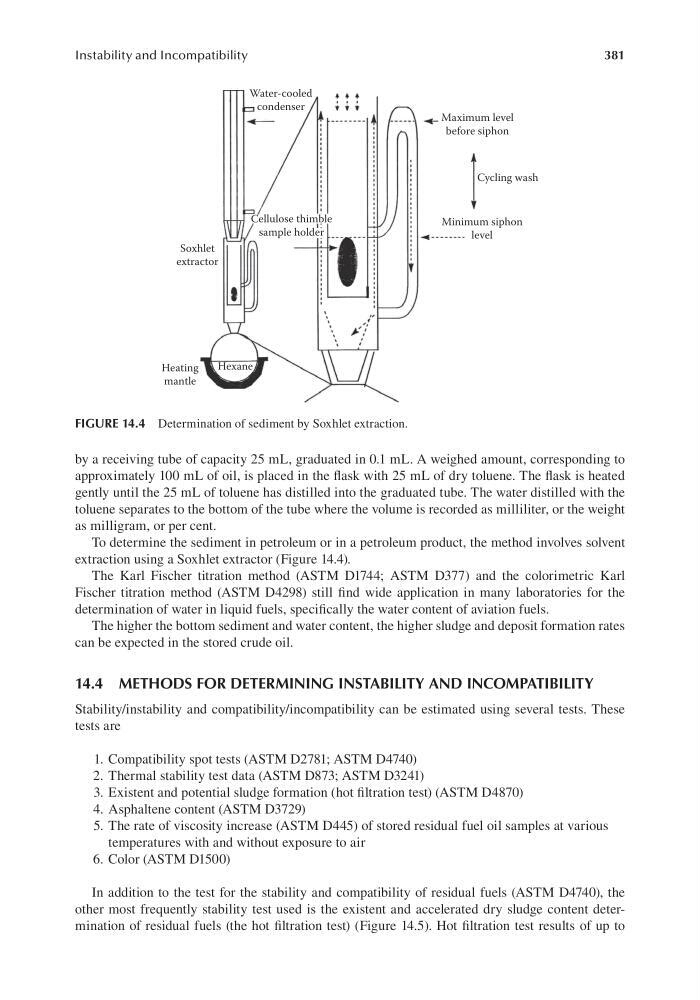
To determine the sediment in petroleum or in a petroleum product, the method involves solvent
extraction using a Soxhlet extractor (Figure 14.4).
The Karl Fischer titration method (ASTM D1744; ASTM D377) and the colorimetric Karl
Fischer titration method (ASTM D4298) still find wide application in many laboratories for the
determination of water in liquid fuels, specifically the water content of aviation fuels.
The higher the bottom sediment and water content, the higher sludge and deposit formation rates
can be expected in the stored crude oil.
14.4 METHODS FOR DETERMINING INSTABILITY AND INCOMPATIBILITY
Stability/instability and compatibility/incompatibility can be estimated using several tests. These
tests are
1. Compatibility spot tests (ASTM D2781; ASTM D4740)
2. Thermal stability test data (ASTM D873; ASTM D3241)
3. Existent and potential sludge formation (hot filtration test) (ASTM D4870)
4. Asphaltene content (ASTM D3729)
5. The rate of viscosity increase (ASTM D445) of stored residual fuel oil samples at various
temperatures with and without exposure to air
6. Color (ASTM D1500)
In addition to the test for the stability and compatibility of residual fuels (ASTM D4740), the
other most frequently stability test used is the existent and accelerated dry sludge content determination of residual fuels (the hot filtration test) (Figure 14.5). Hot filtration test results of up to
Maximum level
before siphon
Water-cooled
condenser
Minimum siphon
level
Soxhlet
extractor
Heating
mantle
Hexane
Cycling wash
Cellulose thimble
sample holder
FIGURE 14.4 Determination of sediment by Soxhlet extraction.
Instability and Incompatibility
by a receiving tube of capacity 25 mL, graduated in 0.1 mL. A weighed amount, corresponding to
approximately 100 mL of oil, is placed in the flask with 25 mL of dry toluene. The flask is heated
gently until the 25 mL of toluene has distilled into the graduated tube. The water distilled with the
toluene separates to the bottom of the tube where the volume is recorded as milliliter, or the weight
as milligram, or per cent.
To determine the sediment in petroleum or in a petroleum product, the method involves solvent
extraction using a Soxhlet extractor (Figure 14.4).
The Karl Fischer titration method (ASTM D1744; ASTM D377) and the colorimetric Karl
Fischer titration method (ASTM D4298) still find wide application in many laboratories for the
determination of water in liquid fuels, specifically the water content of aviation fuels.
The higher the bottom sediment and water content, the higher sludge and deposit formation rates
can be expected in the stored crude oil.
14.4 METHODS FOR DETERMINING INSTABILITY AND INCOMPATIBILITY
Stability/instability and compatibility/incompatibility can be estimated using several tests. These
tests are
1. Compatibility spot tests (ASTM D2781; ASTM D4740)
2. Thermal stability test data (ASTM D873; ASTM D3241)
3. Existent and potential sludge formation (hot filtration test) (ASTM D4870)
4. Asphaltene content (ASTM D3729)
5. The rate of viscosity increase (ASTM D445) of stored residual fuel oil samples at various
temperatures with and without exposure to air
6. Color (ASTM D1500)
In addition to the test for the stability and compatibility of residual fuels (ASTM D4740), the
other most frequently stability test used is the existent and accelerated dry sludge content determination of residual fuels (the hot filtration test) (Figure 14.5). Hot filtration test results of up to
Maximum level
before siphon
Water-cooled
condenser
Minimum siphon
level
Soxhlet
extractor
Heating
mantle
Hexane
Cycling wash
Cellulose thimble
sample holder
FIGURE 14.4 Determination of sediment by Soxhlet extraction.