

380
The Chemistry and Technology of Petroleum
which nickel and vanadium are the principal metals, are very influential in regard to feedstock
behavior in processing operations.
The metal (inorganic) constituents of petroleum or a liquid fuel arise from either the inorganic
constituents present in the crude oil originally or those picked up by the crude oil during storage.
The former are mostly metallic substances such as vanadium, nickel, sodium, iron and silica; the
latter may be contaminants such as sand, dust, and corrosion products.
Incompatibility, leading to deposition of the metals (in any form), on to the catalyst leads to catalyst deactivation, whether it is by physical blockage of the pores or destruction of reactive sites. In
the present context, the metals must first be removed if erroneously high carbon residue data are to
be avoided. Alternatively, they can be estimated as ash by complete burning of the coke after carbon
residue determination.
Metals content above 200 ppm are considered to be significant, but the variations are very large.
The higher the ash content, the higher is the tendency of the crude oil to form sludge or sediment.
14.3.9 WAter Content, sAlt Content, And Bottom sedIment And WAter
Water content (ASTM D4006; ASTM D4007; ASTM D4377; ASTM D4928), salt content (ASTM
D3230), and bottom sediment and water (BS&W) (ASTM D96; ASTM D1796; ASTM D4007) indicate the concentrations of aqueous contaminants, present in the crude either originally or picked up
by the crude during handling and storage. Water and salt content of crude oils produced at the field
can be very high and this water is usually separated at the field, usually by settling and draining,
surface-active agents electrical emulsion breakers (desalters) are sometimes employed. The water
and salt contents of crude oil supplied to the buyers are function of the production field. Water content below 0.5%, salt content up to 20 lb/1000 barrels, and bottom sediment and water up to 0.5%
are considered to be satisfactory.
Although the centrifuge methods are still employed (ASTM D96; ASTM D1796; ASTM D2709
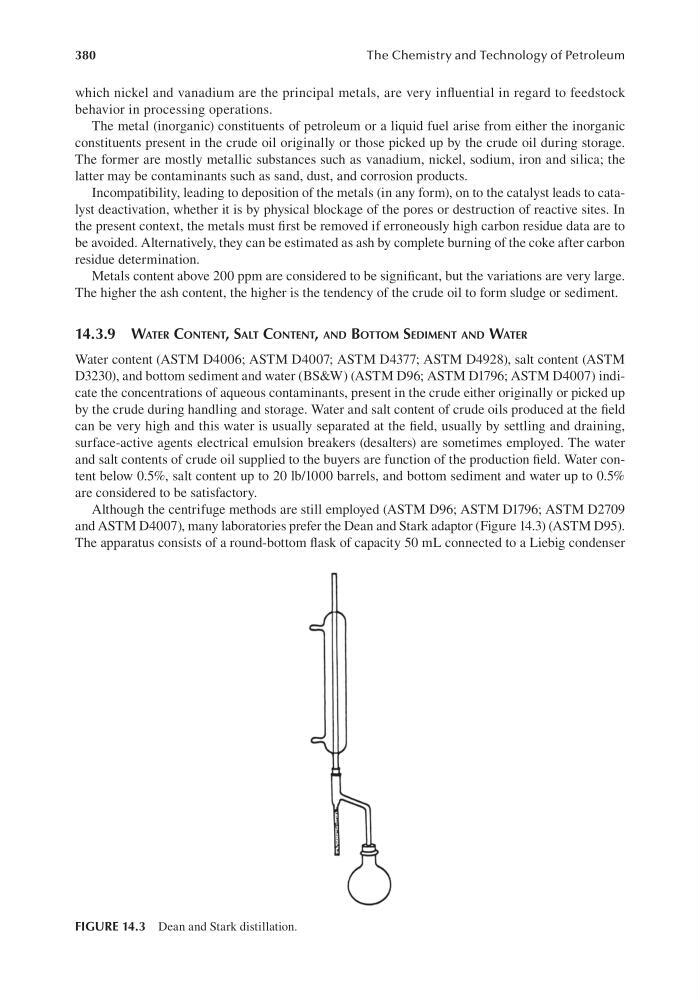
and ASTM D4007), many laboratories prefer the Dean and Stark adaptor (Figure 14.3) (ASTM D95).
The apparatus consists of a round-bottom flask of capacity 50 mL connected to a Liebig condenser
FIGURE 14.3 Dean and Stark distillation.
The Chemistry and Technology of Petroleum
which nickel and vanadium are the principal metals, are very influential in regard to feedstock
behavior in processing operations.
The metal (inorganic) constituents of petroleum or a liquid fuel arise from either the inorganic
constituents present in the crude oil originally or those picked up by the crude oil during storage.
The former are mostly metallic substances such as vanadium, nickel, sodium, iron and silica; the
latter may be contaminants such as sand, dust, and corrosion products.
Incompatibility, leading to deposition of the metals (in any form), on to the catalyst leads to catalyst deactivation, whether it is by physical blockage of the pores or destruction of reactive sites. In
the present context, the metals must first be removed if erroneously high carbon residue data are to
be avoided. Alternatively, they can be estimated as ash by complete burning of the coke after carbon
residue determination.
Metals content above 200 ppm are considered to be significant, but the variations are very large.
The higher the ash content, the higher is the tendency of the crude oil to form sludge or sediment.
14.3.9 WAter Content, sAlt Content, And Bottom sedIment And WAter
Water content (ASTM D4006; ASTM D4007; ASTM D4377; ASTM D4928), salt content (ASTM
D3230), and bottom sediment and water (BS&W) (ASTM D96; ASTM D1796; ASTM D4007) indicate the concentrations of aqueous contaminants, present in the crude either originally or picked up
by the crude during handling and storage. Water and salt content of crude oils produced at the field
can be very high and this water is usually separated at the field, usually by settling and draining,
surface-active agents electrical emulsion breakers (desalters) are sometimes employed. The water
and salt contents of crude oil supplied to the buyers are function of the production field. Water content below 0.5%, salt content up to 20 lb/1000 barrels, and bottom sediment and water up to 0.5%
are considered to be satisfactory.
Although the centrifuge methods are still employed (ASTM D96; ASTM D1796; ASTM D2709
and ASTM D4007), many laboratories prefer the Dean and Stark adaptor (Figure 14.3) (ASTM D95).
The apparatus consists of a round-bottom flask of capacity 50 mL connected to a Liebig condenser
FIGURE 14.3 Dean and Stark distillation.