

248
The Chemistry and Technology of Petroleum
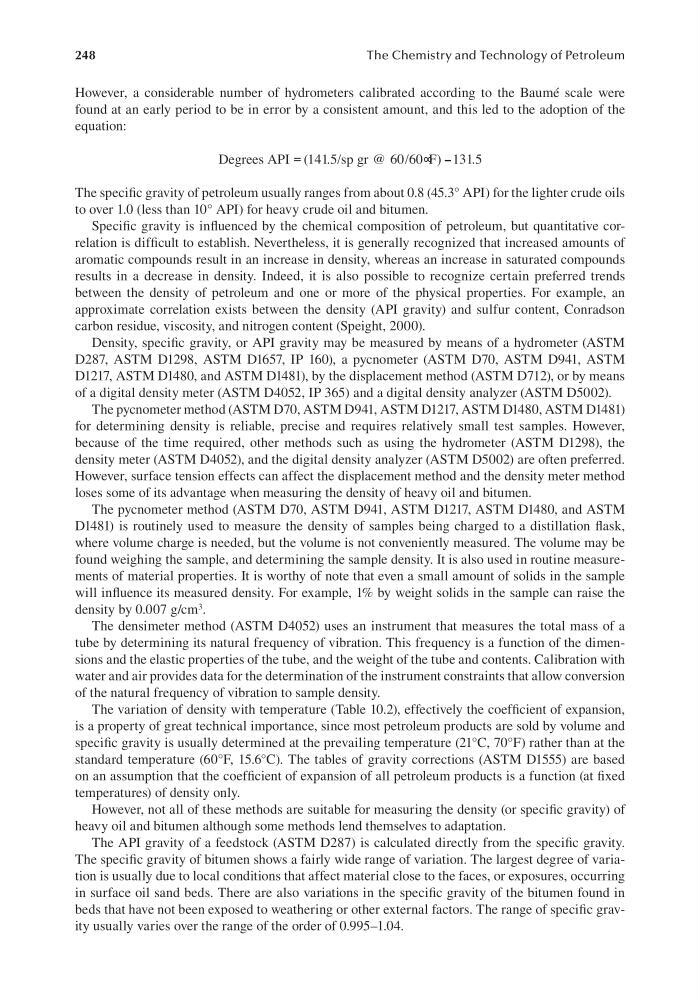
However, a considerable number of hydrometers calibrated according to the Baumé scale were
found at an early period to be in error by a consistent amount, and this led to the adoption of the
equation:
Degrees API 141 5/sp gr
6 /6 F 131 5
=
∞( .
@
)
.
0 0
The specific gravity of petroleum usually ranges from about 0.8 (45.3° API) for the lighter crude oils
to over 1.0 (less than 10° API) for heavy crude oil and bitumen.
Specific gravity is influenced by the chemical composition of petroleum, but quantitative correlation is difficult to establish. Nevertheless, it is generally recognized that increased amounts of
aromatic compounds result in an increase in density, whereas an increase in saturated compounds
results in a decrease in density. Indeed, it is also possible to recognize certain preferred trends
between the density of petroleum and one or more of the physical properties. For example, an
approximate correlation exists between the density (API gravity) and sulfur content, Conradson
carbon residue, viscosity, and nitrogen content (Speight, 2000).
Density, specific gravity, or API gravity may be measured by means of a hydrometer (ASTM
D287, ASTM D1298, ASTM D1657, IP 160), a pycnometer (ASTM D70, ASTM D941, ASTM
D1217, ASTM D1480, and ASTM D1481), by the displacement method (ASTM D712), or by means
of a digital density meter (ASTM D4052, IP 365) and a digital density analyzer (ASTM D5002).
The pycnometer method (ASTM D70, ASTM D941, ASTM D1217, ASTM D1480, ASTM D1481)
for determining density is reliable, precise and requires relatively small test samples. However,
because of the time required, other methods such as using the hydrometer (ASTM D1298), the
density meter (ASTM D4052), and the digital density analyzer (ASTM D5002) are often preferred.
However, surface tension effects can affect the displacement method and the density meter method
loses some of its advantage when measuring the density of heavy oil and bitumen.
The pycnometer method (ASTM D70, ASTM D941, ASTM D1217, ASTM D1480, and ASTM
D1481) is routinely used to measure the density of samples being charged to a distillation flask,
where volume charge is needed, but the volume is not conveniently measured. The volume may be
found weighing the sample, and determining the sample density. It is also used in routine measurements of material properties. It is worthy of note that even a small amount of solids in the sample
will influence its measured density. For example, 1% by weight solids in the sample can raise the
density by 0.007 g/cm 3 .
The densimeter method (ASTM D4052) uses an instrument that measures the total mass of a
tube by determining its natural frequency of vibration. This frequency is a function of the dimensions and the elastic properties of the tube, and the weight of the tube and contents. Calibration with
water and air provides data for the determination of the instrument constraints that allow conversion
of the natural frequency of vibration to sample density.
The variation of density with temperature (Table 10.2), effectively the coefficient of expansion,
is a property of great technical importance, since most petroleum products are sold by volume and
specific gravity is usually determined at the prevailing temperature (21°C, 70°F) rather than at the
standard temperature (60°F, 15.6°C). The tables of gravity corrections (ASTM D1555) are based
on an assumption that the coefficient of expansion of all petroleum products is a function (at fixed
temperatures) of density only.
However, not all of these methods are suitable for measuring the density (or specific gravity) of
heavy oil and bitumen although some methods lend themselves to adaptation.
The API gravity of a feedstock (ASTM D287) is calculated directly from the specific gravity.
The specific gravity of bitumen shows a fairly wide range of variation. The largest degree of variation is usually due to local conditions that affect material close to the faces, or exposures, occurring
in surface oil sand beds. There are also variations in the specific gravity of the bitumen found in
beds that have not been exposed to weathering or other external factors. The range of specific gravity usually varies over the range of the order of 0.995–1.04.
The Chemistry and Technology of Petroleum
However, a considerable number of hydrometers calibrated according to the Baumé scale were
found at an early period to be in error by a consistent amount, and this led to the adoption of the
equation:
Degrees API 141 5/sp gr
6 /6 F 131 5
=
∞( .
@
)
.
0 0
The specific gravity of petroleum usually ranges from about 0.8 (45.3° API) for the lighter crude oils
to over 1.0 (less than 10° API) for heavy crude oil and bitumen.
Specific gravity is influenced by the chemical composition of petroleum, but quantitative correlation is difficult to establish. Nevertheless, it is generally recognized that increased amounts of
aromatic compounds result in an increase in density, whereas an increase in saturated compounds
results in a decrease in density. Indeed, it is also possible to recognize certain preferred trends
between the density of petroleum and one or more of the physical properties. For example, an
approximate correlation exists between the density (API gravity) and sulfur content, Conradson
carbon residue, viscosity, and nitrogen content (Speight, 2000).
Density, specific gravity, or API gravity may be measured by means of a hydrometer (ASTM
D287, ASTM D1298, ASTM D1657, IP 160), a pycnometer (ASTM D70, ASTM D941, ASTM
D1217, ASTM D1480, and ASTM D1481), by the displacement method (ASTM D712), or by means
of a digital density meter (ASTM D4052, IP 365) and a digital density analyzer (ASTM D5002).
The pycnometer method (ASTM D70, ASTM D941, ASTM D1217, ASTM D1480, ASTM D1481)
for determining density is reliable, precise and requires relatively small test samples. However,
because of the time required, other methods such as using the hydrometer (ASTM D1298), the
density meter (ASTM D4052), and the digital density analyzer (ASTM D5002) are often preferred.
However, surface tension effects can affect the displacement method and the density meter method
loses some of its advantage when measuring the density of heavy oil and bitumen.
The pycnometer method (ASTM D70, ASTM D941, ASTM D1217, ASTM D1480, and ASTM
D1481) is routinely used to measure the density of samples being charged to a distillation flask,
where volume charge is needed, but the volume is not conveniently measured. The volume may be
found weighing the sample, and determining the sample density. It is also used in routine measurements of material properties. It is worthy of note that even a small amount of solids in the sample
will influence its measured density. For example, 1% by weight solids in the sample can raise the
density by 0.007 g/cm 3 .
The densimeter method (ASTM D4052) uses an instrument that measures the total mass of a
tube by determining its natural frequency of vibration. This frequency is a function of the dimensions and the elastic properties of the tube, and the weight of the tube and contents. Calibration with
water and air provides data for the determination of the instrument constraints that allow conversion
of the natural frequency of vibration to sample density.
The variation of density with temperature (Table 10.2), effectively the coefficient of expansion,
is a property of great technical importance, since most petroleum products are sold by volume and
specific gravity is usually determined at the prevailing temperature (21°C, 70°F) rather than at the
standard temperature (60°F, 15.6°C). The tables of gravity corrections (ASTM D1555) are based
on an assumption that the coefficient of expansion of all petroleum products is a function (at fixed
temperatures) of density only.
However, not all of these methods are suitable for measuring the density (or specific gravity) of
heavy oil and bitumen although some methods lend themselves to adaptation.
The API gravity of a feedstock (ASTM D287) is calculated directly from the specific gravity.
The specific gravity of bitumen shows a fairly wide range of variation. The largest degree of variation is usually due to local conditions that affect material close to the faces, or exposures, occurring
in surface oil sand beds. There are also variations in the specific gravity of the bitumen found in
beds that have not been exposed to weathering or other external factors. The range of specific gravity usually varies over the range of the order of 0.995–1.04.