

249
Petroleum Analysis
A very important property of the Athabasca bitumen (which also accounts for the success of the
hot water separation process) is the variation in density (specific gravity) of the bitumen with temperature. Over the temperature range 30°C–130°C (85°F–265°F) the bitumen is lighter than water.
Flotation of the bitumen (with aeration) on the water is facilitated, hence the logic of the hot water
separation process (Chapter 7) (Speight, 2005, 2009).
10.3.3 vIsCosIty
Viscosity is the force in dynes required to move a plane of 1 cm 2 area at a distance of 1 cm from
another plane of 1 cm 2 area through a distance of 1 cm in 1 s. In the cgs system the unit of viscosity is the poise or centipoise (0.01 P). Two other terms in common use are kinematic viscosity
and fluidity. The kinematic viscosity is the viscosity in centipoises divided by the specific gravity,
and the unit is the stoke (cm 2 /s), although centistokes (0.01 cSt) is in more common usage; fluidity is simply the reciprocal of viscosity. The viscosity (ASTM D445, ASTM D88, ASTM D2161,
ASTM D341, and ASTM D2270) of crude oils varies markedly over a very wide range. Values
vary from less than 10 cP at room temperature to many thousands of centipoises at the same
temperature.
In the early days of the petroleum industry viscosity was regarded as the body of petroleum,
a significant number for lubricants or for any liquid pumped or handled in quantity. The changes
in viscosity with temperature, pressure, and rate of shear are pertinent not only in lubrication but
also for such engineering concepts as heat transfer. The viscosity and relative viscosity of different phases, such as gas, liquid oil, and water, are determining influences in producing the flow of
reservoir fluids through porous oil-bearing formations. The rate and amount of oil production from
a reservoir are often governed by these properties.
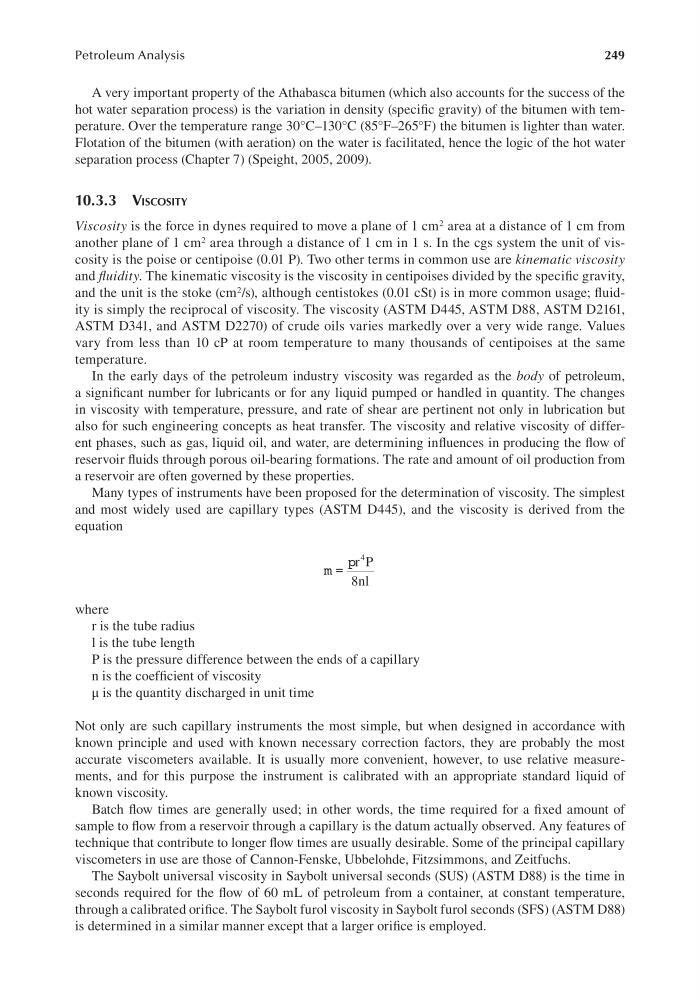
Many types of instruments have been proposed for the determination of viscosity. The simplest
and most widely used are capillary types (ASTM D445), and the viscosity is derived from the
equation
m
p
=
r P
8nl
4
where
r is the tube radius
l is the tube length
P is the pressure difference between the ends of a capillary
n is the coefficient of viscosity
μ is the quantity discharged in unit time
Not only are such capillary instruments the most simple, but when designed in accordance with
known principle and used with known necessary correction factors, they are probably the most
accurate viscometers available. It is usually more convenient, however, to use relative measurements, and for this purpose the instrument is calibrated with an appropriate standard liquid of
known viscosity.
Batch flow times are generally used; in other words, the time required for a fixed amount of
sample to flow from a reservoir through a capillary is the datum actually observed. Any features of
technique that contribute to longer flow times are usually desirable. Some of the principal capillary
viscometers in use are those of Cannon-Fenske, Ubbelohde, Fitzsimmons, and Zeitfuchs.
The Saybolt universal viscosity in Saybolt universal seconds (SUS) (ASTM D88) is the time in
seconds required for the flow of 60 mL of petroleum from a container, at constant temperature,
through a calibrated orifice. The Saybolt furol viscosity in Saybolt furol seconds (SFS) (ASTM D88)
is determined in a similar manner except that a larger orifice is employed.
Petroleum Analysis
A very important property of the Athabasca bitumen (which also accounts for the success of the
hot water separation process) is the variation in density (specific gravity) of the bitumen with temperature. Over the temperature range 30°C–130°C (85°F–265°F) the bitumen is lighter than water.
Flotation of the bitumen (with aeration) on the water is facilitated, hence the logic of the hot water
separation process (Chapter 7) (Speight, 2005, 2009).
10.3.3 vIsCosIty
Viscosity is the force in dynes required to move a plane of 1 cm 2 area at a distance of 1 cm from
another plane of 1 cm 2 area through a distance of 1 cm in 1 s. In the cgs system the unit of viscosity is the poise or centipoise (0.01 P). Two other terms in common use are kinematic viscosity
and fluidity. The kinematic viscosity is the viscosity in centipoises divided by the specific gravity,
and the unit is the stoke (cm 2 /s), although centistokes (0.01 cSt) is in more common usage; fluidity is simply the reciprocal of viscosity. The viscosity (ASTM D445, ASTM D88, ASTM D2161,
ASTM D341, and ASTM D2270) of crude oils varies markedly over a very wide range. Values
vary from less than 10 cP at room temperature to many thousands of centipoises at the same
temperature.
In the early days of the petroleum industry viscosity was regarded as the body of petroleum,
a significant number for lubricants or for any liquid pumped or handled in quantity. The changes
in viscosity with temperature, pressure, and rate of shear are pertinent not only in lubrication but
also for such engineering concepts as heat transfer. The viscosity and relative viscosity of different phases, such as gas, liquid oil, and water, are determining influences in producing the flow of
reservoir fluids through porous oil-bearing formations. The rate and amount of oil production from
a reservoir are often governed by these properties.
Many types of instruments have been proposed for the determination of viscosity. The simplest
and most widely used are capillary types (ASTM D445), and the viscosity is derived from the
equation
m
p
=
r P
8nl
4
where
r is the tube radius
l is the tube length
P is the pressure difference between the ends of a capillary
n is the coefficient of viscosity
μ is the quantity discharged in unit time
Not only are such capillary instruments the most simple, but when designed in accordance with
known principle and used with known necessary correction factors, they are probably the most
accurate viscometers available. It is usually more convenient, however, to use relative measurements, and for this purpose the instrument is calibrated with an appropriate standard liquid of
known viscosity.
Batch flow times are generally used; in other words, the time required for a fixed amount of
sample to flow from a reservoir through a capillary is the datum actually observed. Any features of
technique that contribute to longer flow times are usually desirable. Some of the principal capillary
viscometers in use are those of Cannon-Fenske, Ubbelohde, Fitzsimmons, and Zeitfuchs.
The Saybolt universal viscosity in Saybolt universal seconds (SUS) (ASTM D88) is the time in
seconds required for the flow of 60 mL of petroleum from a container, at constant temperature,
through a calibrated orifice. The Saybolt furol viscosity in Saybolt furol seconds (SFS) (ASTM D88)
is determined in a similar manner except that a larger orifice is employed.