

247
Petroleum Analysis
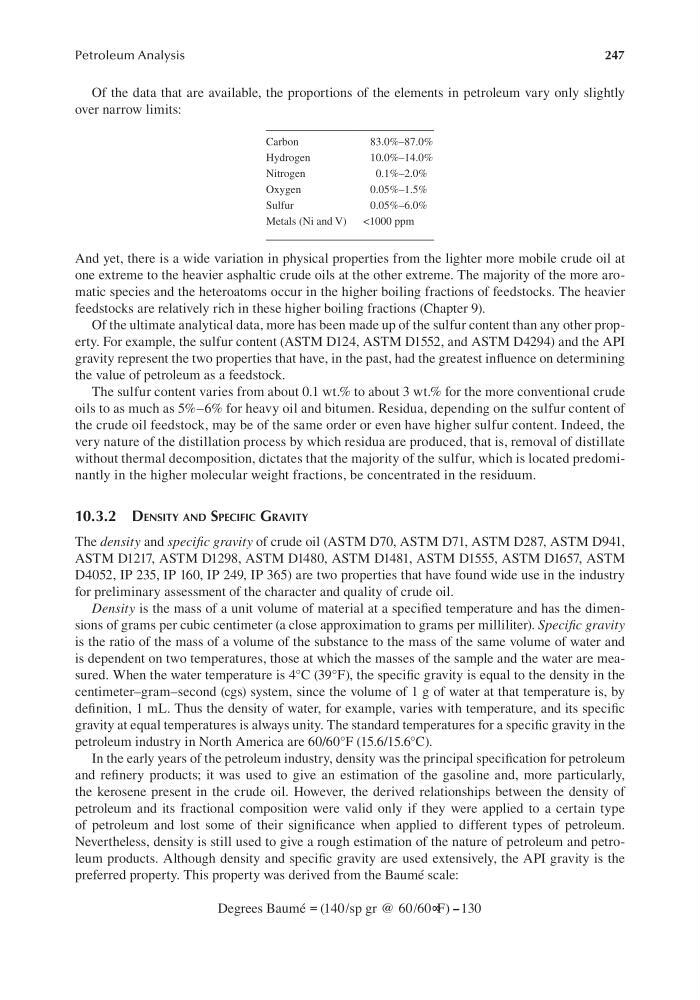
Of the data that are available, the proportions of the elements in petroleum vary only slightly
over narrow limits:
Carbon
83.0%–87.0%
Hydrogen
10.0%–14.0%
Nitrogen
0.1%–2.0%
Oxygen
0.05%–1.5%
Sulfur
0.05%–6.0%
Metals (Ni and V) <1000 ppm
And yet, there is a wide variation in physical properties from the lighter more mobile crude oil at
one extreme to the heavier asphaltic crude oils at the other extreme. The majority of the more aromatic species and the heteroatoms occur in the higher boiling fractions of feedstocks. The heavier
feedstocks are relatively rich in these higher boiling fractions (Chapter 9).
Of the ultimate analytical data, more has been made up of the sulfur content than any other property. For example, the sulfur content (ASTM D124, ASTM D1552, and ASTM D4294) and the API
gravity represent the two properties that have, in the past, had the greatest influence on determining
the value of petroleum as a feedstock.
The sulfur content varies from about 0.1 wt.% to about 3 wt.% for the more conventional crude
oils to as much as 5%–6% for heavy oil and bitumen. Residua, depending on the sulfur content of
the crude oil feedstock, may be of the same order or even have higher sulfur content. Indeed, the
very nature of the distillation process by which residua are produced, that is, removal of distillate
without thermal decomposition, dictates that the majority of the sulfur, which is located predominantly in the higher molecular weight fractions, be concentrated in the residuum.
10.3.2 densIty And sPeCIFIC grAvIty
The density and specific gravity of crude oil (ASTM D70, ASTM D71, ASTM D287, ASTM D941,
ASTM D1217, ASTM D1298, ASTM D1480, ASTM D1481, ASTM D1555, ASTM D1657, ASTM
D4052, IP 235, IP 160, IP 249, IP 365) are two properties that have found wide use in the industry
for preliminary assessment of the character and quality of crude oil.
Density is the mass of a unit volume of material at a specified temperature and has the dimensions of grams per cubic centimeter (a close approximation to grams per milliliter). Specific gravity
is the ratio of the mass of a volume of the substance to the mass of the same volume of water and
is dependent on two temperatures, those at which the masses of the sample and the water are measured. When the water temperature is 4°C (39°F), the specific gravity is equal to the density in the
centimeter–gram–second (cgs) system, since the volume of 1 g of water at that temperature is, by
definition, 1 mL. Thus the density of water, for example, varies with temperature, and its specific
gravity at equal temperatures is always unity. The standard temperatures for a specific gravity in the
petroleum industry in North America are 60/60°F (15.6/15.6°C).
In the early years of the petroleum industry, density was the principal specification for petroleum
and refinery products; it was used to give an estimation of the gasoline and, more particularly,
the kerosene present in the crude oil. However, the derived relationships between the density of
petroleum and its fractional composition were valid only if they were applied to a certain type
of petroleum and lost some of their significance when applied to different types of petroleum.
Nevertheless, density is still used to give a rough estimation of the nature of petroleum and petroleum products. Although density and specific gravity are used extensively, the API gravity is the
preferred property. This property was derived from the Baumé scale:
Degrees Baum
14 /sp gr
6 /6 F 13
é =
∞(
@
)
0
0 0
0
Petroleum Analysis
Of the data that are available, the proportions of the elements in petroleum vary only slightly
over narrow limits:
Carbon
83.0%–87.0%
Hydrogen
10.0%–14.0%
Nitrogen
0.1%–2.0%
Oxygen
0.05%–1.5%
Sulfur
0.05%–6.0%
Metals (Ni and V) <1000 ppm
And yet, there is a wide variation in physical properties from the lighter more mobile crude oil at
one extreme to the heavier asphaltic crude oils at the other extreme. The majority of the more aromatic species and the heteroatoms occur in the higher boiling fractions of feedstocks. The heavier
feedstocks are relatively rich in these higher boiling fractions (Chapter 9).
Of the ultimate analytical data, more has been made up of the sulfur content than any other property. For example, the sulfur content (ASTM D124, ASTM D1552, and ASTM D4294) and the API
gravity represent the two properties that have, in the past, had the greatest influence on determining
the value of petroleum as a feedstock.
The sulfur content varies from about 0.1 wt.% to about 3 wt.% for the more conventional crude
oils to as much as 5%–6% for heavy oil and bitumen. Residua, depending on the sulfur content of
the crude oil feedstock, may be of the same order or even have higher sulfur content. Indeed, the
very nature of the distillation process by which residua are produced, that is, removal of distillate
without thermal decomposition, dictates that the majority of the sulfur, which is located predominantly in the higher molecular weight fractions, be concentrated in the residuum.
10.3.2 densIty And sPeCIFIC grAvIty
The density and specific gravity of crude oil (ASTM D70, ASTM D71, ASTM D287, ASTM D941,
ASTM D1217, ASTM D1298, ASTM D1480, ASTM D1481, ASTM D1555, ASTM D1657, ASTM
D4052, IP 235, IP 160, IP 249, IP 365) are two properties that have found wide use in the industry
for preliminary assessment of the character and quality of crude oil.
Density is the mass of a unit volume of material at a specified temperature and has the dimensions of grams per cubic centimeter (a close approximation to grams per milliliter). Specific gravity
is the ratio of the mass of a volume of the substance to the mass of the same volume of water and
is dependent on two temperatures, those at which the masses of the sample and the water are measured. When the water temperature is 4°C (39°F), the specific gravity is equal to the density in the
centimeter–gram–second (cgs) system, since the volume of 1 g of water at that temperature is, by
definition, 1 mL. Thus the density of water, for example, varies with temperature, and its specific
gravity at equal temperatures is always unity. The standard temperatures for a specific gravity in the
petroleum industry in North America are 60/60°F (15.6/15.6°C).
In the early years of the petroleum industry, density was the principal specification for petroleum
and refinery products; it was used to give an estimation of the gasoline and, more particularly,
the kerosene present in the crude oil. However, the derived relationships between the density of
petroleum and its fractional composition were valid only if they were applied to a certain type
of petroleum and lost some of their significance when applied to different types of petroleum.
Nevertheless, density is still used to give a rough estimation of the nature of petroleum and petroleum products. Although density and specific gravity are used extensively, the API gravity is the
preferred property. This property was derived from the Baumé scale:
Degrees Baum
14 /sp gr
6 /6 F 13
é =
∞(
@
)
0
0 0
0