

223
Fractional Composition
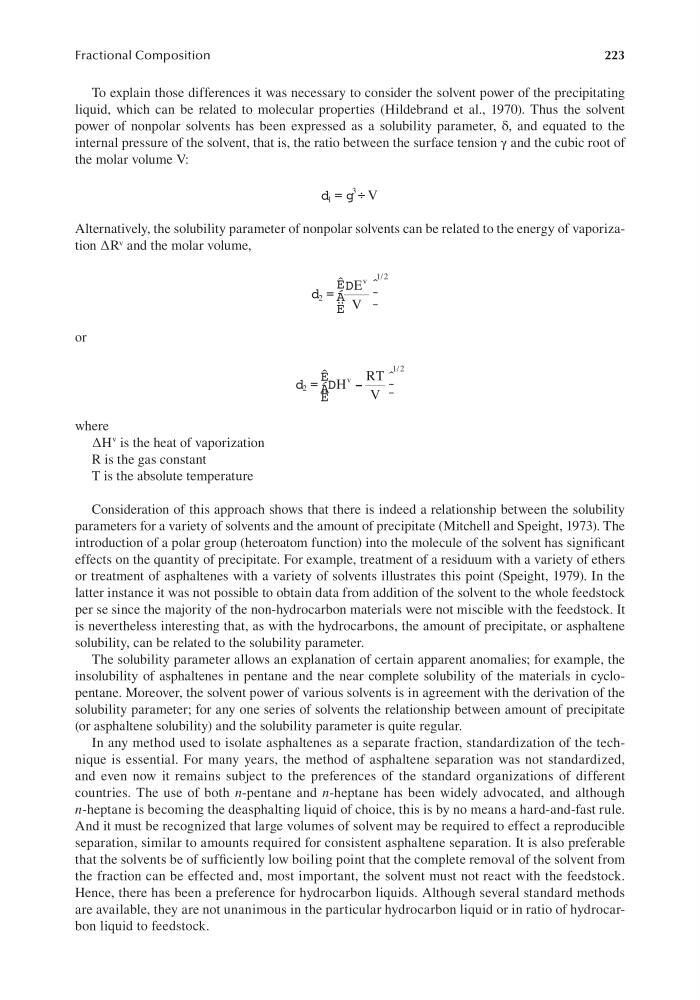
To explain those differences it was necessary to consider the solvent power of the precipitating
liquid, which can be related to molecular properties (Hildebrand et al., 1970). Thus the solvent
power of nonpolar solvents has been expressed as a solubility parameter, δ, and equated to the
internal pressure of the solvent, that is, the ratio between the surface tension γ and the cubic root of
the molar volume V:
d 1
3
V
= ÷
g
Alternatively, the solubility parameter of nonpolar solvents can be related to the energy of vaporization ∆R v and the molar volume,
d 2
1 2
=
Ê
Ë
Á
ˆ
¯
˜
DE
V
v
/
or
d
D
2
1 2
=
-
Ê
Ë
Á
ˆ
¯
˜
H
RT
V
v
/
where
∆H
v
is the heat of vaporization
R is the gas constant
T is the absolute temperature
Consideration of this approach shows that there is indeed a relationship between the solubility
parameters for a variety of solvents and the amount of precipitate (Mitchell and Speight, 1973). The
introduction of a polar group (heteroatom function) into the molecule of the solvent has significant
effects on the quantity of precipitate. For example, treatment of a residuum with a variety of ethers
or treatment of asphaltenes with a variety of solvents illustrates this point (Speight, 1979). In the
latter instance it was not possible to obtain data from addition of the solvent to the whole feedstock
per se since the majority of the non-hydrocarbon materials were not miscible with the feedstock. It
is nevertheless interesting that, as with the hydrocarbons, the amount of precipitate, or asphaltene
solubility, can be related to the solubility parameter.
The solubility parameter allows an explanation of certain apparent anomalies; for example, the
insolubility of asphaltenes in pentane and the near complete solubility of the materials in cyclopentane. Moreover, the solvent power of various solvents is in agreement with the derivation of the
solubility parameter; for any one series of solvents the relationship between amount of precipitate
(or asphaltene solubility) and the solubility parameter is quite regular.
In any method used to isolate asphaltenes as a separate fraction, standardization of the technique is essential. For many years, the method of asphaltene separation was not standardized,
and even now it remains subject to the preferences of the standard organizations of different
countries. The use of both n-pentane and n-heptane has been widely advocated, and although
n-heptane is becoming the deasphalting liquid of choice, this is by no means a hard-and-fast rule.
And it must be recognized that large volumes of solvent may be required to effect a reproducible
separation, similar to amounts required for consistent asphaltene separation. It is also preferable
that the solvents be of sufficiently low boiling point that the complete removal of the solvent from
the fraction can be effected and, most important, the solvent must not react with the feedstock.
Hence, there has been a preference for hydrocarbon liquids. Although several standard methods
are available, they are not unanimous in the particular hydrocarbon liquid or in ratio of hydrocarbon liquid to feedstock.
Fractional Composition
To explain those differences it was necessary to consider the solvent power of the precipitating
liquid, which can be related to molecular properties (Hildebrand et al., 1970). Thus the solvent
power of nonpolar solvents has been expressed as a solubility parameter, δ, and equated to the
internal pressure of the solvent, that is, the ratio between the surface tension γ and the cubic root of
the molar volume V:
d 1
3
V
= ÷
g
Alternatively, the solubility parameter of nonpolar solvents can be related to the energy of vaporization ∆R v and the molar volume,
d 2
1 2
=
Ê
Ë
Á
ˆ
¯
˜
DE
V
v
/
or
d
D
2
1 2
=
-
Ê
Ë
Á
ˆ
¯
˜
H
RT
V
v
/
where
∆H
v
is the heat of vaporization
R is the gas constant
T is the absolute temperature
Consideration of this approach shows that there is indeed a relationship between the solubility
parameters for a variety of solvents and the amount of precipitate (Mitchell and Speight, 1973). The
introduction of a polar group (heteroatom function) into the molecule of the solvent has significant
effects on the quantity of precipitate. For example, treatment of a residuum with a variety of ethers
or treatment of asphaltenes with a variety of solvents illustrates this point (Speight, 1979). In the
latter instance it was not possible to obtain data from addition of the solvent to the whole feedstock
per se since the majority of the non-hydrocarbon materials were not miscible with the feedstock. It
is nevertheless interesting that, as with the hydrocarbons, the amount of precipitate, or asphaltene
solubility, can be related to the solubility parameter.
The solubility parameter allows an explanation of certain apparent anomalies; for example, the
insolubility of asphaltenes in pentane and the near complete solubility of the materials in cyclopentane. Moreover, the solvent power of various solvents is in agreement with the derivation of the
solubility parameter; for any one series of solvents the relationship between amount of precipitate
(or asphaltene solubility) and the solubility parameter is quite regular.
In any method used to isolate asphaltenes as a separate fraction, standardization of the technique is essential. For many years, the method of asphaltene separation was not standardized,
and even now it remains subject to the preferences of the standard organizations of different
countries. The use of both n-pentane and n-heptane has been widely advocated, and although
n-heptane is becoming the deasphalting liquid of choice, this is by no means a hard-and-fast rule.
And it must be recognized that large volumes of solvent may be required to effect a reproducible
separation, similar to amounts required for consistent asphaltene separation. It is also preferable
that the solvents be of sufficiently low boiling point that the complete removal of the solvent from
the fraction can be effected and, most important, the solvent must not react with the feedstock.
Hence, there has been a preference for hydrocarbon liquids. Although several standard methods
are available, they are not unanimous in the particular hydrocarbon liquid or in ratio of hydrocarbon liquid to feedstock.