

222
The Chemistry and Technology of Petroleum
On the basis of the solubility in a variety of solvents, it has become possible to distinguish
among the various constituents of petroleum, heavy oil, and tar sand bitumen (Figure 9.1). Highly
paraffin crude oil may contain only small portions of asphaltenes. Crude oil generally does not
contain carboids and carbenes that are, for the purposes of this text, considered to be the products
of thermal processes. Hence, residua from cracking distillation or from cracking processes may
contain 2% w/w by weight or more carboids and carbenes.
Thus the separation of crude oil into two fractions, asphaltenes and maltenes, is conveniently
brought about by means of low-molecular-weight paraffinic hydrocarbons, which were recognized
to have selective solvency for hydrocarbons, and simple relatively low molecular weight hydrocarbon derivatives. The more complex, higher molecular weight compounds are precipitated particularly well by addition of 40 volumes of n-pentane or n-heptane in the methods generally preferred
at present (Speight et al., 1984; Speight, 1994). It is no doubt a separation of the chemical components with the most complex structures from the mixture, and this fraction, which should correctly be called n-pentane asphaltenes or n-heptane asphaltenes is qualitatively and quantitatively
reproducible (Figure 9.1).
If the precipitation method (deasphalting) involves the use of a solvent and a residuum and is
essentially a leaching of the heavy oil from the insoluble residue, this process may be referred to as
extraction. However, under the prevailing conditions now in laboratory use, the term precipitation
is perhaps more correct and descriptive of the method.
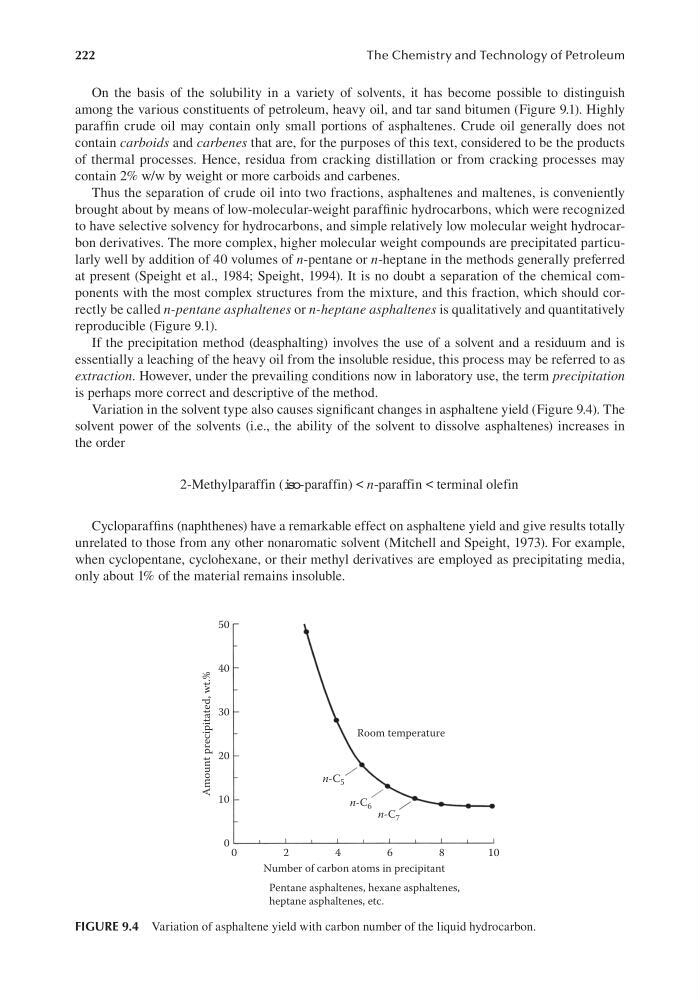
Variation in the solvent type also causes significant changes in asphaltene yield (Figure 9.4). The
solvent power of the solvents (i.e., the ability of the solvent to dissolve asphaltenes) increases in
the order
2-Methylparaffin ( -paraffin)
-paraffin terminal olefin
i so
<
<
n
Cycloparaffins (naphthenes) have a remarkable effect on asphaltene yield and give results totally
unrelated to those from any other nonaromatic solvent (Mitchell and Speight, 1973). For example,
when cyclopentane, cyclohexane, or their methyl derivatives are employed as precipitating media,
only about 1% of the material remains insoluble.
Room temperature
Amount precipitated, wt.%
10
10
20
30
40
50
8
6
4
2
0
0
n-C 5
n-C 6 n-C 7
Number of carbon atoms in precipitant
Pentane asphaltenes, hexane asphaltenes,
heptane asphaltenes, etc.
FIGURE 9.4 Variation of asphaltene yield with carbon number of the liquid hydrocarbon.
The Chemistry and Technology of Petroleum
On the basis of the solubility in a variety of solvents, it has become possible to distinguish
among the various constituents of petroleum, heavy oil, and tar sand bitumen (Figure 9.1). Highly
paraffin crude oil may contain only small portions of asphaltenes. Crude oil generally does not
contain carboids and carbenes that are, for the purposes of this text, considered to be the products
of thermal processes. Hence, residua from cracking distillation or from cracking processes may
contain 2% w/w by weight or more carboids and carbenes.
Thus the separation of crude oil into two fractions, asphaltenes and maltenes, is conveniently
brought about by means of low-molecular-weight paraffinic hydrocarbons, which were recognized
to have selective solvency for hydrocarbons, and simple relatively low molecular weight hydrocarbon derivatives. The more complex, higher molecular weight compounds are precipitated particularly well by addition of 40 volumes of n-pentane or n-heptane in the methods generally preferred
at present (Speight et al., 1984; Speight, 1994). It is no doubt a separation of the chemical components with the most complex structures from the mixture, and this fraction, which should correctly be called n-pentane asphaltenes or n-heptane asphaltenes is qualitatively and quantitatively
reproducible (Figure 9.1).
If the precipitation method (deasphalting) involves the use of a solvent and a residuum and is
essentially a leaching of the heavy oil from the insoluble residue, this process may be referred to as
extraction. However, under the prevailing conditions now in laboratory use, the term precipitation
is perhaps more correct and descriptive of the method.
Variation in the solvent type also causes significant changes in asphaltene yield (Figure 9.4). The
solvent power of the solvents (i.e., the ability of the solvent to dissolve asphaltenes) increases in
the order
2-Methylparaffin ( -paraffin)
-paraffin terminal olefin
i so
<
<
n
Cycloparaffins (naphthenes) have a remarkable effect on asphaltene yield and give results totally
unrelated to those from any other nonaromatic solvent (Mitchell and Speight, 1973). For example,
when cyclopentane, cyclohexane, or their methyl derivatives are employed as precipitating media,
only about 1% of the material remains insoluble.
Room temperature
Amount precipitated, wt.%
10
10
20
30
40
50
8
6
4
2
0
0
n-C 5
n-C 6 n-C 7
Number of carbon atoms in precipitant
Pentane asphaltenes, hexane asphaltenes,
heptane asphaltenes, etc.
FIGURE 9.4 Variation of asphaltene yield with carbon number of the liquid hydrocarbon.