

221
Fractional Composition
The separation of petroleum fractions by the use of solvents has to some extent already been
considered, but it is necessary at this point to briefly review the basis of solvent extraction for a better understanding of the application of this method to the fractionation of petroleum and petroleum
products.
The simplest application of solvent extraction consists of mixing petroleum with another liquid,
which results in the formation of two phases. This causes distribution of the petroleum constituents
over the two phases; the dissolved portion is referred to as the extract, and the non-dissolved part of
the petroleum is referred to as the raffinate.
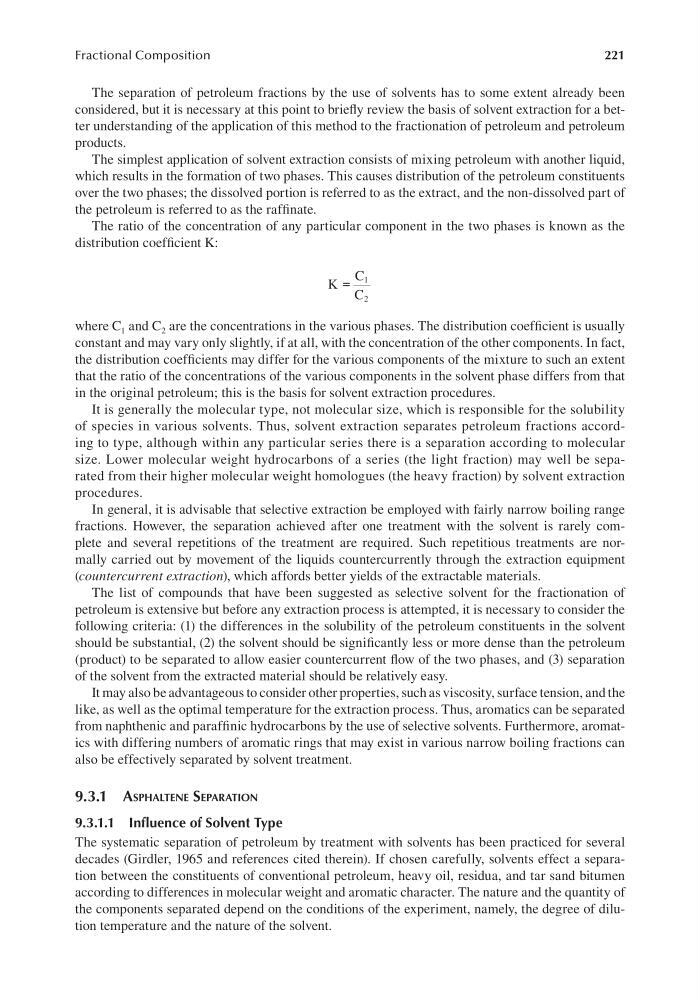
The ratio of the concentration of any particular component in the two phases is known as the
distribution coefficient K:
K
C
C
=
1
2
where C 1 and C 2 are the concentrations in the various phases. The distribution coefficient is usually
constant and may vary only slightly, if at all, with the concentration of the other components. In fact,
the distribution coefficients may differ for the various components of the mixture to such an extent
that the ratio of the concentrations of the various components in the solvent phase differs from that
in the original petroleum; this is the basis for solvent extraction procedures.
It is generally the molecular type, not molecular size, which is responsible for the solubility
of species in various solvents. Thus, solvent extraction separates petroleum fractions according to type, although within any particular series there is a separation according to molecular
size. Lower molecular weight hydrocarbons of a series (the light fraction) may well be separated from their higher molecular weight homologues (the heavy fraction) by solvent extraction
procedures.
In general, it is advisable that selective extraction be employed with fairly narrow boiling range
fractions. However, the separation achieved after one treatment with the solvent is rarely complete and several repetitions of the treatment are required. Such repetitious treatments are normally carried out by movement of the liquids countercurrently through the extraction equipment
( countercurrent extraction), which affords better yields of the extractable materials.
The list of compounds that have been suggested as selective solvent for the fractionation of
petroleum is extensive but before any extraction process is attempted, it is necessary to consider the
following criteria: (1) the differences in the solubility of the petroleum constituents in the solvent
should be substantial, (2) the solvent should be significantly less or more dense than the petroleum
(product) to be separated to allow easier countercurrent flow of the two phases, and (3) separation
of the solvent from the extracted material should be relatively easy.
It may also be advantageous to consider other properties, such as viscosity, surface tension, and the
like, as well as the optimal temperature for the extraction process. Thus, aromatics can be separated
from naphthenic and paraffinic hydrocarbons by the use of selective solvents. Furthermore, aromatics with differing numbers of aromatic rings that may exist in various narrow boiling fractions can
also be effectively separated by solvent treatment.
9.3.1 AsPHAltene sePArAtIon
9.3.1.1 Influence of Solvent Type
The systematic separation of petroleum by treatment with solvents has been practiced for several
decades (Girdler, 1965 and references cited therein). If chosen carefully, solvents effect a separation between the constituents of conventional petroleum, heavy oil, residua, and tar sand bitumen
according to differences in molecular weight and aromatic character. The nature and the quantity of
the components separated depend on the conditions of the experiment, namely, the degree of dilution temperature and the nature of the solvent.
Fractional Composition
The separation of petroleum fractions by the use of solvents has to some extent already been
considered, but it is necessary at this point to briefly review the basis of solvent extraction for a better understanding of the application of this method to the fractionation of petroleum and petroleum
products.
The simplest application of solvent extraction consists of mixing petroleum with another liquid,
which results in the formation of two phases. This causes distribution of the petroleum constituents
over the two phases; the dissolved portion is referred to as the extract, and the non-dissolved part of
the petroleum is referred to as the raffinate.
The ratio of the concentration of any particular component in the two phases is known as the
distribution coefficient K:
K
C
C
=
1
2
where C 1 and C 2 are the concentrations in the various phases. The distribution coefficient is usually
constant and may vary only slightly, if at all, with the concentration of the other components. In fact,
the distribution coefficients may differ for the various components of the mixture to such an extent
that the ratio of the concentrations of the various components in the solvent phase differs from that
in the original petroleum; this is the basis for solvent extraction procedures.
It is generally the molecular type, not molecular size, which is responsible for the solubility
of species in various solvents. Thus, solvent extraction separates petroleum fractions according to type, although within any particular series there is a separation according to molecular
size. Lower molecular weight hydrocarbons of a series (the light fraction) may well be separated from their higher molecular weight homologues (the heavy fraction) by solvent extraction
procedures.
In general, it is advisable that selective extraction be employed with fairly narrow boiling range
fractions. However, the separation achieved after one treatment with the solvent is rarely complete and several repetitions of the treatment are required. Such repetitious treatments are normally carried out by movement of the liquids countercurrently through the extraction equipment
( countercurrent extraction), which affords better yields of the extractable materials.
The list of compounds that have been suggested as selective solvent for the fractionation of
petroleum is extensive but before any extraction process is attempted, it is necessary to consider the
following criteria: (1) the differences in the solubility of the petroleum constituents in the solvent
should be substantial, (2) the solvent should be significantly less or more dense than the petroleum
(product) to be separated to allow easier countercurrent flow of the two phases, and (3) separation
of the solvent from the extracted material should be relatively easy.
It may also be advantageous to consider other properties, such as viscosity, surface tension, and the
like, as well as the optimal temperature for the extraction process. Thus, aromatics can be separated
from naphthenic and paraffinic hydrocarbons by the use of selective solvents. Furthermore, aromatics with differing numbers of aromatic rings that may exist in various narrow boiling fractions can
also be effectively separated by solvent treatment.
9.3.1 AsPHAltene sePArAtIon
9.3.1.1 Influence of Solvent Type
The systematic separation of petroleum by treatment with solvents has been practiced for several
decades (Girdler, 1965 and references cited therein). If chosen carefully, solvents effect a separation between the constituents of conventional petroleum, heavy oil, residua, and tar sand bitumen
according to differences in molecular weight and aromatic character. The nature and the quantity of
the components separated depend on the conditions of the experiment, namely, the degree of dilution temperature and the nature of the solvent.