

220
The Chemistry and Technology of Petroleum
constitute from 1% to 60% of the petroleum, cannot be fractionated by distillation without the
possibility of thermal decomposition, and as a result alternative methods of fractionation have
been developed.
The distillation process separates light (lower molecular weight) and heavy (higher molecular
weight) constituents by virtue of their volatility and involves the participation of a vapor phase and
a liquid phase. These are, however, physical processes that involve the use of two liquid phases, usually a solvent phase and an oil phase.
Solvent methods have also been applied to petroleum fractionation on the basis of molecular
weight. The major molecular weight separation process used in the laboratory as well as in the
refinery is solvent precipitation. Solvent precipitation occurs in a refinery in a deasphalting unit
(Chapter 20) and is essentially an extension of the procedure for separation by molecular weight,
although some separation by polarity might also be operative. The deasphalting process is usually
applied to the higher molecular weight fractions of petroleum such as atmospheric and vacuum
residua for the production of asphalt or demetallized deasphalted oil.
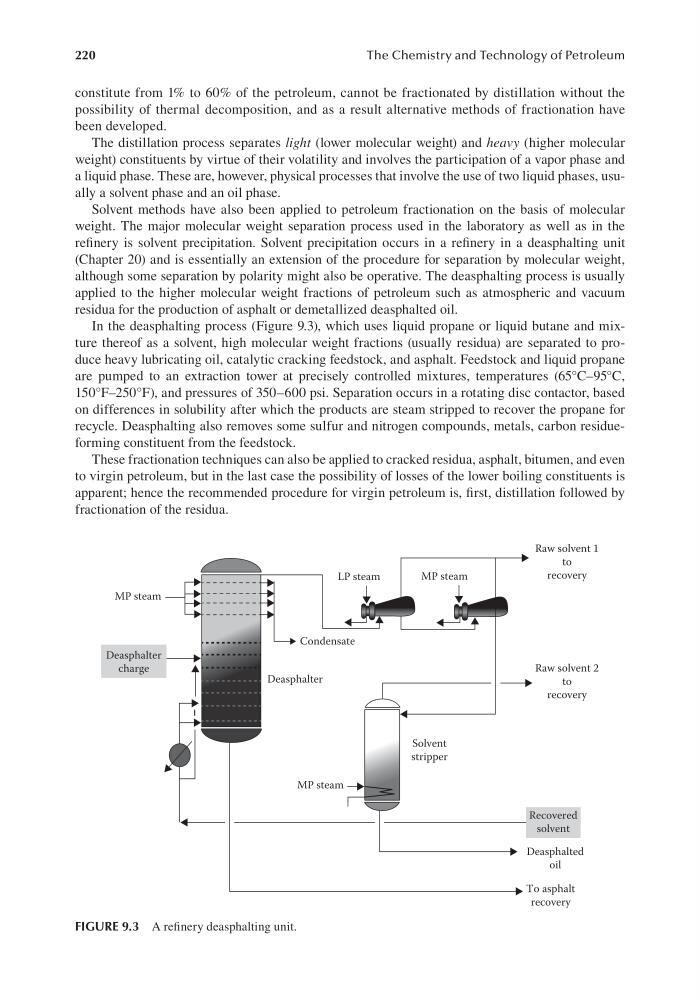
In the deasphalting process (Figure 9.3), which uses liquid propane or liquid butane and mixture thereof as a solvent, high molecular weight fractions (usually residua) are separated to produce heavy lubricating oil, catalytic cracking feedstock, and asphalt. Feedstock and liquid propane
are pumped to an extraction tower at precisely controlled mixtures, temperatures (65°C–95°C,
150°F–250°F), and pressures of 350–600 psi. Separation occurs in a rotating disc contactor, based
on differences in solubility after which the products are steam stripped to recover the propane for
recycle. Deasphalting also removes some sulfur and nitrogen compounds, metals, carbon residueforming constituent from the feedstock.
These fractionation techniques can also be applied to cracked residua, asphalt, bitumen, and even
to virgin petroleum, but in the last case the possibility of losses of the lower boiling constituents is
apparent; hence the recommended procedure for virgin petroleum is, first, distillation followed by
fractionation of the residua.
Solvent
stripper
Deasphalter
Deasphalter
charge
Condensate
MP steam
MP steam
MP steam
Recovered
solvent
Raw solvent 1
to
recovery
Raw solvent 2
to
recovery
Deasphalted
oil
LP steam
To asphalt
recovery
FIGURE 9.3 A refinery deasphalting unit.
The Chemistry and Technology of Petroleum
constitute from 1% to 60% of the petroleum, cannot be fractionated by distillation without the
possibility of thermal decomposition, and as a result alternative methods of fractionation have
been developed.
The distillation process separates light (lower molecular weight) and heavy (higher molecular
weight) constituents by virtue of their volatility and involves the participation of a vapor phase and
a liquid phase. These are, however, physical processes that involve the use of two liquid phases, usually a solvent phase and an oil phase.
Solvent methods have also been applied to petroleum fractionation on the basis of molecular
weight. The major molecular weight separation process used in the laboratory as well as in the
refinery is solvent precipitation. Solvent precipitation occurs in a refinery in a deasphalting unit
(Chapter 20) and is essentially an extension of the procedure for separation by molecular weight,
although some separation by polarity might also be operative. The deasphalting process is usually
applied to the higher molecular weight fractions of petroleum such as atmospheric and vacuum
residua for the production of asphalt or demetallized deasphalted oil.
In the deasphalting process (Figure 9.3), which uses liquid propane or liquid butane and mixture thereof as a solvent, high molecular weight fractions (usually residua) are separated to produce heavy lubricating oil, catalytic cracking feedstock, and asphalt. Feedstock and liquid propane
are pumped to an extraction tower at precisely controlled mixtures, temperatures (65°C–95°C,
150°F–250°F), and pressures of 350–600 psi. Separation occurs in a rotating disc contactor, based
on differences in solubility after which the products are steam stripped to recover the propane for
recycle. Deasphalting also removes some sulfur and nitrogen compounds, metals, carbon residueforming constituent from the feedstock.
These fractionation techniques can also be applied to cracked residua, asphalt, bitumen, and even
to virgin petroleum, but in the last case the possibility of losses of the lower boiling constituents is
apparent; hence the recommended procedure for virgin petroleum is, first, distillation followed by
fractionation of the residua.
Solvent
stripper
Deasphalter
Deasphalter
charge
Condensate
MP steam
MP steam
MP steam
Recovered
solvent
Raw solvent 1
to
recovery
Raw solvent 2
to
recovery
Deasphalted
oil
LP steam
To asphalt
recovery
FIGURE 9.3 A refinery deasphalting unit.