

Dynamics of Industrial Revolution 4.0: Digital Technology Transformation and Cultural Evolution –
Wulandari et al (eds)
© 2021 The Author(s), ISBN 978-1-032-04451-4
Exploring Sumba woven textile motifs through a digital technique
using the Escher method
M. Rosandini & J. Samuel
Telkom University, Bandung, Indonesia
ABSTRACT: East Sumba traditional woven textiles are East Indonesian textile artifacts. They
have considerable visual potential because of their ornaments and motif patterns. This article
explores the transformation of the East Sumba motif pattern through digital art techniques. Using
digital experimentation with the Escher-types repeats method, innovative and varied new patterns
were produced to meet the fashion industry’s needs. As a result, four new digital patterns were
created. The most effective Escher techniques for exploring non-geometric forms are translation,
reflection, and glide reflection. The further development of the East Sumba–Escher digital motif
will enhance the various artwork on surface pattern textiles and fashion designs.
Keywords: digital art, Escher, exploration, motif, Sumba
1 THEORETICAL BACKGROUND
1.1 Introduction
Sumba woven motif patterns are inspired by the Sumba community and its environment, which are
then distilled into decorative ornaments. Stilation is a changing the shape of an object in nature into
an artistic form or a particular style (Nizam 2019). The characteristics of Sumba weaving motif
patterns are geometric and non-geometric shapes. The ornaments on the East Sumba Ikat woven
fabric are dynamic with their inspiration coming from natural, non-geometric decoration in the
form of humans, flora, and fauna. According to Kartiwa (2007), Sumba ornaments are inspired by
nature, and are usually in the form of animals such as horses and chickens.
The horse ornament symbolizes courage, unity, authority, and the nature of a noble. The horse’s
motif on Sumba’s ikat weaving is often depicted by the horse’s character swinging its legs back
and forth, where this pose symbolizes the courage and nature of a warrior (Kartiwa 2007). The
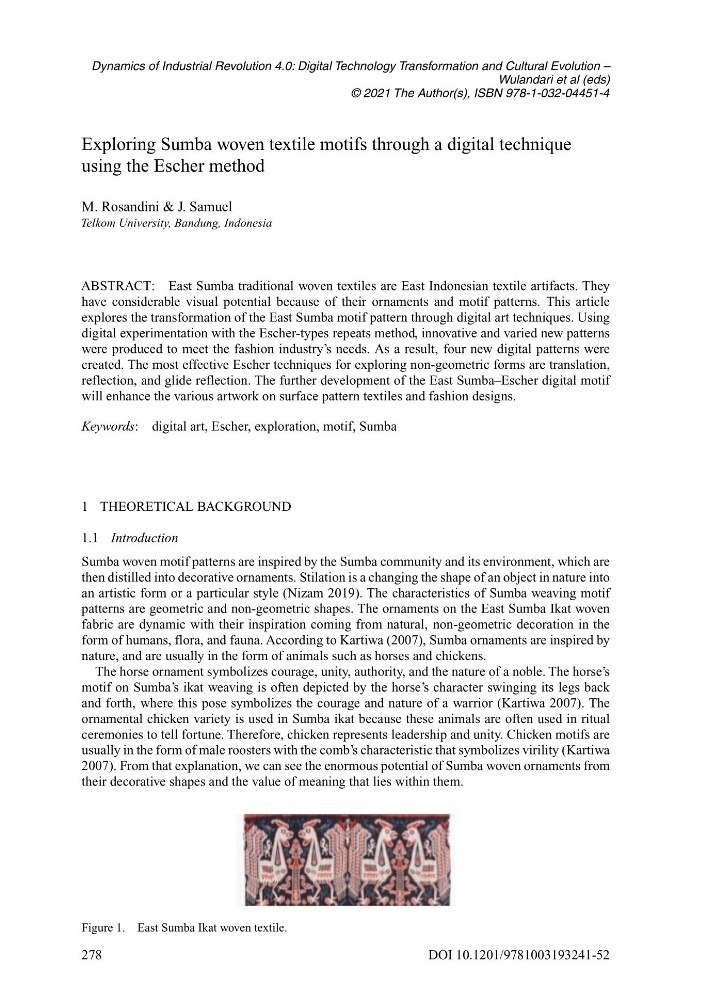
ornamental chicken variety is used in Sumba ikat because these animals are often used in ritual
ceremonies to tell fortune. Therefore, chicken represents leadership and unity. Chicken motifs are
usually in the form of male roosters with the comb’s characteristic that symbolizes virility (Kartiwa
2007). From that explanation, we can see the enormous potential of Sumba woven ornaments from
their decorative shapes and the value of meaning that lies within them.
Figure 1. East Sumba Ikat woven textile.
278
DOI 10.1201/9781003193241-52
Wulandari et al (eds)
© 2021 The Author(s), ISBN 978-1-032-04451-4
Exploring Sumba woven textile motifs through a digital technique
using the Escher method
M. Rosandini & J. Samuel
Telkom University, Bandung, Indonesia
ABSTRACT: East Sumba traditional woven textiles are East Indonesian textile artifacts. They
have considerable visual potential because of their ornaments and motif patterns. This article
explores the transformation of the East Sumba motif pattern through digital art techniques. Using
digital experimentation with the Escher-types repeats method, innovative and varied new patterns
were produced to meet the fashion industry’s needs. As a result, four new digital patterns were
created. The most effective Escher techniques for exploring non-geometric forms are translation,
reflection, and glide reflection. The further development of the East Sumba–Escher digital motif
will enhance the various artwork on surface pattern textiles and fashion designs.
Keywords: digital art, Escher, exploration, motif, Sumba
1 THEORETICAL BACKGROUND
1.1 Introduction
Sumba woven motif patterns are inspired by the Sumba community and its environment, which are
then distilled into decorative ornaments. Stilation is a changing the shape of an object in nature into
an artistic form or a particular style (Nizam 2019). The characteristics of Sumba weaving motif
patterns are geometric and non-geometric shapes. The ornaments on the East Sumba Ikat woven
fabric are dynamic with their inspiration coming from natural, non-geometric decoration in the
form of humans, flora, and fauna. According to Kartiwa (2007), Sumba ornaments are inspired by
nature, and are usually in the form of animals such as horses and chickens.
The horse ornament symbolizes courage, unity, authority, and the nature of a noble. The horse’s
motif on Sumba’s ikat weaving is often depicted by the horse’s character swinging its legs back
and forth, where this pose symbolizes the courage and nature of a warrior (Kartiwa 2007). The
ornamental chicken variety is used in Sumba ikat because these animals are often used in ritual
ceremonies to tell fortune. Therefore, chicken represents leadership and unity. Chicken motifs are
usually in the form of male roosters with the comb’s characteristic that symbolizes virility (Kartiwa
2007). From that explanation, we can see the enormous potential of Sumba woven ornaments from
their decorative shapes and the value of meaning that lies within them.
Figure 1. East Sumba Ikat woven textile.
278
DOI 10.1201/9781003193241-52