

However, despite its great potential, many designers and researchers utilize the Sumba woven
textile to develop and use its decorative shapes as the inspiration for products, especially for the
surface motif patterns in digital techniques.
Some research that leads us to the utilization of East Sumba woven textiles was conducted by
Ningsih (2019) that wrote about the utilization of the textiles through fashion for urban people.
Ningsih (2019) used natural woven textiles. The innovation appeared on the function and form
of its original woven textile, the result of which was a collection of fashion wear. On the other
hand, Indonesian surface pattern designer Fika Julia, with her brand byfikajulia in 2016, produced
textile printing inspired by motif patterns from East Sumba woven textiles. The textiles were then
applied to ready-to-wear fashion. She used a digital technique to compose the shapes of Sumba
motifs, with some simple repeat patterns. The motifs that Julia produced has a more modernpop look because she was targeting young people. Based on Julia’s motif pattern observation, it
was discovered that she was using simple, seamless, repeat patterns, such as half-drop and brick
repeat patterns (Kight 2011). However, to make motifs, there are many ways to create innovation.
Therefore, digital techniques for developing patterns utilizing Sumba ornaments still need to be
developed to produce a greater variety of forms.
1.2 Initial conceptual framework
Chun (2011) said that digital technology development is rapidly exercising influence across all
fields, including contemporary art. He applied new concepts, values, tools, and methods. Based
on the authors’ observation, research of traditional motif pattern development using advanced
techniques is limited. In fact, some of artists are still using conventional repeat pattern techniques,
such as square repeat or half-way repeat (half-drop and brick repeat pattern) (Kight 2011), which
therefore brings out the usual pattern composition. There is a potential repeat pattern technique,
the Escher Repeat Type, which could be applied to any non-geometric form to make an innovative
composition. The Escher Repeat Type is usually used for artwork, considering its original form was
from M.C. Escher’s graphic art masterpiece, but the principle of making the composition could be
applied to digital surface pattern design as well.
M.C. Escher was a graphic designer who used mathematics in the making of his works. The tessellation technique that Escher introduced, or commonly called the Escher technique, was inspired
by the beautiful and intricate arrangement of tiles in architecture in Alhambra, Spain. However,
the elements forming its patterns were only limited to geometric shapes, so Escher tried to make
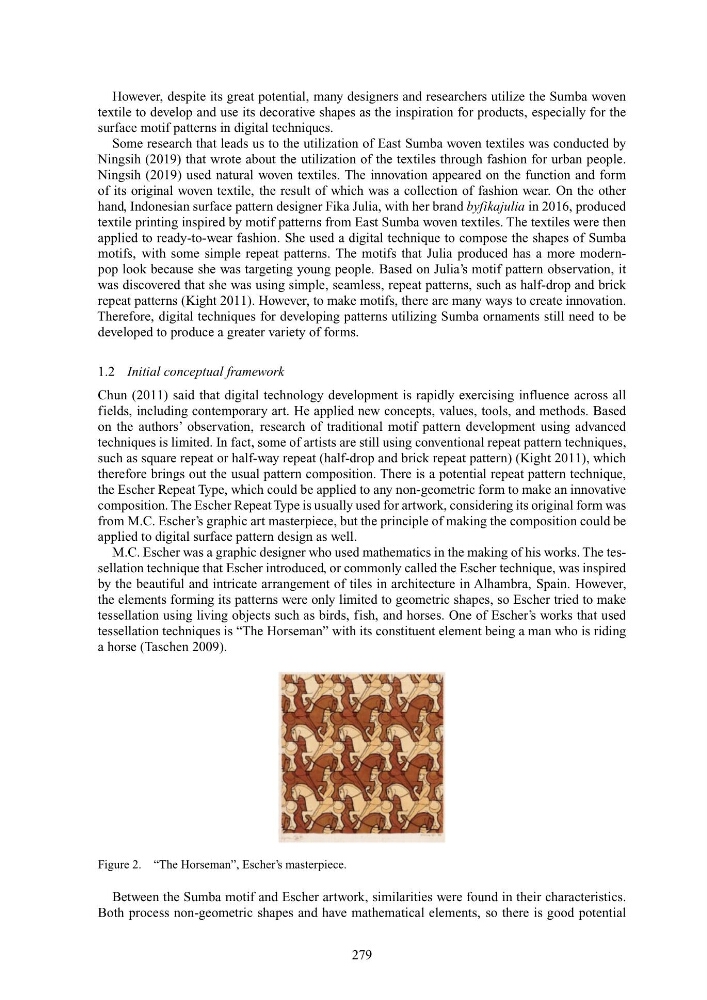
tessellation using living objects such as birds, fish, and horses. One of Escher’s works that used
tessellation techniques is “The Horseman” with its constituent element being a man who is riding
a horse (Taschen 2009).
Figure 2. “The Horseman”, Escher’s masterpiece.
Between the Sumba motif and Escher artwork, similarities were found in their characteristics.
Both process non-geometric shapes and have mathematical elements, so there is good potential
279
textile to develop and use its decorative shapes as the inspiration for products, especially for the
surface motif patterns in digital techniques.
Some research that leads us to the utilization of East Sumba woven textiles was conducted by
Ningsih (2019) that wrote about the utilization of the textiles through fashion for urban people.
Ningsih (2019) used natural woven textiles. The innovation appeared on the function and form
of its original woven textile, the result of which was a collection of fashion wear. On the other
hand, Indonesian surface pattern designer Fika Julia, with her brand byfikajulia in 2016, produced
textile printing inspired by motif patterns from East Sumba woven textiles. The textiles were then
applied to ready-to-wear fashion. She used a digital technique to compose the shapes of Sumba
motifs, with some simple repeat patterns. The motifs that Julia produced has a more modernpop look because she was targeting young people. Based on Julia’s motif pattern observation, it
was discovered that she was using simple, seamless, repeat patterns, such as half-drop and brick
repeat patterns (Kight 2011). However, to make motifs, there are many ways to create innovation.
Therefore, digital techniques for developing patterns utilizing Sumba ornaments still need to be
developed to produce a greater variety of forms.
1.2 Initial conceptual framework
Chun (2011) said that digital technology development is rapidly exercising influence across all
fields, including contemporary art. He applied new concepts, values, tools, and methods. Based
on the authors’ observation, research of traditional motif pattern development using advanced
techniques is limited. In fact, some of artists are still using conventional repeat pattern techniques,
such as square repeat or half-way repeat (half-drop and brick repeat pattern) (Kight 2011), which
therefore brings out the usual pattern composition. There is a potential repeat pattern technique,
the Escher Repeat Type, which could be applied to any non-geometric form to make an innovative
composition. The Escher Repeat Type is usually used for artwork, considering its original form was
from M.C. Escher’s graphic art masterpiece, but the principle of making the composition could be
applied to digital surface pattern design as well.
M.C. Escher was a graphic designer who used mathematics in the making of his works. The tessellation technique that Escher introduced, or commonly called the Escher technique, was inspired
by the beautiful and intricate arrangement of tiles in architecture in Alhambra, Spain. However,
the elements forming its patterns were only limited to geometric shapes, so Escher tried to make
tessellation using living objects such as birds, fish, and horses. One of Escher’s works that used
tessellation techniques is “The Horseman” with its constituent element being a man who is riding
a horse (Taschen 2009).
Figure 2. “The Horseman”, Escher’s masterpiece.
Between the Sumba motif and Escher artwork, similarities were found in their characteristics.
Both process non-geometric shapes and have mathematical elements, so there is good potential
279