

the green designs and in the making of green construction (ConstructionSuite since 1999, Green
Wizard, Autodesk Green Building Studio and Greengrade), and to create animated images, moving
objects, simulations, and hyperreal spaces utilizing virtual reality. This study reviewed the combination of physical and digital elements in interior design to learn the values of hybrid space created
when users experienced the mixture of static stable image and the constantly moving/changing
image. The physical space has the temporary, ambiguous, dual coding (physical-digital) characteristics, which in turn generates the problem of representation referred to as Heteropia space by
Michel Foucault in 1967.
2 METHOD
This study’s question was how the value of Heterotopia space was created by the hybridity of
physical and digital space elements. This research used the case study method with two bases as
follows: (1) as a method that can be used to deepen a theory and its implementation in various cases
and (2) to put theories into tests as well as enriching them to modify it and broadening the readers’
horizon on contextual truth. The chosen cases were the Museum of the Bible in Washington, DC, the
Luis Vuitton Store at Changi Airport, Singapore, and the Miguel Chevalier Digital Art Installation
at Cathedral Notre-Dame, Rodez, France. They were chosen for the accessibility and capability in
illustrating the theory to show Heterotopia space and the aesthetic experience created by it.
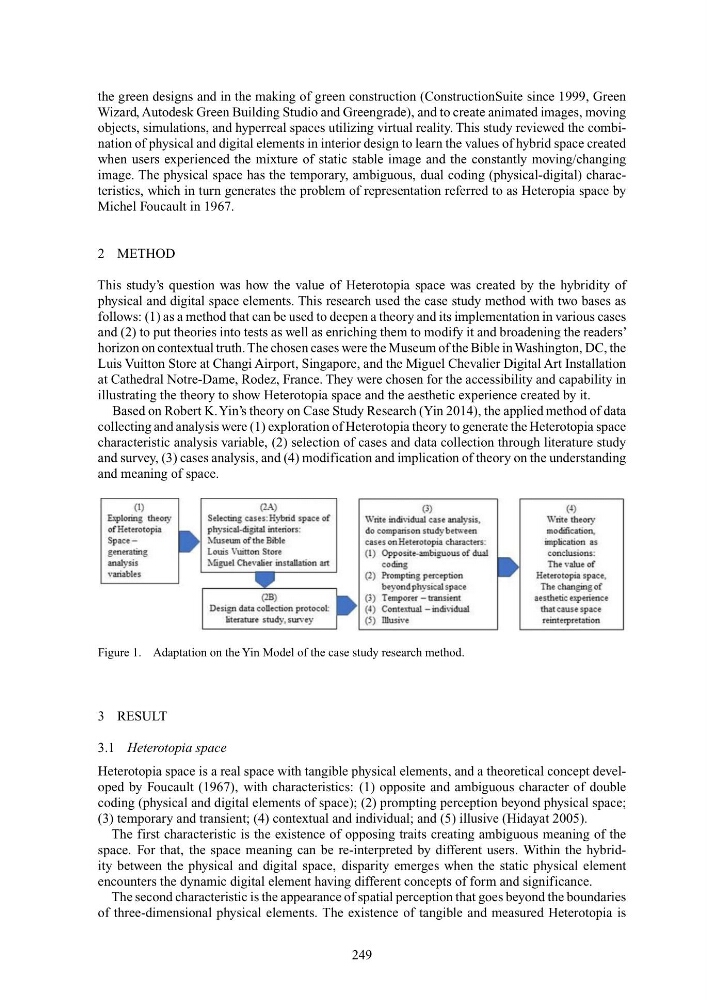
Based on Robert K. Yin’s theory on Case Study Research (Yin 2014), the applied method of data
collecting and analysis were (1) exploration of Heterotopia theory to generate the Heterotopia space
characteristic analysis variable, (2) selection of cases and data collection through literature study
and survey, (3) cases analysis, and (4) modification and implication of theory on the understanding
and meaning of space.
Figure 1. Adaptation on the Yin Model of the case study research method.
3 RESULT
3.1 Heterotopia space
Heterotopia space is a real space with tangible physical elements, and a theoretical concept developed by Foucault (1967), with characteristics: (1) opposite and ambiguous character of double
coding (physical and digital elements of space); (2) prompting perception beyond physical space;
(3) temporary and transient; (4) contextual and individual; and (5) illusive (Hidayat 2005).
The first characteristic is the existence of opposing traits creating ambiguous meaning of the
space. For that, the space meaning can be re-interpreted by different users. Within the hybridity between the physical and digital space, disparity emerges when the static physical element
encounters the dynamic digital element having different concepts of form and significance.
The second characteristic is the appearance of spatial perception that goes beyond the boundaries
of three-dimensional physical elements. The existence of tangible and measured Heterotopia is
249
Wizard, Autodesk Green Building Studio and Greengrade), and to create animated images, moving
objects, simulations, and hyperreal spaces utilizing virtual reality. This study reviewed the combination of physical and digital elements in interior design to learn the values of hybrid space created
when users experienced the mixture of static stable image and the constantly moving/changing
image. The physical space has the temporary, ambiguous, dual coding (physical-digital) characteristics, which in turn generates the problem of representation referred to as Heteropia space by
Michel Foucault in 1967.
2 METHOD
This study’s question was how the value of Heterotopia space was created by the hybridity of
physical and digital space elements. This research used the case study method with two bases as
follows: (1) as a method that can be used to deepen a theory and its implementation in various cases
and (2) to put theories into tests as well as enriching them to modify it and broadening the readers’
horizon on contextual truth. The chosen cases were the Museum of the Bible in Washington, DC, the
Luis Vuitton Store at Changi Airport, Singapore, and the Miguel Chevalier Digital Art Installation
at Cathedral Notre-Dame, Rodez, France. They were chosen for the accessibility and capability in
illustrating the theory to show Heterotopia space and the aesthetic experience created by it.
Based on Robert K. Yin’s theory on Case Study Research (Yin 2014), the applied method of data
collecting and analysis were (1) exploration of Heterotopia theory to generate the Heterotopia space
characteristic analysis variable, (2) selection of cases and data collection through literature study
and survey, (3) cases analysis, and (4) modification and implication of theory on the understanding
and meaning of space.
Figure 1. Adaptation on the Yin Model of the case study research method.
3 RESULT
3.1 Heterotopia space
Heterotopia space is a real space with tangible physical elements, and a theoretical concept developed by Foucault (1967), with characteristics: (1) opposite and ambiguous character of double
coding (physical and digital elements of space); (2) prompting perception beyond physical space;
(3) temporary and transient; (4) contextual and individual; and (5) illusive (Hidayat 2005).
The first characteristic is the existence of opposing traits creating ambiguous meaning of the
space. For that, the space meaning can be re-interpreted by different users. Within the hybridity between the physical and digital space, disparity emerges when the static physical element
encounters the dynamic digital element having different concepts of form and significance.
The second characteristic is the appearance of spatial perception that goes beyond the boundaries
of three-dimensional physical elements. The existence of tangible and measured Heterotopia is
249