

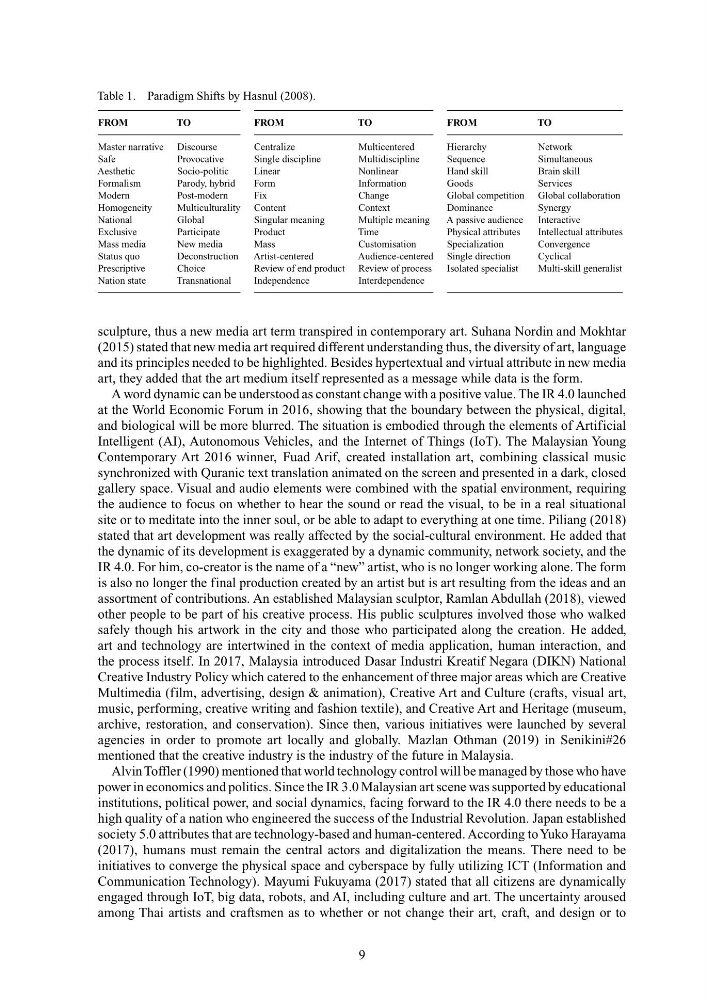
Table 1. Paradigm Shifts by Hasnul (2008).
FROM
TO
FROM
TO
FROM
TO
Master narrative Discourse
Centralize
Multicentered
Hierarchy
Network
Safe
Provocative
Single discipline
Multidiscipline
Sequence
Simultaneous
Aesthetic
Socio-politic
Linear
Nonlinear
Hand skill
Brain skill
Formalism
Parody, hybrid
Form
Information
Goods
Services
Modern
Post-modern
Fix
Change
Global competition Global collaboration
Homogeneity
Multiculturality Content
Context
Dominance
Synergy
National
Global
Singular meaning
Multiple meaning
A passive audience Interactive
Exclusive
Participate
Product
Time
Physical attributes
Intellectual attributes
Mass media
New media
Mass
Customisation
Specialization
Convergence
Status quo
Deconstruction
Artist-centered
Audience-centered Single direction
Cyclical
Prescriptive
Choice
Review of end product Review of process
Isolated specialist
Multi-skill generalist
Nation state
Transnational
Independence
Interdependence
sculpture, thus a new media art term transpired in contemporary art. Suhana Nordin and Mokhtar
(2015) stated that new media art required different understanding thus, the diversity of art, language
and its principles needed to be highlighted. Besides hypertextual and virtual attribute in new media
art, they added that the art medium itself represented as a message while data is the form.
A word dynamic can be understood as constant change with a positive value. The IR 4.0 launched
at the World Economic Forum in 2016, showing that the boundary between the physical, digital,
and biological will be more blurred. The situation is embodied through the elements of Artificial
Intelligent (AI), Autonomous Vehicles, and the Internet of Things (IoT). The Malaysian Young
Contemporary Art 2016 winner, Fuad Arif, created installation art, combining classical music
synchronized with Quranic text translation animated on the screen and presented in a dark, closed
gallery space. Visual and audio elements were combined with the spatial environment, requiring
the audience to focus on whether to hear the sound or read the visual, to be in a real situational
site or to meditate into the inner soul, or be able to adapt to everything at one time. Piliang (2018)
stated that art development was really affected by the social-cultural environment. He added that
the dynamic of its development is exaggerated by a dynamic community, network society, and the
IR 4.0. For him, co-creator is the name of a “new” artist, who is no longer working alone. The form
is also no longer the final production created by an artist but is art resulting from the ideas and an
assortment of contributions. An established Malaysian sculptor, Ramlan Abdullah (2018), viewed
other people to be part of his creative process. His public sculptures involved those who walked
safely though his artwork in the city and those who participated along the creation. He added,
art and technology are intertwined in the context of media application, human interaction, and
the process itself. In 2017, Malaysia introduced Dasar Industri Kreatif Negara (DIKN) National
Creative Industry Policy which catered to the enhancement of three major areas which are Creative
Multimedia (film, advertising, design & animation), Creative Art and Culture (crafts, visual art,
music, performing, creative writing and fashion textile), and Creative Art and Heritage (museum,
archive, restoration, and conservation). Since then, various initiatives were launched by several
agencies in order to promote art locally and globally. Mazlan Othman (2019) in Senikini#26
mentioned that the creative industry is the industry of the future in Malaysia.
Alvin Toffler (1990) mentioned that world technology control will be managed by those who have
power in economics and politics. Since the IR 3.0 Malaysian art scene was supported by educational
institutions, political power, and social dynamics, facing forward to the IR 4.0 there needs to be a
high quality of a nation who engineered the success of the Industrial Revolution. Japan established
society 5.0 attributes that are technology-based and human-centered. According to Yuko Harayama
(2017), humans must remain the central actors and digitalization the means. There need to be
initiatives to converge the physical space and cyberspace by fully utilizing ICT (Information and
Communication Technology). Mayumi Fukuyama (2017) stated that all citizens are dynamically
engaged through IoT, big data, robots, and AI, including culture and art. The uncertainty aroused
among Thai artists and craftsmen as to whether or not change their art, craft, and design or to
9
FROM
TO
FROM
TO
FROM
TO
Master narrative Discourse
Centralize
Multicentered
Hierarchy
Network
Safe
Provocative
Single discipline
Multidiscipline
Sequence
Simultaneous
Aesthetic
Socio-politic
Linear
Nonlinear
Hand skill
Brain skill
Formalism
Parody, hybrid
Form
Information
Goods
Services
Modern
Post-modern
Fix
Change
Global competition Global collaboration
Homogeneity
Multiculturality Content
Context
Dominance
Synergy
National
Global
Singular meaning
Multiple meaning
A passive audience Interactive
Exclusive
Participate
Product
Time
Physical attributes
Intellectual attributes
Mass media
New media
Mass
Customisation
Specialization
Convergence
Status quo
Deconstruction
Artist-centered
Audience-centered Single direction
Cyclical
Prescriptive
Choice
Review of end product Review of process
Isolated specialist
Multi-skill generalist
Nation state
Transnational
Independence
Interdependence
sculpture, thus a new media art term transpired in contemporary art. Suhana Nordin and Mokhtar
(2015) stated that new media art required different understanding thus, the diversity of art, language
and its principles needed to be highlighted. Besides hypertextual and virtual attribute in new media
art, they added that the art medium itself represented as a message while data is the form.
A word dynamic can be understood as constant change with a positive value. The IR 4.0 launched
at the World Economic Forum in 2016, showing that the boundary between the physical, digital,
and biological will be more blurred. The situation is embodied through the elements of Artificial
Intelligent (AI), Autonomous Vehicles, and the Internet of Things (IoT). The Malaysian Young
Contemporary Art 2016 winner, Fuad Arif, created installation art, combining classical music
synchronized with Quranic text translation animated on the screen and presented in a dark, closed
gallery space. Visual and audio elements were combined with the spatial environment, requiring
the audience to focus on whether to hear the sound or read the visual, to be in a real situational
site or to meditate into the inner soul, or be able to adapt to everything at one time. Piliang (2018)
stated that art development was really affected by the social-cultural environment. He added that
the dynamic of its development is exaggerated by a dynamic community, network society, and the
IR 4.0. For him, co-creator is the name of a “new” artist, who is no longer working alone. The form
is also no longer the final production created by an artist but is art resulting from the ideas and an
assortment of contributions. An established Malaysian sculptor, Ramlan Abdullah (2018), viewed
other people to be part of his creative process. His public sculptures involved those who walked
safely though his artwork in the city and those who participated along the creation. He added,
art and technology are intertwined in the context of media application, human interaction, and
the process itself. In 2017, Malaysia introduced Dasar Industri Kreatif Negara (DIKN) National
Creative Industry Policy which catered to the enhancement of three major areas which are Creative
Multimedia (film, advertising, design & animation), Creative Art and Culture (crafts, visual art,
music, performing, creative writing and fashion textile), and Creative Art and Heritage (museum,
archive, restoration, and conservation). Since then, various initiatives were launched by several
agencies in order to promote art locally and globally. Mazlan Othman (2019) in Senikini#26
mentioned that the creative industry is the industry of the future in Malaysia.
Alvin Toffler (1990) mentioned that world technology control will be managed by those who have
power in economics and politics. Since the IR 3.0 Malaysian art scene was supported by educational
institutions, political power, and social dynamics, facing forward to the IR 4.0 there needs to be a
high quality of a nation who engineered the success of the Industrial Revolution. Japan established
society 5.0 attributes that are technology-based and human-centered. According to Yuko Harayama
(2017), humans must remain the central actors and digitalization the means. There need to be
initiatives to converge the physical space and cyberspace by fully utilizing ICT (Information and
Communication Technology). Mayumi Fukuyama (2017) stated that all citizens are dynamically
engaged through IoT, big data, robots, and AI, including culture and art. The uncertainty aroused
among Thai artists and craftsmen as to whether or not change their art, craft, and design or to
9