

Beam dynamics topics 37
∆β
x
/β
x
-0.05
0
0.05
φ=ψ/ν (rad)
0
1
2
3
4
5
6
∆β
y
/β
y
-0.02
0
0.02
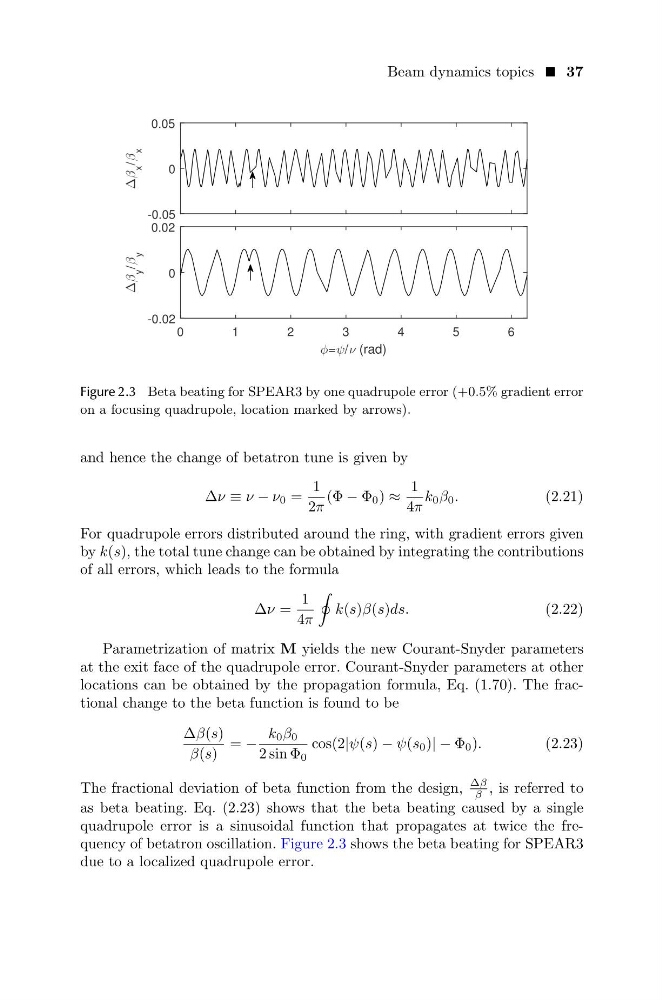
Figure 2.3 Beta beating for SPEAR3 by one quadrupole error (+0.5% gradient error
on a focusing quadrupole, location marked by arrows).
and hence the change of betatron tune is given by
∆ν ≡ ν − ν 0 =
1
2π
(Φ − Φ 0 ) ≈
1
4π
k 0 β 0 .
(2.21)
For quadrupole errors distributed around the ring, with gradient errors given
by k(s), the total tune change can be obtained by integrating the contributions
of all errors, which leads to the formula
∆ν =
1
4π
k(s)β(s)ds.
(2.22)
Parametrization of matrix M yields the new Courant-Snyder parameters
at the exit face of the quadrupole error. Courant-Snyder parameters at other
locations can be obtained by the propagation formula, Eq. (1.70). The fractional change to the beta function is found to be
∆β(s)
β(s)
= −
k 0 β 0
2 sin Φ 0
cos(2|ψ(s) − ψ(s 0 )| − Φ 0 ).
(2.23)
The fractional deviation of beta function from the design,
∆β
β , is referred to
as beta beating. Eq. (2.23) shows that the beta beating caused by a single
quadrupole error is a sinusoidal function that propagates at twice the frequency of betatron oscillation. Figure 2.3 shows the beta beating for SPEAR3
due to a localized quadrupole error.
∆β
x
/β
x
-0.05
0
0.05
φ=ψ/ν (rad)
0
1
2
3
4
5
6
∆β
y
/β
y
-0.02
0
0.02
Figure 2.3 Beta beating for SPEAR3 by one quadrupole error (+0.5% gradient error
on a focusing quadrupole, location marked by arrows).
and hence the change of betatron tune is given by
∆ν ≡ ν − ν 0 =
1
2π
(Φ − Φ 0 ) ≈
1
4π
k 0 β 0 .
(2.21)
For quadrupole errors distributed around the ring, with gradient errors given
by k(s), the total tune change can be obtained by integrating the contributions
of all errors, which leads to the formula
∆ν =
1
4π
k(s)β(s)ds.
(2.22)
Parametrization of matrix M yields the new Courant-Snyder parameters
at the exit face of the quadrupole error. Courant-Snyder parameters at other
locations can be obtained by the propagation formula, Eq. (1.70). The fractional change to the beta function is found to be
∆β(s)
β(s)
= −
k 0 β 0
2 sin Φ 0
cos(2|ψ(s) − ψ(s 0 )| − Φ 0 ).
(2.23)
The fractional deviation of beta function from the design,
∆β
β , is referred to
as beta beating. Eq. (2.23) shows that the beta beating caused by a single
quadrupole error is a sinusoidal function that propagates at twice the frequency of betatron oscillation. Figure 2.3 shows the beta beating for SPEAR3
due to a localized quadrupole error.