

38 Beam-based Correction and Optimization for Accelerators
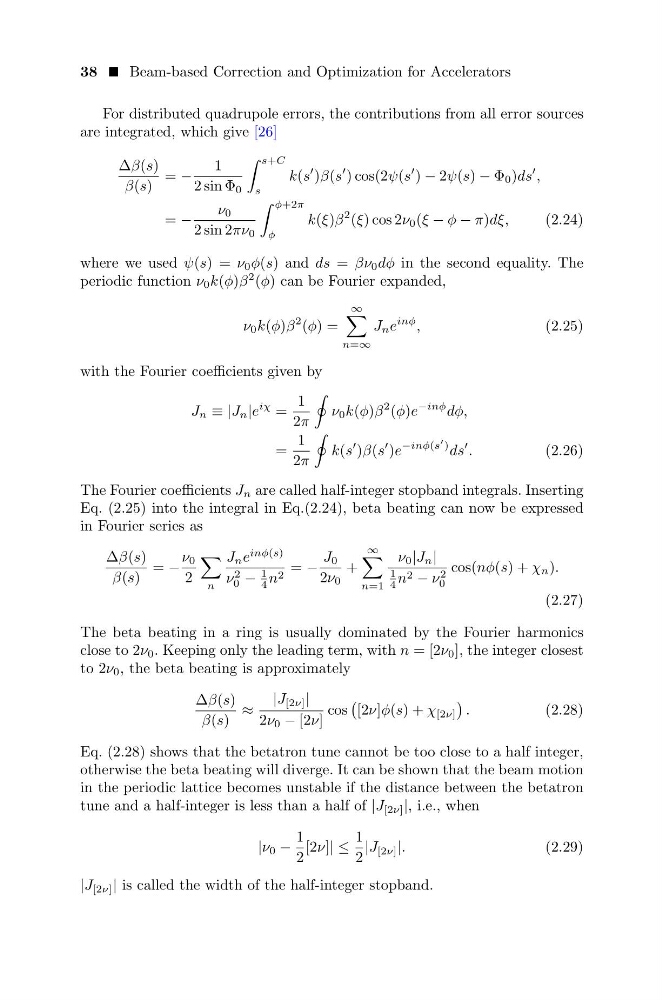
For distributed quadrupole errors, the contributions from all error sources
are integrated, which give [26]
∆β(s)
β(s)
= −
1
2 sin Φ 0
s+C
s
k(s
)β(s
) cos(2ψ(s
) − 2ψ(s) − Φ 0 )ds
,
= −
ν 0
2 sin 2πν 0
φ+2π
φ
k(ξ)β
2 (ξ) cos 2ν 0 (ξ − φ − π)dξ,
(2.24)
where we used ψ(s) = ν 0 φ(s) and ds = βν 0 dφ in the second equality. The
periodic function ν 0 k(φ)β
2 (φ) can be Fourier expanded,
ν 0 k(φ)β
2 (φ) =
∞
n=∞
J n e
inφ ,
(2.25)
with the Fourier coefficients given by
J n ≡ |J n |e
iχ =
1
2π
ν 0 k(φ)β
2 (φ)e
−inφ dφ,
=
1
2π
k(s
)β(s
)e
−inφ(s
) ds
.
(2.26)
The Fourier coefficients J n are called half-integer stopband integrals. Inserting
Eq. (2.25) into the integral in Eq.(2.24), beta beating can now be expressed
in Fourier series as
∆β(s)
β(s)
= −
ν 0
2
n
J n e
inφ(s)
ν 2
0 −
1
4 n 2 = −
J 0
2ν 0
+
∞
n=1
ν 0 |J n |
1
4 n 2 − ν 2
0
cos(nφ(s) + χ n ).
(2.27)
The beta beating in a ring is usually dominated by the Fourier harmonics
close to 2ν 0 . Keeping only the leading term, with n = [2ν 0 ], the integer closest
to 2ν 0 , the beta beating is approximately
∆β(s)
β(s)
≈
|J [2ν] |
2ν 0 − [2ν]
cos
[2ν]φ(s) + χ [2ν]
.
(2.28)
Eq. (2.28) shows that the betatron tune cannot be too close to a half integer,
otherwise the beta beating will diverge. It can be shown that the beam motion
in the periodic lattice becomes unstable if the distance between the betatron
tune and a half-integer is less than a half of |J [2ν] |, i.e., when
|ν 0 −
1
2
[2ν]| ≤
1
2
|J [2ν] |.
(2.29)
|J [2ν] | is called the width of the half-integer stopband.
For distributed quadrupole errors, the contributions from all error sources
are integrated, which give [26]
∆β(s)
β(s)
= −
1
2 sin Φ 0
s+C
s
k(s
)β(s
) cos(2ψ(s
) − 2ψ(s) − Φ 0 )ds
,
= −
ν 0
2 sin 2πν 0
φ+2π
φ
k(ξ)β
2 (ξ) cos 2ν 0 (ξ − φ − π)dξ,
(2.24)
where we used ψ(s) = ν 0 φ(s) and ds = βν 0 dφ in the second equality. The
periodic function ν 0 k(φ)β
2 (φ) can be Fourier expanded,
ν 0 k(φ)β
2 (φ) =
∞
n=∞
J n e
inφ ,
(2.25)
with the Fourier coefficients given by
J n ≡ |J n |e
iχ =
1
2π
ν 0 k(φ)β
2 (φ)e
−inφ dφ,
=
1
2π
k(s
)β(s
)e
−inφ(s
) ds
.
(2.26)
The Fourier coefficients J n are called half-integer stopband integrals. Inserting
Eq. (2.25) into the integral in Eq.(2.24), beta beating can now be expressed
in Fourier series as
∆β(s)
β(s)
= −
ν 0
2
n
J n e
inφ(s)
ν 2
0 −
1
4 n 2 = −
J 0
2ν 0
+
∞
n=1
ν 0 |J n |
1
4 n 2 − ν 2
0
cos(nφ(s) + χ n ).
(2.27)
The beta beating in a ring is usually dominated by the Fourier harmonics
close to 2ν 0 . Keeping only the leading term, with n = [2ν 0 ], the integer closest
to 2ν 0 , the beta beating is approximately
∆β(s)
β(s)
≈
|J [2ν] |
2ν 0 − [2ν]
cos
[2ν]φ(s) + χ [2ν]
.
(2.28)
Eq. (2.28) shows that the betatron tune cannot be too close to a half integer,
otherwise the beta beating will diverge. It can be shown that the beam motion
in the periodic lattice becomes unstable if the distance between the betatron
tune and a half-integer is less than a half of |J [2ν] |, i.e., when
|ν 0 −
1
2
[2ν]| ≤
1
2
|J [2ν] |.
(2.29)
|J [2ν] | is called the width of the half-integer stopband.