

36 Beam-based Correction and Optimization for Accelerators
2.2 LINEAR OPTICS ERRORS
In this section we discuss the effects of quadrupole field errors [26]. Since
quadrupole magnets determine the linear optics of the accelerators, deviations
of the quadrupole fields from the design will distort the linear optics. In other
words, the propagation of phase space coordinates through the beam line will
be changed.
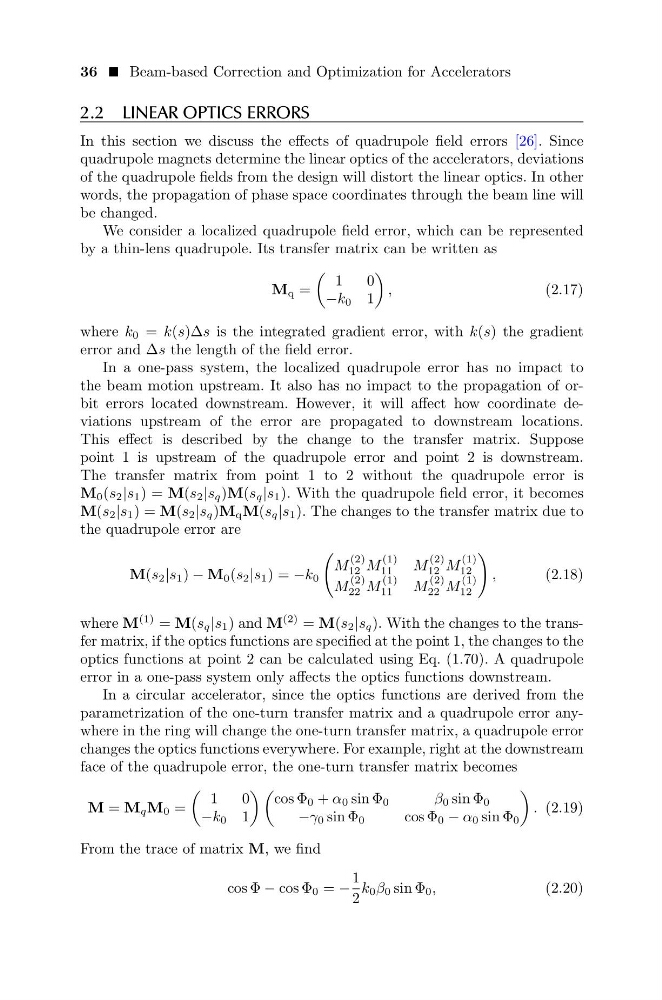
We consider a localized quadrupole field error, which can be represented
by a thin-lens quadrupole. Its transfer matrix can be written as
M q =
1
0
−k 0 1
,
(2.17)
where k 0 = k(s)∆s is the integrated gradient error, with k(s) the gradient
error and ∆s the length of the field error.
In a one-pass system, the localized quadrupole error has no impact to
the beam motion upstream. It also has no impact to the propagation of orbit errors located downstream. However, it will affect how coordinate deviations upstream of the error are propagated to downstream locations.
This effect is described by the change to the transfer matrix. Suppose
point 1 is upstream of the quadrupole error and point 2 is downstream.
The transfer matrix from point 1 to 2 without the quadrupole error is
M 0 (s 2 |s 1 ) = M(s 2 |s q )M(s q |s 1 ). With the quadrupole field error, it becomes
M(s 2 |s 1 ) = M(s 2 |s q )M q M(s q |s 1 ). The changes to the transfer matrix due to
the quadrupole error are
M(s 2 |s 1 ) − M 0 (s 2 |s 1 ) = −k 0
M
(2)
12 M
(1)
11
M
(2)
12 M
(1)
12
M
(2)
22 M
(1)
11
M
(2)
22 M
(1)
12
,
(2.18)
where M
(1) = M(s q |s 1 ) and M
(2) = M(s 2 |s q ). With the changes to the transfer matrix, if the optics functions are specified at the point 1, the changes to the
optics functions at point 2 can be calculated using Eq. (1.70). A quadrupole
error in a one-pass system only affects the optics functions downstream.
In a circular accelerator, since the optics functions are derived from the
parametrization of the one-turn transfer matrix and a quadrupole error anywhere in the ring will change the one-turn transfer matrix, a quadrupole error
changes the optics functions everywhere. For example, right at the downstream
face of the quadrupole error, the one-turn transfer matrix becomes
M = M q M 0 =
1
0
−k 0 1
cos Φ 0 + α 0 sin Φ 0
β 0 sin Φ 0
−γ 0 sin Φ 0
cos Φ 0 − α 0 sin Φ 0
. (2.19)
From the trace of matrix M, we find
cos Φ − cos Φ 0 = −
1
2
k 0 β 0 sin Φ 0 ,
(2.20)
2.2 LINEAR OPTICS ERRORS
In this section we discuss the effects of quadrupole field errors [26]. Since
quadrupole magnets determine the linear optics of the accelerators, deviations
of the quadrupole fields from the design will distort the linear optics. In other
words, the propagation of phase space coordinates through the beam line will
be changed.
We consider a localized quadrupole field error, which can be represented
by a thin-lens quadrupole. Its transfer matrix can be written as
M q =
1
0
−k 0 1
,
(2.17)
where k 0 = k(s)∆s is the integrated gradient error, with k(s) the gradient
error and ∆s the length of the field error.
In a one-pass system, the localized quadrupole error has no impact to
the beam motion upstream. It also has no impact to the propagation of orbit errors located downstream. However, it will affect how coordinate deviations upstream of the error are propagated to downstream locations.
This effect is described by the change to the transfer matrix. Suppose
point 1 is upstream of the quadrupole error and point 2 is downstream.
The transfer matrix from point 1 to 2 without the quadrupole error is
M 0 (s 2 |s 1 ) = M(s 2 |s q )M(s q |s 1 ). With the quadrupole field error, it becomes
M(s 2 |s 1 ) = M(s 2 |s q )M q M(s q |s 1 ). The changes to the transfer matrix due to
the quadrupole error are
M(s 2 |s 1 ) − M 0 (s 2 |s 1 ) = −k 0
M
(2)
12 M
(1)
11
M
(2)
12 M
(1)
12
M
(2)
22 M
(1)
11
M
(2)
22 M
(1)
12
,
(2.18)
where M
(1) = M(s q |s 1 ) and M
(2) = M(s 2 |s q ). With the changes to the transfer matrix, if the optics functions are specified at the point 1, the changes to the
optics functions at point 2 can be calculated using Eq. (1.70). A quadrupole
error in a one-pass system only affects the optics functions downstream.
In a circular accelerator, since the optics functions are derived from the
parametrization of the one-turn transfer matrix and a quadrupole error anywhere in the ring will change the one-turn transfer matrix, a quadrupole error
changes the optics functions everywhere. For example, right at the downstream
face of the quadrupole error, the one-turn transfer matrix becomes
M = M q M 0 =
1
0
−k 0 1
cos Φ 0 + α 0 sin Φ 0
β 0 sin Φ 0
−γ 0 sin Φ 0
cos Φ 0 − α 0 sin Φ 0
. (2.19)
From the trace of matrix M, we find
cos Φ − cos Φ 0 = −
1
2
k 0 β 0 sin Φ 0 ,
(2.20)