

Beam dynamics topics 33
s (m)
0
500
1000
1500
∆y (mm)
-5
0
5
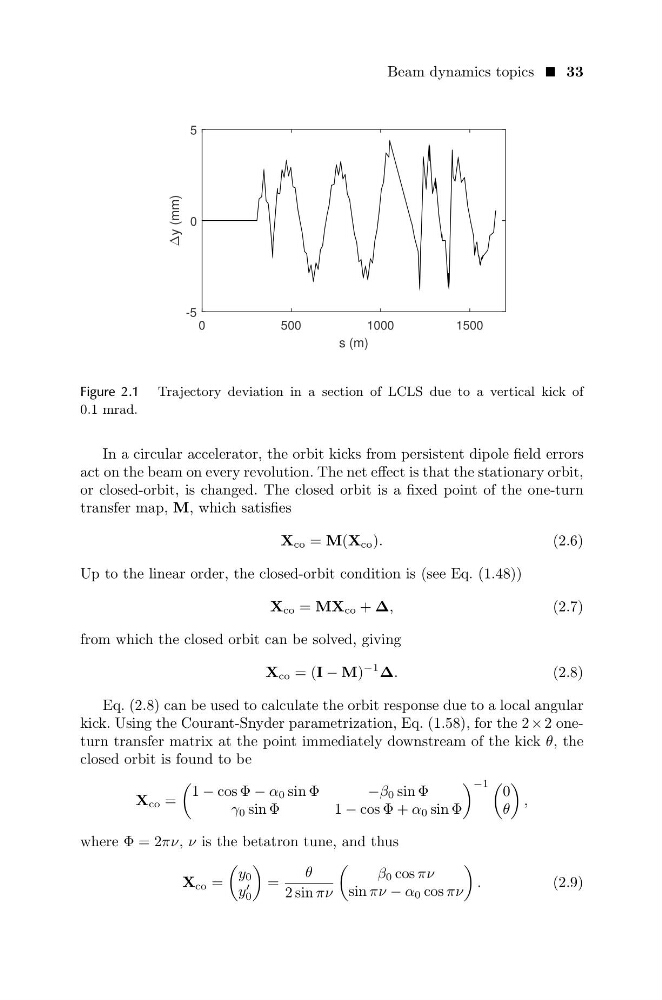
Figure 2.1 Trajectory deviation in a section of LCLS due to a vertical kick of
0.1 mrad.
In a circular accelerator, the orbit kicks from persistent dipole field errors
act on the beam on every revolution. The net effect is that the stationary orbit,
or closed-orbit, is changed. The closed orbit is a fixed point of the one-turn
transfer map, M, which satisfies
X co = M(X co ).
(2.6)
Up to the linear order, the closed-orbit condition is (see Eq. (1.48))
X co = MX co + ∆,
(2.7)
from which the closed orbit can be solved, giving
X co = (I − M)
−1 ∆.
(2.8)
Eq. (2.8) can be used to calculate the orbit response due to a local angular
kick. Using the Courant-Snyder parametrization, Eq. (1.58), for the 2 × 2 oneturn transfer matrix at the point immediately downstream of the kick θ, the
closed orbit is found to be
X co =
1 − cos Φ − α 0 sin Φ
−β 0 sin Φ
γ 0 sin Φ
1 − cos Φ + α 0 sin Φ
−1
0
θ
,
where Φ = 2πν, ν is the betatron tune, and thus
X co =
y 0
y
0
=
θ
2 sin πν
β 0 cos πν
sin πν − α 0 cos πν
.
(2.9)
s (m)
0
500
1000
1500
∆y (mm)
-5
0
5
Figure 2.1 Trajectory deviation in a section of LCLS due to a vertical kick of
0.1 mrad.
In a circular accelerator, the orbit kicks from persistent dipole field errors
act on the beam on every revolution. The net effect is that the stationary orbit,
or closed-orbit, is changed. The closed orbit is a fixed point of the one-turn
transfer map, M, which satisfies
X co = M(X co ).
(2.6)
Up to the linear order, the closed-orbit condition is (see Eq. (1.48))
X co = MX co + ∆,
(2.7)
from which the closed orbit can be solved, giving
X co = (I − M)
−1 ∆.
(2.8)
Eq. (2.8) can be used to calculate the orbit response due to a local angular
kick. Using the Courant-Snyder parametrization, Eq. (1.58), for the 2 × 2 oneturn transfer matrix at the point immediately downstream of the kick θ, the
closed orbit is found to be
X co =
1 − cos Φ − α 0 sin Φ
−β 0 sin Φ
γ 0 sin Φ
1 − cos Φ + α 0 sin Φ
−1
0
θ
,
where Φ = 2πν, ν is the betatron tune, and thus
X co =
y 0
y
0
=
θ
2 sin πν
β 0 cos πν
sin πν − α 0 cos πν
.
(2.9)