

28 Beam-based Correction and Optimization for Accelerators
φ = 0
φ = π
φ = 2π
1.5
−1.5
φs = 165
◦
¯
δ
¯
δ = δ
πhηβ 2
s Es
eV
For η > 0
φ = 0
φ = π
φ = −π
1.5
−1.5
φs = 15
◦
¯
δ
¯
δ = δ
−
πhηβ 2
s Es
eV
For η < 0
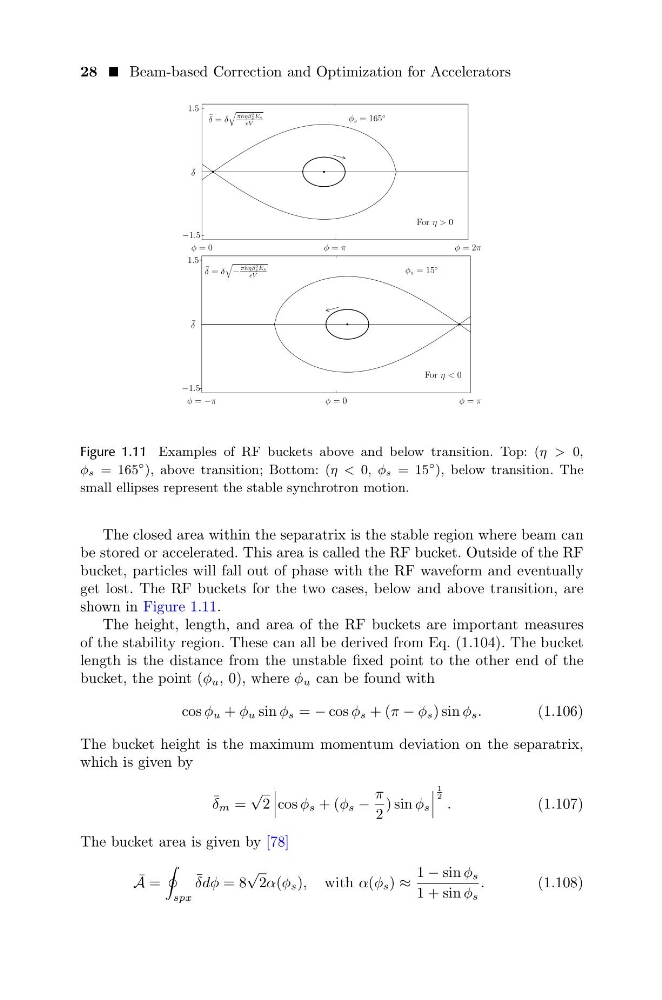
Figure 1.11 Examples of RF buckets above and below transition. Top: (η > 0,
φs = 165
◦ ), above transition; Bottom: (η < 0, φs = 15
◦ ), below transition. The
small ellipses represent the stable synchrotron motion.
The closed area within the separatrix is the stable region where beam can
be stored or accelerated. This area is called the RF bucket. Outside of the RF
bucket, particles will fall out of phase with the RF waveform and eventually
get lost. The RF buckets for the two cases, below and above transition, are
shown in Figure 1.11.
The height, length, and area of the RF buckets are important measures
of the stability region. These can all be derived from Eq. (1.104). The bucket
length is the distance from the unstable fixed point to the other end of the
bucket, the point (φ u , 0), where φ u can be found with
cos φ u + φ u sin φ s = − cos φ s + (π − φ s ) sin φ s .
(1.106)
The bucket height is the maximum momentum deviation on the separatrix,
which is given by
¯
δ m =
√
2
cos φ s + (φ s −
π
2
) sin φ s
1
2 .
(1.107)
The bucket area is given by [78]
¯
A =
spx
¯
δdφ = 8
√
2α(φ s ), with α(φ s ) ≈
1 − sin φ s
1 + sin φ s
.
(1.108)
φ = 0
φ = π
φ = 2π
1.5
−1.5
φs = 165
◦
¯
δ
¯
δ = δ
πhηβ 2
s Es
eV
For η > 0
φ = 0
φ = π
φ = −π
1.5
−1.5
φs = 15
◦
¯
δ
¯
δ = δ
−
πhηβ 2
s Es
eV
For η < 0
Figure 1.11 Examples of RF buckets above and below transition. Top: (η > 0,
φs = 165
◦ ), above transition; Bottom: (η < 0, φs = 15
◦ ), below transition. The
small ellipses represent the stable synchrotron motion.
The closed area within the separatrix is the stable region where beam can
be stored or accelerated. This area is called the RF bucket. Outside of the RF
bucket, particles will fall out of phase with the RF waveform and eventually
get lost. The RF buckets for the two cases, below and above transition, are
shown in Figure 1.11.
The height, length, and area of the RF buckets are important measures
of the stability region. These can all be derived from Eq. (1.104). The bucket
length is the distance from the unstable fixed point to the other end of the
bucket, the point (φ u , 0), where φ u can be found with
cos φ u + φ u sin φ s = − cos φ s + (π − φ s ) sin φ s .
(1.106)
The bucket height is the maximum momentum deviation on the separatrix,
which is given by
¯
δ m =
√
2
cos φ s + (φ s −
π
2
) sin φ s
1
2 .
(1.107)
The bucket area is given by [78]
¯
A =
spx
¯
δdφ = 8
√
2α(φ s ), with α(φ s ) ≈
1 − sin φ s
1 + sin φ s
.
(1.108)