

Basics of beam dynamics 29
sinφ s
0
0.2
0.4
0.6
0.8
1
bucket length, height, and area
0
0.2
0.4
0.6
0.8
1
φLen/2π
¯
δm/
√
2
α(φs)
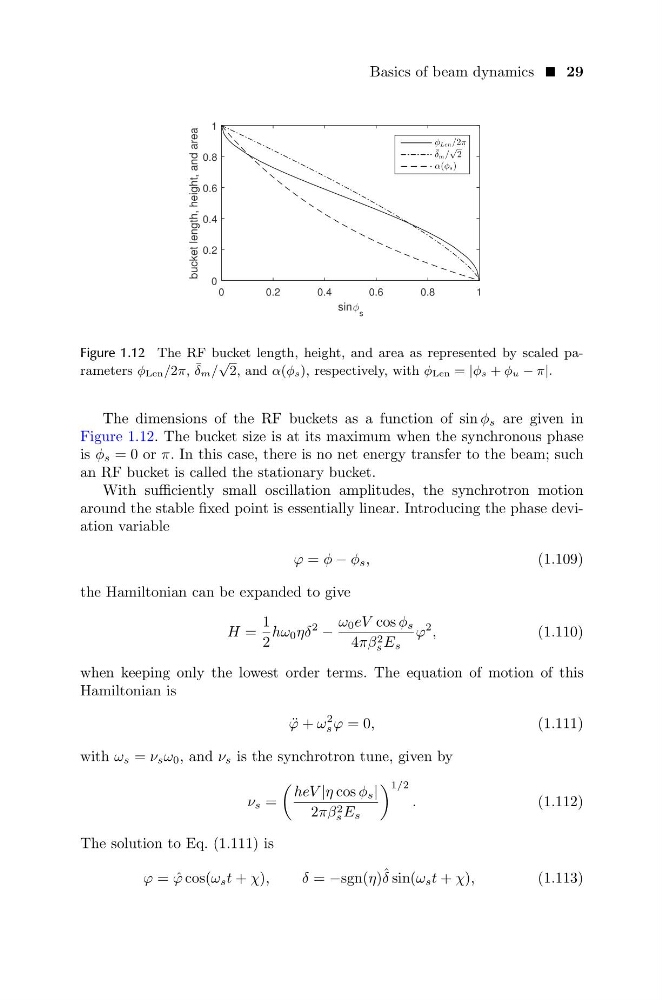
Figure 1.12 The RF bucket length, height, and area as represented by scaled parameters φLen/2π, ¯
δm/
√
2, and α(φs), respectively, with φLen = |φs + φu − π|.
The dimensions of the RF buckets as a function of sin φ s are given in
Figure 1.12. The bucket size is at its maximum when the synchronous phase
is φ s = 0 or π. In this case, there is no net energy transfer to the beam; such
an RF bucket is called the stationary bucket.
With sufficiently small oscillation amplitudes, the synchrotron motion
around the stable fixed point is essentially linear. Introducing the phase deviation variable
ϕ = φ − φ s ,
(1.109)
the Hamiltonian can be expanded to give
H =
1
2
hω 0 ηδ
2 −
ω 0 eV cos φ s
4πβ 2
s E s
ϕ
2 ,
(1.110)
when keeping only the lowest order terms. The equation of motion of this
Hamiltonian is
¨
ϕ + ω
2
s ϕ = 0,
(1.111)
with ω s = ν s ω 0 , and ν s is the synchrotron tune, given by
ν s =
heV |η cos φ s |
2πβ 2
s E s
1/2
.
(1.112)
The solution to Eq. (1.111) is
ϕ = ˆ
ϕ cos(ω s t + χ),
δ = −sgn(η) ˆ
δ sin(ω s t + χ),
(1.113)
sinφ s
0
0.2
0.4
0.6
0.8
1
bucket length, height, and area
0
0.2
0.4
0.6
0.8
1
φLen/2π
¯
δm/
√
2
α(φs)
Figure 1.12 The RF bucket length, height, and area as represented by scaled parameters φLen/2π, ¯
δm/
√
2, and α(φs), respectively, with φLen = |φs + φu − π|.
The dimensions of the RF buckets as a function of sin φ s are given in
Figure 1.12. The bucket size is at its maximum when the synchronous phase
is φ s = 0 or π. In this case, there is no net energy transfer to the beam; such
an RF bucket is called the stationary bucket.
With sufficiently small oscillation amplitudes, the synchrotron motion
around the stable fixed point is essentially linear. Introducing the phase deviation variable
ϕ = φ − φ s ,
(1.109)
the Hamiltonian can be expanded to give
H =
1
2
hω 0 ηδ
2 −
ω 0 eV cos φ s
4πβ 2
s E s
ϕ
2 ,
(1.110)
when keeping only the lowest order terms. The equation of motion of this
Hamiltonian is
¨
ϕ + ω
2
s ϕ = 0,
(1.111)
with ω s = ν s ω 0 , and ν s is the synchrotron tune, given by
ν s =
heV |η cos φ s |
2πβ 2
s E s
1/2
.
(1.112)
The solution to Eq. (1.111) is
ϕ = ˆ
ϕ cos(ω s t + χ),
δ = −sgn(η) ˆ
δ sin(ω s t + χ),
(1.113)