

Basics of beam dynamics 27
In a storage ring, beam energy and the RF frequency do not change. The
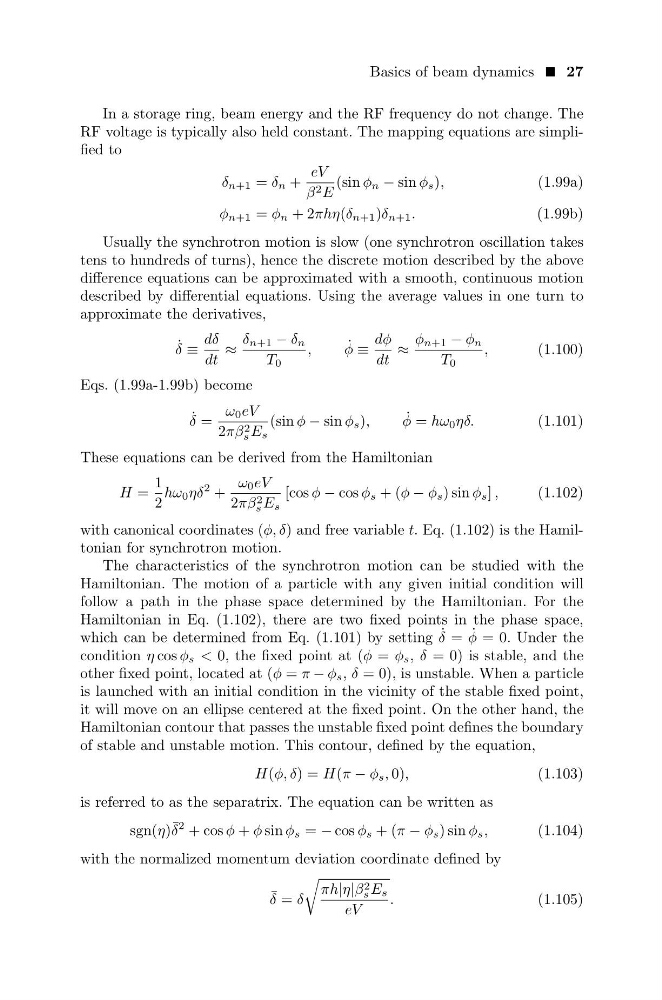
RF voltage is typically also held constant. The mapping equations are simplified to
δ n+1 = δ n +
eV
β 2 E
(sin φ n − sin φ s ),
(1.99a)
φ n+1 = φ n + 2πhη(δ n+1 )δ n+1 .
(1.99b)
Usually the synchrotron motion is slow (one synchrotron oscillation takes
tens to hundreds of turns), hence the discrete motion described by the above
difference equations can be approximated with a smooth, continuous motion
described by differential equations. Using the average values in one turn to
approximate the derivatives,
˙
δ ≡
dδ
dt
≈
δ n+1 − δ n
T 0
,
˙
φ ≡
dφ
dt
≈
φ n+1 − φ n
T 0
,
(1.100)
Eqs. (1.99a-1.99b) become
˙
δ =
ω 0 eV
2πβ 2
s E s
(sin φ − sin φ s ),
˙
φ = hω 0 ηδ.
(1.101)
These equations can be derived from the Hamiltonian
H =
1
2
hω 0 ηδ
2 +
ω 0 eV
2πβ 2
s E s
[cos φ − cos φ s + (φ − φ s ) sin φ s ] ,
(1.102)
with canonical coordinates (φ, δ) and free variable t. Eq. (1.102) is the Hamiltonian for synchrotron motion.
The characteristics of the synchrotron motion can be studied with the
Hamiltonian. The motion of a particle with any given initial condition will
follow a path in the phase space determined by the Hamiltonian. For the
Hamiltonian in Eq. (1.102), there are two fixed points in the phase space,
which can be determined from Eq. (1.101) by setting ˙
δ = ˙
φ = 0. Under the
condition η cos φ s < 0, the fixed point at (φ = φ s , δ = 0) is stable, and the
other fixed point, located at (φ = π − φ s , δ = 0), is unstable. When a particle
is launched with an initial condition in the vicinity of the stable fixed point,
it will move on an ellipse centered at the fixed point. On the other hand, the
Hamiltonian contour that passes the unstable fixed point defines the boundary
of stable and unstable motion. This contour, defined by the equation,
H(φ, δ) = H(π − φ s , 0),
(1.103)
is referred to as the separatrix. The equation can be written as
sgn(η) ¯
δ
2 + cos φ + φ sin φ s = − cos φ s + (π − φ s ) sin φ s ,
(1.104)
with the normalized momentum deviation coordinate defined by
¯
δ = δ
πh|η|β 2
s E s
eV
.
(1.105)
In a storage ring, beam energy and the RF frequency do not change. The
RF voltage is typically also held constant. The mapping equations are simplified to
δ n+1 = δ n +
eV
β 2 E
(sin φ n − sin φ s ),
(1.99a)
φ n+1 = φ n + 2πhη(δ n+1 )δ n+1 .
(1.99b)
Usually the synchrotron motion is slow (one synchrotron oscillation takes
tens to hundreds of turns), hence the discrete motion described by the above
difference equations can be approximated with a smooth, continuous motion
described by differential equations. Using the average values in one turn to
approximate the derivatives,
˙
δ ≡
dδ
dt
≈
δ n+1 − δ n
T 0
,
˙
φ ≡
dφ
dt
≈
φ n+1 − φ n
T 0
,
(1.100)
Eqs. (1.99a-1.99b) become
˙
δ =
ω 0 eV
2πβ 2
s E s
(sin φ − sin φ s ),
˙
φ = hω 0 ηδ.
(1.101)
These equations can be derived from the Hamiltonian
H =
1
2
hω 0 ηδ
2 +
ω 0 eV
2πβ 2
s E s
[cos φ − cos φ s + (φ − φ s ) sin φ s ] ,
(1.102)
with canonical coordinates (φ, δ) and free variable t. Eq. (1.102) is the Hamiltonian for synchrotron motion.
The characteristics of the synchrotron motion can be studied with the
Hamiltonian. The motion of a particle with any given initial condition will
follow a path in the phase space determined by the Hamiltonian. For the
Hamiltonian in Eq. (1.102), there are two fixed points in the phase space,
which can be determined from Eq. (1.101) by setting ˙
δ = ˙
φ = 0. Under the
condition η cos φ s < 0, the fixed point at (φ = φ s , δ = 0) is stable, and the
other fixed point, located at (φ = π − φ s , δ = 0), is unstable. When a particle
is launched with an initial condition in the vicinity of the stable fixed point,
it will move on an ellipse centered at the fixed point. On the other hand, the
Hamiltonian contour that passes the unstable fixed point defines the boundary
of stable and unstable motion. This contour, defined by the equation,
H(φ, δ) = H(π − φ s , 0),
(1.103)
is referred to as the separatrix. The equation can be written as
sgn(η) ¯
δ
2 + cos φ + φ sin φ s = − cos φ s + (π − φ s ) sin φ s ,
(1.104)
with the normalized momentum deviation coordinate defined by
¯
δ = δ
πh|η|β 2
s E s
eV
.
(1.105)