

Application of beam-based optimization 211
of K2 and K3 are varied to match the K1 parameters. There are 8 control
parameters in total: the pulse voltage (amplitude), the pulse width, and the
pulse timing of K2 and K3, and the two skew quadrupoles [57].
Betatron oscillations can be measured with a turn-by-turn BPM. Because
of the different pulse shapes of the three kickers and the potential time shifts
between the kickers, for a given kicker setting, the amplitudes and phases of
residual oscillations at different bunches in a bunch train are not the same.
Since the turn-by-turn BPM measures the average position of all bunches, it
could happen that some bunches are oscillating in opposite phases and their
motion is not detected by the BPM. A likely case is for the timing of one kicker
to be shifted from the perfectly matched setting, which causes the bunches
in the head and the tail of the kicker pulse to see net kicks of opposite signs.
The goal of kicker bump matching is to minimize the average of oscillations at
all bunches, as measured by the sum of squares of their amplitudes. To avoid
the cancellation in the measured beam motion, a bunch train much shorter
than the pulse width can be used. To measure the residual oscillations at a
different position in the bunch train, the kicker timing is shifted to align with
the certain bucket. The objective of optimization is the sum of the oscillation
amplitudes of the short bunch train with a few kicker timing selections. For
the 372 buckets in SPEAR3, a bunch train of 186 bunches can be used and
the kicker pulses can be aligned with buckets 1, 93, 187, and 280.
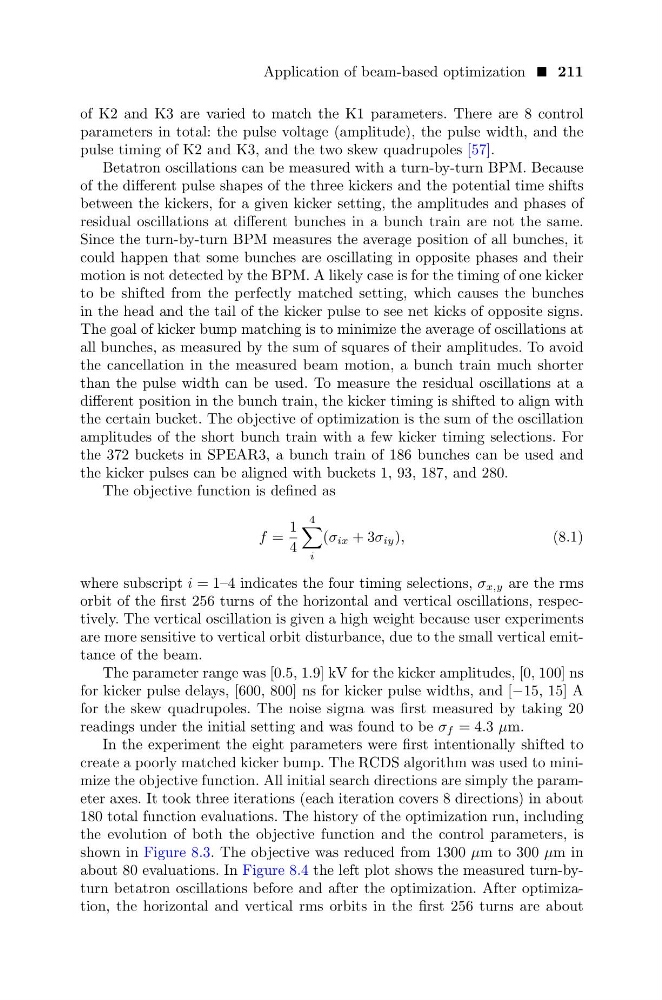
The objective function is defined as
f =
1
4
4
i
(σ ix + 3σ iy ),
(8.1)
where subscript i = 1–4 indicates the four timing selections, σ x,y are the rms
orbit of the first 256 turns of the horizontal and vertical oscillations, respectively. The vertical oscillation is given a high weight because user experiments
are more sensitive to vertical orbit disturbance, due to the small vertical emittance of the beam.
The parameter range was [0.5, 1.9] kV for the kicker amplitudes, [0, 100] ns
for kicker pulse delays, [600, 800] ns for kicker pulse widths, and [−15, 15] A
for the skew quadrupoles. The noise sigma was first measured by taking 20
readings under the initial setting and was found to be σ f = 4.3 µm.
In the experiment the eight parameters were first intentionally shifted to
create a poorly matched kicker bump. The RCDS algorithm was used to minimize the objective function. All initial search directions are simply the parameter axes. It took three iterations (each iteration covers 8 directions) in about
180 total function evaluations. The history of the optimization run, including
the evolution of both the objective function and the control parameters, is
shown in Figure 8.3. The objective was reduced from 1300 µm to 300 µm in
about 80 evaluations. In Figure 8.4 the left plot shows the measured turn-byturn betatron oscillations before and after the optimization. After optimization, the horizontal and vertical rms orbits in the first 256 turns are about
of K2 and K3 are varied to match the K1 parameters. There are 8 control
parameters in total: the pulse voltage (amplitude), the pulse width, and the
pulse timing of K2 and K3, and the two skew quadrupoles [57].
Betatron oscillations can be measured with a turn-by-turn BPM. Because
of the different pulse shapes of the three kickers and the potential time shifts
between the kickers, for a given kicker setting, the amplitudes and phases of
residual oscillations at different bunches in a bunch train are not the same.
Since the turn-by-turn BPM measures the average position of all bunches, it
could happen that some bunches are oscillating in opposite phases and their
motion is not detected by the BPM. A likely case is for the timing of one kicker
to be shifted from the perfectly matched setting, which causes the bunches
in the head and the tail of the kicker pulse to see net kicks of opposite signs.
The goal of kicker bump matching is to minimize the average of oscillations at
all bunches, as measured by the sum of squares of their amplitudes. To avoid
the cancellation in the measured beam motion, a bunch train much shorter
than the pulse width can be used. To measure the residual oscillations at a
different position in the bunch train, the kicker timing is shifted to align with
the certain bucket. The objective of optimization is the sum of the oscillation
amplitudes of the short bunch train with a few kicker timing selections. For
the 372 buckets in SPEAR3, a bunch train of 186 bunches can be used and
the kicker pulses can be aligned with buckets 1, 93, 187, and 280.
The objective function is defined as
f =
1
4
4
i
(σ ix + 3σ iy ),
(8.1)
where subscript i = 1–4 indicates the four timing selections, σ x,y are the rms
orbit of the first 256 turns of the horizontal and vertical oscillations, respectively. The vertical oscillation is given a high weight because user experiments
are more sensitive to vertical orbit disturbance, due to the small vertical emittance of the beam.
The parameter range was [0.5, 1.9] kV for the kicker amplitudes, [0, 100] ns
for kicker pulse delays, [600, 800] ns for kicker pulse widths, and [−15, 15] A
for the skew quadrupoles. The noise sigma was first measured by taking 20
readings under the initial setting and was found to be σ f = 4.3 µm.
In the experiment the eight parameters were first intentionally shifted to
create a poorly matched kicker bump. The RCDS algorithm was used to minimize the objective function. All initial search directions are simply the parameter axes. It took three iterations (each iteration covers 8 directions) in about
180 total function evaluations. The history of the optimization run, including
the evolution of both the objective function and the control parameters, is
shown in Figure 8.3. The objective was reduced from 1300 µm to 300 µm in
about 80 evaluations. In Figure 8.4 the left plot shows the measured turn-byturn betatron oscillations before and after the optimization. After optimization, the horizontal and vertical rms orbits in the first 256 turns are about