

126 Beam-based Correction and Optimization for Accelerators
Theoretically, NAFF with Hanning window can achieve the tune precision of
1
N 4 . But that is typically not the case with random noise in the data.
Interpolated FFT: When the tune of the signal does not fall exactly on
a spectral line (with interval of
1
N ), the neighboring spectral lines will have
nonzero heights. For a pure sinusoidal signal, the heights of the spectral lines
can be calculated, which gives [7],
|F (ν j )| =
sin N π(ν − ν j )
N sin π(ν − ν j )
,
(5.12)
where ν j =
j−1
N . Using the heights of the peak spectral line and its highest
neighbor, the tune can be determined with the formula
ν =
k − 1
N
+
1
π
tan
−1
|F (ν k+1 )| sin
π
N
|F (ν k )| + |F (ν k+1 )| cos
π
N
,
(5.13)
where k is the peak and k + 1 its highest neighbor. For a large N , the above
formula can be approximated very well by
ν =
k − 1
N
+
1
N
·
|F (ν k+1 )|
|F (ν k )| + |F (ν k+1 )|
,
(5.14)
which is essentially a linear interpolation between the two highest lines.
The precision of tune measurement with interpolated FFT is also
1
N 2 and
it can be improved by data windowing to
1
N 4 using the Hanning window.
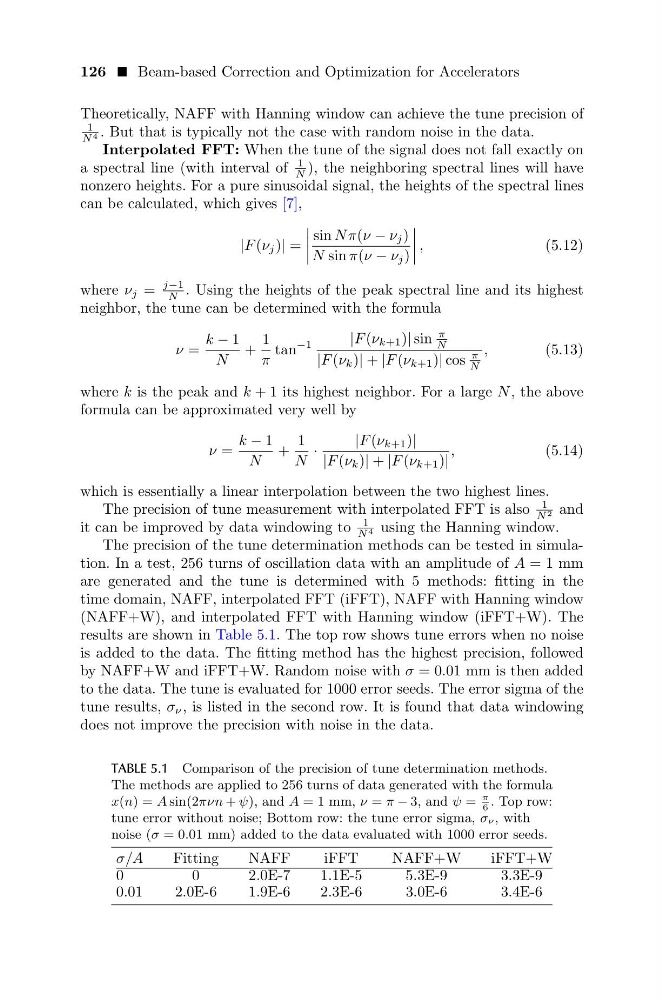
The precision of the tune determination methods can be tested in simulation. In a test, 256 turns of oscillation data with an amplitude of A = 1 mm
are generated and the tune is determined with 5 methods: fitting in the
time domain, NAFF, interpolated FFT (iFFT), NAFF with Hanning window
(NAFF+W), and interpolated FFT with Hanning window (iFFT+W). The
results are shown in Table 5.1. The top row shows tune errors when no noise
is added to the data. The fitting method has the highest precision, followed
by NAFF+W and iFFT+W. Random noise with σ = 0.01 mm is then added
to the data. The tune is evaluated for 1000 error seeds. The error sigma of the
tune results, σ ν , is listed in the second row. It is found that data windowing
does not improve the precision with noise in the data.
TABLE 5.1 Comparison of the precision of tune determination methods.
The methods are applied to 256 turns of data generated with the formula
x(n) = A sin(2πνn + ψ), and A = 1 mm, ν = π − 3, and ψ =
π
6
. Top row:
tune error without noise; Bottom row: the tune error sigma, σν , with
noise (σ = 0.01 mm) added to the data evaluated with 1000 error seeds.
σ/A
Fitting
NAFF
iFFT
NAFF+W
iFFT+W
0
0
2.0E-7
1.1E-5
5.3E-9
3.3E-9
0.01
2.0E-6
1.9E-6
2.3E-6
3.0E-6
3.4E-6
Theoretically, NAFF with Hanning window can achieve the tune precision of
1
N 4 . But that is typically not the case with random noise in the data.
Interpolated FFT: When the tune of the signal does not fall exactly on
a spectral line (with interval of
1
N ), the neighboring spectral lines will have
nonzero heights. For a pure sinusoidal signal, the heights of the spectral lines
can be calculated, which gives [7],
|F (ν j )| =
sin N π(ν − ν j )
N sin π(ν − ν j )
,
(5.12)
where ν j =
j−1
N . Using the heights of the peak spectral line and its highest
neighbor, the tune can be determined with the formula
ν =
k − 1
N
+
1
π
tan
−1
|F (ν k+1 )| sin
π
N
|F (ν k )| + |F (ν k+1 )| cos
π
N
,
(5.13)
where k is the peak and k + 1 its highest neighbor. For a large N , the above
formula can be approximated very well by
ν =
k − 1
N
+
1
N
·
|F (ν k+1 )|
|F (ν k )| + |F (ν k+1 )|
,
(5.14)
which is essentially a linear interpolation between the two highest lines.
The precision of tune measurement with interpolated FFT is also
1
N 2 and
it can be improved by data windowing to
1
N 4 using the Hanning window.
The precision of the tune determination methods can be tested in simulation. In a test, 256 turns of oscillation data with an amplitude of A = 1 mm
are generated and the tune is determined with 5 methods: fitting in the
time domain, NAFF, interpolated FFT (iFFT), NAFF with Hanning window
(NAFF+W), and interpolated FFT with Hanning window (iFFT+W). The
results are shown in Table 5.1. The top row shows tune errors when no noise
is added to the data. The fitting method has the highest precision, followed
by NAFF+W and iFFT+W. Random noise with σ = 0.01 mm is then added
to the data. The tune is evaluated for 1000 error seeds. The error sigma of the
tune results, σ ν , is listed in the second row. It is found that data windowing
does not improve the precision with noise in the data.
TABLE 5.1 Comparison of the precision of tune determination methods.
The methods are applied to 256 turns of data generated with the formula
x(n) = A sin(2πνn + ψ), and A = 1 mm, ν = π − 3, and ψ =
π
6
. Top row:
tune error without noise; Bottom row: the tune error sigma, σν , with
noise (σ = 0.01 mm) added to the data evaluated with 1000 error seeds.
σ/A
Fitting
NAFF
iFFT
NAFF+W
iFFT+W
0
0
2.0E-7
1.1E-5
5.3E-9
3.3E-9
0.01
2.0E-6
1.9E-6
2.3E-6
3.0E-6
3.4E-6