

Linear optics measurement and correction - II 125
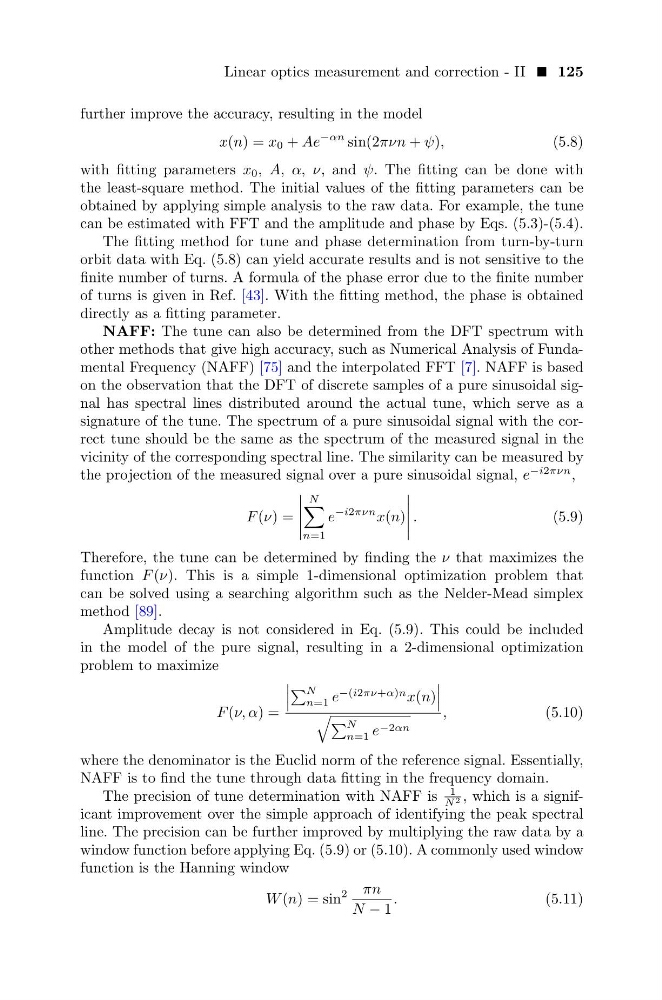
further improve the accuracy, resulting in the model
x(n) = x 0 + Ae
−αn sin(2πνn + ψ),
(5.8)
with fitting parameters x 0 , A, α, ν, and ψ. The fitting can be done with
the least-square method. The initial values of the fitting parameters can be
obtained by applying simple analysis to the raw data. For example, the tune
can be estimated with FFT and the amplitude and phase by Eqs. (5.3)-(5.4).
The fitting method for tune and phase determination from turn-by-turn
orbit data with Eq. (5.8) can yield accurate results and is not sensitive to the
finite number of turns. A formula of the phase error due to the finite number
of turns is given in Ref. [43]. With the fitting method, the phase is obtained
directly as a fitting parameter.
NAFF: The tune can also be determined from the DFT spectrum with
other methods that give high accuracy, such as Numerical Analysis of Fundamental Frequency (NAFF) [75] and the interpolated FFT [7]. NAFF is based
on the observation that the DFT of discrete samples of a pure sinusoidal signal has spectral lines distributed around the actual tune, which serve as a
signature of the tune. The spectrum of a pure sinusoidal signal with the correct tune should be the same as the spectrum of the measured signal in the
vicinity of the corresponding spectral line. The similarity can be measured by
the projection of the measured signal over a pure sinusoidal signal, e
−i2πνn ,
F (ν) =
N
n=1
e
−i2πνn x(n)
.
(5.9)
Therefore, the tune can be determined by finding the ν that maximizes the
function F (ν). This is a simple 1-dimensional optimization problem that
can be solved using a searching algorithm such as the Nelder-Mead simplex
method [89].
Amplitude decay is not considered in Eq. (5.9). This could be included
in the model of the pure signal, resulting in a 2-dimensional optimization
problem to maximize
F (ν, α) =
N
n=1 e
−(i2πν+α)n x(n)
N
n=1 e −2αn
,
(5.10)
where the denominator is the Euclid norm of the reference signal. Essentially,
NAFF is to find the tune through data fitting in the frequency domain.
The precision of tune determination with NAFF is
1
N 2 , which is a significant improvement over the simple approach of identifying the peak spectral
line. The precision can be further improved by multiplying the raw data by a
window function before applying Eq. (5.9) or (5.10). A commonly used window
function is the Hanning window
W (n) = sin
2
πn
N − 1
.
(5.11)
further improve the accuracy, resulting in the model
x(n) = x 0 + Ae
−αn sin(2πνn + ψ),
(5.8)
with fitting parameters x 0 , A, α, ν, and ψ. The fitting can be done with
the least-square method. The initial values of the fitting parameters can be
obtained by applying simple analysis to the raw data. For example, the tune
can be estimated with FFT and the amplitude and phase by Eqs. (5.3)-(5.4).
The fitting method for tune and phase determination from turn-by-turn
orbit data with Eq. (5.8) can yield accurate results and is not sensitive to the
finite number of turns. A formula of the phase error due to the finite number
of turns is given in Ref. [43]. With the fitting method, the phase is obtained
directly as a fitting parameter.
NAFF: The tune can also be determined from the DFT spectrum with
other methods that give high accuracy, such as Numerical Analysis of Fundamental Frequency (NAFF) [75] and the interpolated FFT [7]. NAFF is based
on the observation that the DFT of discrete samples of a pure sinusoidal signal has spectral lines distributed around the actual tune, which serve as a
signature of the tune. The spectrum of a pure sinusoidal signal with the correct tune should be the same as the spectrum of the measured signal in the
vicinity of the corresponding spectral line. The similarity can be measured by
the projection of the measured signal over a pure sinusoidal signal, e
−i2πνn ,
F (ν) =
N
n=1
e
−i2πνn x(n)
.
(5.9)
Therefore, the tune can be determined by finding the ν that maximizes the
function F (ν). This is a simple 1-dimensional optimization problem that
can be solved using a searching algorithm such as the Nelder-Mead simplex
method [89].
Amplitude decay is not considered in Eq. (5.9). This could be included
in the model of the pure signal, resulting in a 2-dimensional optimization
problem to maximize
F (ν, α) =
N
n=1 e
−(i2πν+α)n x(n)
N
n=1 e −2αn
,
(5.10)
where the denominator is the Euclid norm of the reference signal. Essentially,
NAFF is to find the tune through data fitting in the frequency domain.
The precision of tune determination with NAFF is
1
N 2 , which is a significant improvement over the simple approach of identifying the peak spectral
line. The precision can be further improved by multiplying the raw data by a
window function before applying Eq. (5.9) or (5.10). A commonly used window
function is the Hanning window
W (n) = sin
2
πn
N − 1
.
(5.11)