

124 Beam-based Correction and Optimization for Accelerators
The oscillation amplitude on experimental turn-by-turn BPM data typically decreases with the turn number. The amplitude decrease can come from
radiation damping (for electron rings) and head-tail damping (a collective effect). However, the decoherence of the bunched beam due to the tune spread
among the particles in the beam is often a bigger factor. Decoherence causes
the particles to gradually oscillate out of phase and results in a small average
position as measured by the BPMs. The amplitude decrease due to damping
and decoherence has a negative impact on the accuracy of phase measurement
using Eq. (5.4). The method works better for data without a significant amplitude change. Therefore, a proper choice of the number of turns in the data
is desired for the application of the above method.
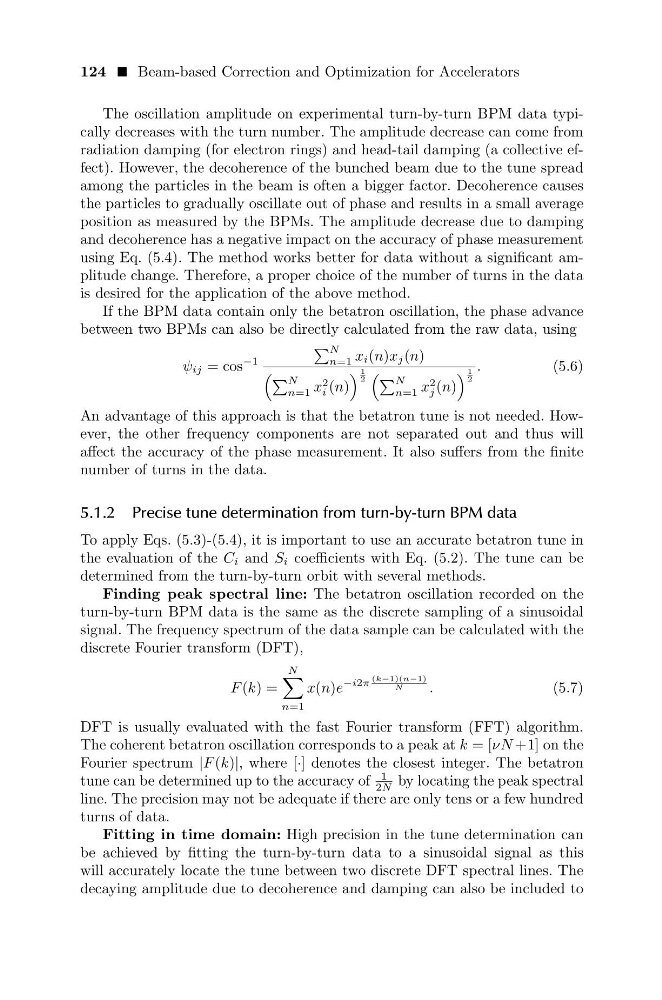
If the BPM data contain only the betatron oscillation, the phase advance
between two BPMs can also be directly calculated from the raw data, using
ψ ij = cos
−1
N
n=1 x i (n)x j (n)
N
n=1 x 2
i (n)
1
2
N
n=1 x 2
j (n)
1
2
.
(5.6)
An advantage of this approach is that the betatron tune is not needed. However, the other frequency components are not separated out and thus will
affect the accuracy of the phase measurement. It also suffers from the finite
number of turns in the data.
5.1.2 Precise tune determination from turn-by-turn BPM data
To apply Eqs. (5.3)-(5.4), it is important to use an accurate betatron tune in
the evaluation of the C i and S i coefficients with Eq. (5.2). The tune can be
determined from the turn-by-turn orbit with several methods.
Finding peak spectral line: The betatron oscillation recorded on the
turn-by-turn BPM data is the same as the discrete sampling of a sinusoidal
signal. The frequency spectrum of the data sample can be calculated with the
discrete Fourier transform (DFT),
F (k) =
N
n=1
x(n)e
−i2π
(k−1)(n−1)
N
.
(5.7)
DFT is usually evaluated with the fast Fourier transform (FFT) algorithm.
The coherent betatron oscillation corresponds to a peak at k = [νN +1] on the
Fourier spectrum |F (k)|, where [·] denotes the closest integer. The betatron
tune can be determined up to the accuracy of
1
2N by locating the peak spectral
line. The precision may not be adequate if there are only tens or a few hundred
turns of data.
Fitting in time domain: High precision in the tune determination can
be achieved by fitting the turn-by-turn data to a sinusoidal signal as this
will accurately locate the tune between two discrete DFT spectral lines. The
decaying amplitude due to decoherence and damping can also be included to
The oscillation amplitude on experimental turn-by-turn BPM data typically decreases with the turn number. The amplitude decrease can come from
radiation damping (for electron rings) and head-tail damping (a collective effect). However, the decoherence of the bunched beam due to the tune spread
among the particles in the beam is often a bigger factor. Decoherence causes
the particles to gradually oscillate out of phase and results in a small average
position as measured by the BPMs. The amplitude decrease due to damping
and decoherence has a negative impact on the accuracy of phase measurement
using Eq. (5.4). The method works better for data without a significant amplitude change. Therefore, a proper choice of the number of turns in the data
is desired for the application of the above method.
If the BPM data contain only the betatron oscillation, the phase advance
between two BPMs can also be directly calculated from the raw data, using
ψ ij = cos
−1
N
n=1 x i (n)x j (n)
N
n=1 x 2
i (n)
1
2
N
n=1 x 2
j (n)
1
2
.
(5.6)
An advantage of this approach is that the betatron tune is not needed. However, the other frequency components are not separated out and thus will
affect the accuracy of the phase measurement. It also suffers from the finite
number of turns in the data.
5.1.2 Precise tune determination from turn-by-turn BPM data
To apply Eqs. (5.3)-(5.4), it is important to use an accurate betatron tune in
the evaluation of the C i and S i coefficients with Eq. (5.2). The tune can be
determined from the turn-by-turn orbit with several methods.
Finding peak spectral line: The betatron oscillation recorded on the
turn-by-turn BPM data is the same as the discrete sampling of a sinusoidal
signal. The frequency spectrum of the data sample can be calculated with the
discrete Fourier transform (DFT),
F (k) =
N
n=1
x(n)e
−i2π
(k−1)(n−1)
N
.
(5.7)
DFT is usually evaluated with the fast Fourier transform (FFT) algorithm.
The coherent betatron oscillation corresponds to a peak at k = [νN +1] on the
Fourier spectrum |F (k)|, where [·] denotes the closest integer. The betatron
tune can be determined up to the accuracy of
1
2N by locating the peak spectral
line. The precision may not be adequate if there are only tens or a few hundred
turns of data.
Fitting in time domain: High precision in the tune determination can
be achieved by fitting the turn-by-turn data to a sinusoidal signal as this
will accurately locate the tune between two discrete DFT spectral lines. The
decaying amplitude due to decoherence and damping can also be included to