

Linear optics measurement and correction - II 123
-2
0
2
x (mm)
10
-1
10
1
10
3
|F
x
|
x
y
50
100 150 200 250
turn
-1
0
1
y (mm)
0
0.1
0.2
0.3
0.4
tune
10
-1
10
1
10
3
|F
y
|
x
y
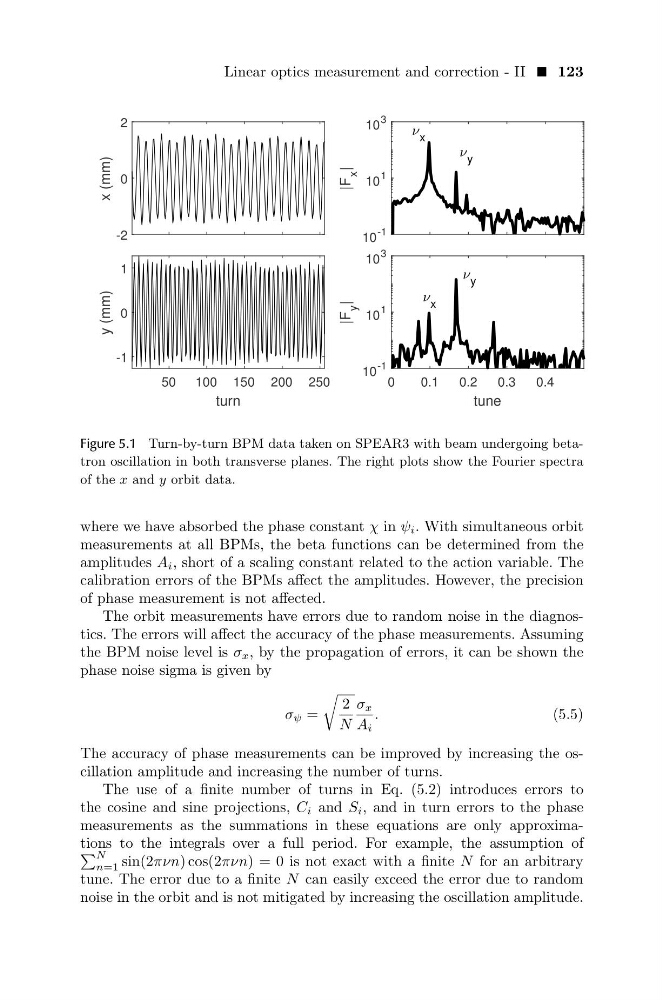
Figure 5.1 Turn-by-turn BPM data taken on SPEAR3 with beam undergoing betatron oscillation in both transverse planes. The right plots show the Fourier spectra
of the x and y orbit data.
where we have absorbed the phase constant χ in ψ i . With simultaneous orbit
measurements at all BPMs, the beta functions can be determined from the
amplitudes A i , short of a scaling constant related to the action variable. The
calibration errors of the BPMs affect the amplitudes. However, the precision
of phase measurement is not affected.
The orbit measurements have errors due to random noise in the diagnostics. The errors will affect the accuracy of the phase measurements. Assuming
the BPM noise level is σ x , by the propagation of errors, it can be shown the
phase noise sigma is given by
σ ψ =
2
N
σ x
A i
.
(5.5)
The accuracy of phase measurements can be improved by increasing the oscillation amplitude and increasing the number of turns.
The use of a finite number of turns in Eq. (5.2) introduces errors to
the cosine and sine projections, C i and S i , and in turn errors to the phase
measurements as the summations in these equations are only approximations to the integrals over a full period. For example, the assumption of
N
n=1 sin(2πνn) cos(2πνn) = 0 is not exact with a finite N for an arbitrary
tune. The error due to a finite N can easily exceed the error due to random
noise in the orbit and is not mitigated by increasing the oscillation amplitude.
-2
0
2
x (mm)
10
-1
10
1
10
3
|F
x
|
x
y
50
100 150 200 250
turn
-1
0
1
y (mm)
0
0.1
0.2
0.3
0.4
tune
10
-1
10
1
10
3
|F
y
|
x
y
Figure 5.1 Turn-by-turn BPM data taken on SPEAR3 with beam undergoing betatron oscillation in both transverse planes. The right plots show the Fourier spectra
of the x and y orbit data.
where we have absorbed the phase constant χ in ψ i . With simultaneous orbit
measurements at all BPMs, the beta functions can be determined from the
amplitudes A i , short of a scaling constant related to the action variable. The
calibration errors of the BPMs affect the amplitudes. However, the precision
of phase measurement is not affected.
The orbit measurements have errors due to random noise in the diagnostics. The errors will affect the accuracy of the phase measurements. Assuming
the BPM noise level is σ x , by the propagation of errors, it can be shown the
phase noise sigma is given by
σ ψ =
2
N
σ x
A i
.
(5.5)
The accuracy of phase measurements can be improved by increasing the oscillation amplitude and increasing the number of turns.
The use of a finite number of turns in Eq. (5.2) introduces errors to
the cosine and sine projections, C i and S i , and in turn errors to the phase
measurements as the summations in these equations are only approximations to the integrals over a full period. For example, the assumption of
N
n=1 sin(2πνn) cos(2πνn) = 0 is not exact with a finite N for an arbitrary
tune. The error due to a finite N can easily exceed the error due to random
noise in the orbit and is not mitigated by increasing the oscillation amplitude.