

Linear optics measurement and correction - I 109
0
5
10
15
20
x
(m)
before corr.
0
5
10
15
20
y
(m)
before corr.
0
50
100
150
200
s (m)
0
5
10
15
x
(m)
after corr.
0
50
100
150
200
s (m)
0
5
10
15
20
y
(m)
after corr.
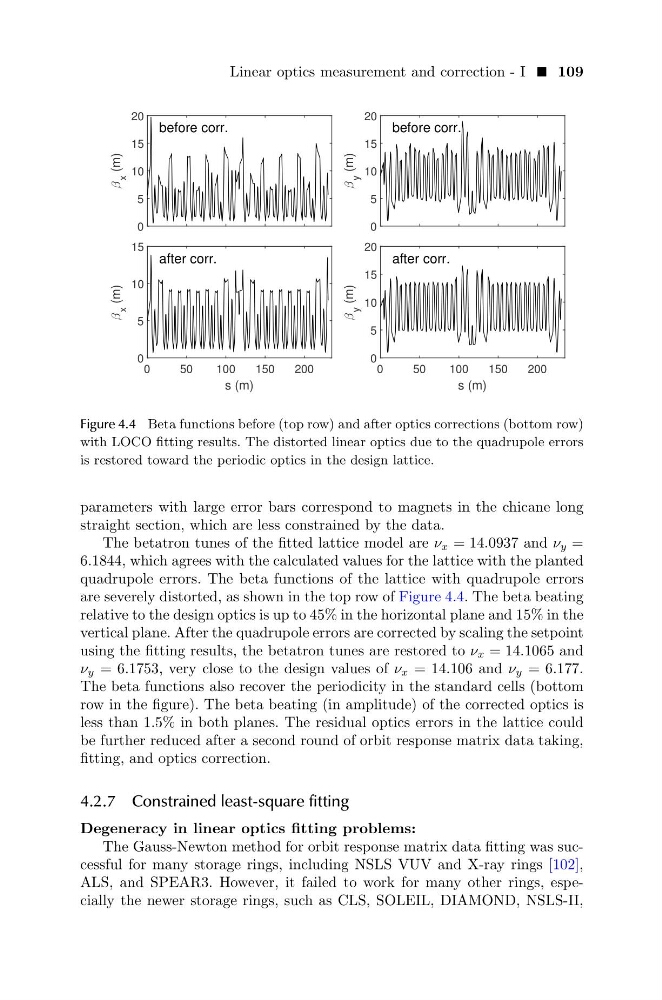
Figure 4.4 Beta functions before (top row) and after optics corrections (bottom row)
with LOCO fitting results. The distorted linear optics due to the quadrupole errors
is restored toward the periodic optics in the design lattice.
parameters with large error bars correspond to magnets in the chicane long
straight section, which are less constrained by the data.
The betatron tunes of the fitted lattice model are ν x = 14.0937 and ν y =
6.1844, which agrees with the calculated values for the lattice with the planted
quadrupole errors. The beta functions of the lattice with quadrupole errors
are severely distorted, as shown in the top row of Figure 4.4. The beta beating
relative to the design optics is up to 45% in the horizontal plane and 15% in the
vertical plane. After the quadrupole errors are corrected by scaling the setpoint
using the fitting results, the betatron tunes are restored to ν x = 14.1065 and
ν y = 6.1753, very close to the design values of ν x = 14.106 and ν y = 6.177.
The beta functions also recover the periodicity in the standard cells (bottom
row in the figure). The beta beating (in amplitude) of the corrected optics is
less than 1.5% in both planes. The residual optics errors in the lattice could
be further reduced after a second round of orbit response matrix data taking,
fitting, and optics correction.
4.2.7 Constrained least-square fitting
Degeneracy in linear optics fitting problems:
The Gauss-Newton method for orbit response matrix data fitting was successful for many storage rings, including NSLS VUV and X-ray rings [102],
ALS, and SPEAR3. However, it failed to work for many other rings, especially the newer storage rings, such as CLS, SOLEIL, DIAMOND, NSLS-II,
0
5
10
15
20
x
(m)
before corr.
0
5
10
15
20
y
(m)
before corr.
0
50
100
150
200
s (m)
0
5
10
15
x
(m)
after corr.
0
50
100
150
200
s (m)
0
5
10
15
20
y
(m)
after corr.
Figure 4.4 Beta functions before (top row) and after optics corrections (bottom row)
with LOCO fitting results. The distorted linear optics due to the quadrupole errors
is restored toward the periodic optics in the design lattice.
parameters with large error bars correspond to magnets in the chicane long
straight section, which are less constrained by the data.
The betatron tunes of the fitted lattice model are ν x = 14.0937 and ν y =
6.1844, which agrees with the calculated values for the lattice with the planted
quadrupole errors. The beta functions of the lattice with quadrupole errors
are severely distorted, as shown in the top row of Figure 4.4. The beta beating
relative to the design optics is up to 45% in the horizontal plane and 15% in the
vertical plane. After the quadrupole errors are corrected by scaling the setpoint
using the fitting results, the betatron tunes are restored to ν x = 14.1065 and
ν y = 6.1753, very close to the design values of ν x = 14.106 and ν y = 6.177.
The beta functions also recover the periodicity in the standard cells (bottom
row in the figure). The beta beating (in amplitude) of the corrected optics is
less than 1.5% in both planes. The residual optics errors in the lattice could
be further reduced after a second round of orbit response matrix data taking,
fitting, and optics correction.
4.2.7 Constrained least-square fitting
Degeneracy in linear optics fitting problems:
The Gauss-Newton method for orbit response matrix data fitting was successful for many storage rings, including NSLS VUV and X-ray rings [102],
ALS, and SPEAR3. However, it failed to work for many other rings, especially the newer storage rings, such as CLS, SOLEIL, DIAMOND, NSLS-II,